General articles are free for 24 hours after publish.
Japan Urges Renewed Cambodia-Thailand Talks, Pledges Continued Humanitarian Aid
The Japanese Ambassador to Cambodia has strongly urged Cambodia and Thailand to resume dialogue for a peaceful resolution of their border dispute. He pledged continued humanitarian aid for approximately 20,000 displaced residents, emphasizing dialogue as the only sustainable path to a solution.
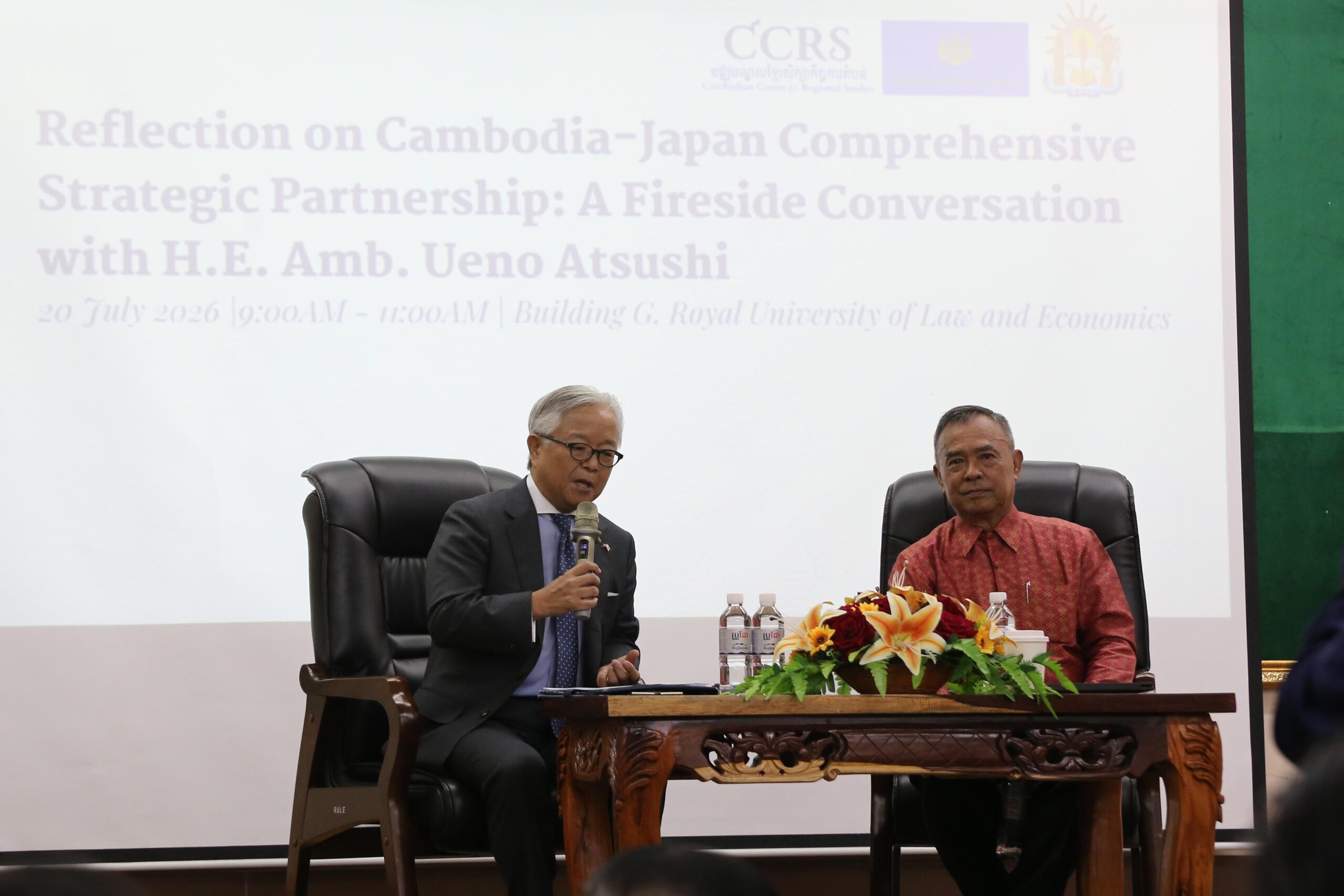
Japan has urged Cambodia and Thailand to resume dialogue to peacefully resolve their border dispute, while pledging to continue humanitarian assistance for the thousands of civilians displaced by the conflict, saying negotiations remain the only sustainable path to allowing affected people to return home. Speaking during a “fireside chat” at the Royal University of Law and Economics on July 20, outgoing Japanese ambassador to Cambodia Ueno Atsushi said Tokyo would continue encouraging both governments to pursue bilateral negotiations and international legal mechanisms while supporting communities affected by the border tensions. “Regarding the border issue, our basic position is to ask both sides to show self-restraint and seek a peaceful solution through bilateral mechanisms or based on international law,” he noted. The ambassador made the remarks during a question-and-answer session at the forum, titled “Reflection on Cambodia-Japan Comprehensive Strategic Partnership”, and organised by the Cambodian Center for Regional Studies (CCRS) and moderated by centre ambassador Pou Sothirak. Responding to a question from The Post about the protection of civilians and lessons from Japan’s post-conflict recovery experience, Ueno said he had personally visited displacement sites along the Cambodia-Thailand border several times and had witnessed the humanitarian challenges facing communities unable to return home. “As you said, I myself have been there several times,” he noted. Japan is already providing humanitarian assistance through international organisations and has also supported Cambodian migrant workers returning from Thailand by helping them find new employment, he added. “We have been, and we will continue to support in many ways to assist the people who are affected around the border region,” Ueno said. He noted that around 20,000 people remain unable to return to their homes because of the continuing border dispute and expressed hope that negotiations between Cambodia and Thailand would resume soon. “We hope peaceful talks and negotiations will be resumed between Thailand and Cambodia so these people can go back to their own homes as soon as they can,” he said. While reaffirming Japan’s commitment to humanitarian support, Ueno stressed that Tokyo could not dictate how either country should resolve the dispute. “Japan cannot force Cambodia and Thailand to do anything,” he said. “What we can do is facilitate and urge both sides to sit at the table and start talks.” “Ultimately, it is a matter between Cambodia and Thailand,” he added. The ambassador said Japan would continue encouraging both governments to utilise existing bilateral mechanisms while recognising the role of international law in resolving disputes peacefully. Earlier in the discussion, Ueno explained that Japan consistently supports resolving international disputes through dialogue and legal frameworks. “This peaceful solution includes bilateral mechanisms such as the Joint Border Commission and multilateral mechanisms under UNCLOS,” he said, referring to the UN Convention on the Law of the Sea. As a country that strongly advocates the rule of law, Japan would continue promoting peaceful dispute resolution through international legal mechanisms, he added. Beyond emergency relief, Ueno outlined several areas where Japan could assist communities recovering from the border conflict. “If necessary, maybe we can support clearing land from unexploded ordnance or landmines, or provide vocational training for returning workers,” he said. The remarks came a week after Minister of Foreign Affairs and International Cooperation Prak Sokhonn received a July 13 farewell call from Ueno, who has completed his diplomatic mission. During the meeting, Sokhonn praised Ueno’s contribution to strengthening the Cambodia-Japan Comprehensive Strategic Partnership, including cooperation in politics, defence and security, trade, investment, education and people-to-people exchanges. Both sides reaffirmed their commitment to further expanding bilateral cooperation. He also briefed the ambassador on the latest developments along the Cambodia-Thailand border, reiterating Cambodia’s adherence to the ceasefire agreement and its commitment to resolving the border dispute peacefully in accordance with international law and existing bilateral agreements. He also expressed appreciation for Japan’s humanitarian assistance to Cambodian displaced persons living along the border. Ueno reaffirmed that the Japanese government would continue closely monitoring the Cambodia-Thailand border situation and stood ready to support efforts to peacefully resolve the dispute and help restore normal relations between Cambodia and Thailand. According to Cambodian authorities, more than 20,000 people are still unable to return to their homes in several western border provinces, where access remains restricted following the construction of military fortifications and other security measures. Japan has been among Cambodia’s longest-standing development partners, supporting mine action, infrastructure, legal reform, education and humanitarian assistance for more than three decades. Ueno said Japan would continue standing with affected communities while encouraging both neighbouring countries to pursue a peaceful settlement. “For the time being, Japan will continue to provide support for the affected people,” he said, adding that humanitarian assistance and dialogue must go hand in hand to achieve a lasting solution.
Original source
Phnom Penh Post