General articles are free for 24 hours after publish.
Ho Chi Minh City and Northern/North-Central Regions Strengthen Cooperation for Socio-Economic Development
Ho Chi Minh City and seven northern/north-central provinces, along with Hue City, have renewed their socio-economic development cooperation agreement, entering a new phase for 2026-2030. The focus shifts from event-based to program, project, and value chain collaboration, prioritizing tangible results for businesses and citizens.
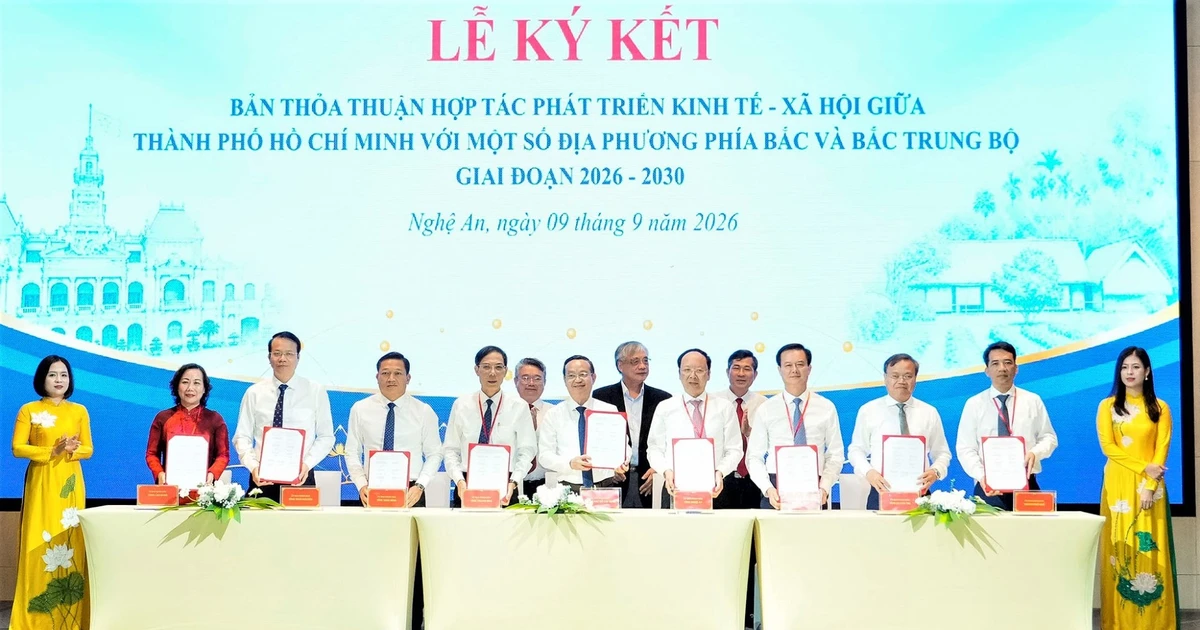
Ho Chi Minh City, Vietnam's economic hub, has renewed its cooperation agreement for socio-economic development with seven northern and north-central provinces, including Cao Bang, Thai Nguyen, Ninh Binh, Thanh Hoa, Nghe An, Ha Tinh, Quang Tri, and Hue City. A conference was held on September 9 in Nghe An province to summarize the implementation of the 2023-2025 cooperation period and sign a new agreement for 2026-2030. Over the past three years, Ho Chi Minh City and its partner regions have organized 98 bilateral cooperation activities and 22 regional events, fostering coordination between state management agencies, businesses, cooperatives, and entities from Ho Chi Minh City and the partner localities. Cooperation has spanned trade, investment promotion, tourism, agriculture, science and technology, culture, sports, education, training, and healthcare, increasingly aligning with the practical needs, potential, and strengths of Ho Chi Minh City and each locality. Representatives from the Ho Chi Minh City People's Committee emphasized the need to elevate cooperation to a new level amidst expanding development spaces and increasing regional linkage demands. The new cooperation aims to broaden development horizons, connect resources, enhance competitiveness, and create added value for the economy. The guiding principles are "more proactive, more practical, more focused, and more effective," with businesses and citizens at the center, and tangible results as the measure. Specifically, there is a strong call to shift from event-based cooperation to collaboration based on programs, projects, and value chains. Each cooperative endeavor must clearly define objectives, outputs, resources, and responsibilities. Priority will be given to areas with high value creation potential, broad ripple effects, and long-term implementation capabilities. For the 2026-2030 period, the cooperation program aims to transform the potential and advantages of each party into concrete values and results, contributing to the socio-economic development of individual localities and the entire region. The focus will be on creating bridges to strengthen linkages and expand markets for businesses, cooperatives, and production and business establishments. Public-private partnerships will be promoted on a mutually beneficial basis, while facilitating access to information and project implementation for businesses and investors. Beyond economic cooperation, experience exchange in administrative reform, state management, business development support, and improving people's lives will be enhanced. Cooperation will be strategically focused on areas with geographical advantages, infrastructure, high-quality human resources, and other development conditions to form economic powerhouses, corridors, and growth poles, thereby contributing to rapid, efficient, and sustainable economic growth. Source: Nhan Dan
Original source
Nhan Dan