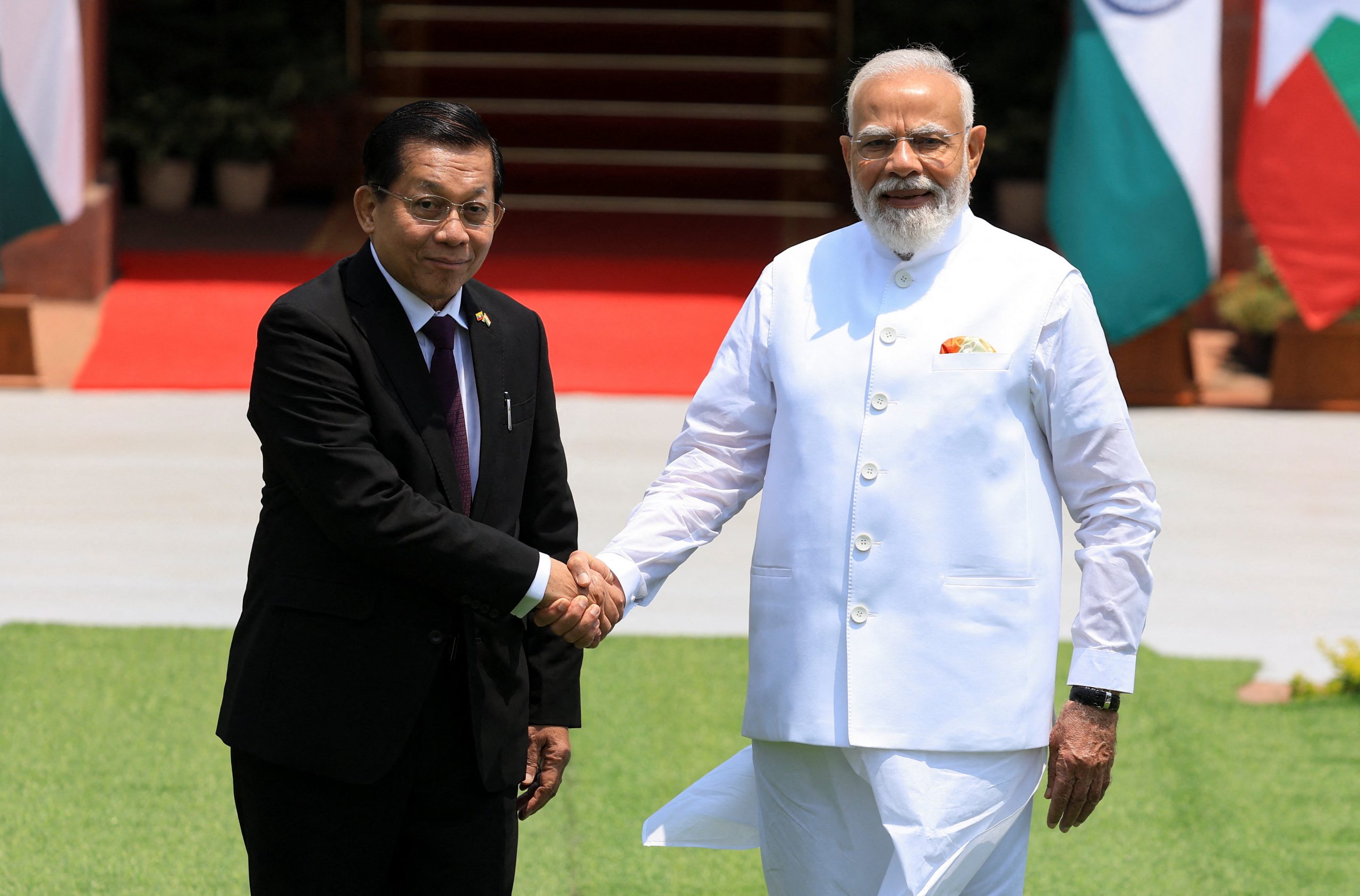
India rewards Min Aung Hlaing and devalues its democratic credentials
Guest contributors Salai Dokhar & Htar The Indian government released an official itinerary of Min Aung Hlaing’s visit, prompting Myanmar nationals in New Delhi to organize a protest. Holding onto hope that Prime Minister Narendra Modi’s government might respect the will of the Myanmar people and cancel the trip, a large crowd took to the streets on May 29. However, before demonstrators could reach their meeting point, they were intercepted and blocked by roughly 100 police officers. This incident underscores Modi’s stance on the crisis: prioritizing the military junta, which seized power in Naypyidaw over the democratic aspirations of the Myanmar people. New Delhi’s superficial approach India monitors the situation in Myanmar through at least five distinct institutional channels. However, these actors rely almost exclusively on mainstream media and direct engagements with the military regime, leaving interactions with resistance forces strictly informal. Through this narrow lens, New Delhi has continuously overlooked the most critical question: why is this military junta fundamentally detrimental to both Myanmar and India’s long-term interests? Burdened with multiple state responsibilities, Indian officials very often lack the capacity to gather and assess accurate, timely, and reliable ground-level information. Consequently, India’s strategy, which supposedly aims to curb Chinese influence, merely rubber-stamps superficial proposals that mimic Beijing’s playbook. This approach leaves India perpetually lagging China. India cannot match Beijing’s financial leverage and only reacts after China’s geopolitical moves have already materialized. While some analysts view inviting Min Aung Hlaing as Myanmar’s “President” as a savvy move to outmaneuver China, it is a serious strategic miscalculation. In reality, China has deliberately avoided granting formal state recognition to avoid widespread public hostility in Myanmar. By walking into the exact minefield Beijing chose to bypass, India has inadvertently allowed China to engineer a diplomatic rift between New Delhi and the Myanmar people. At the expense of its allies Faced with mounting economic friction with Western nations, Modi’s geopolitical alignments have drifted closer to China, raising a glaring question: Is New Delhi compromising its identity as a global democracy for apparent short-term economic interests?
This article requires PRO
This article is outside the free access window or is a special report. PRO unlocks it and the full archive.
Related articles
- Military officials including Major General Myo Aung, Major General Htay Aung removed from arms manufacturing departments by terrorist Min Aung Hlaing's order, despite stepping down as Commander-in-Chief
Yangon, June 8 Terrorist military leader Min Aung Hlaing has removed senior military officials from arms manufacturing departments, including two Deputy Production Officers of the Myanmar War Office (KPC), along with sen
- Ekarri Kyaw from Taunggyi arrested for mocking song honoring Min Aung Hlaing, 68-year-old grandmother also arrested for sharing revolution news on social media
Yangon, June 7 Ekarri Kyaw (aka Nang Ekarri Kyaw) from Taunggyi city, who mocked and criticized a song composed to honor the terrorist military leader Min Aung Hlaing on social media, has been arrested and charged by the
- BWM claims attack on Ketumatī Air Base and hospital after learning of Min Aung Hlaing’s arrival in Taungoo
Brave Warriors for Myanmar (BWM) announced on June 6 that they fired four 107mm rockets at the meeting hall within the Ketumatī Air Base and the No. 3 Military Hospital in Taungoo, after receiving information that the Ch
- Min Aung Hlaing will not attend Russia-ASEAN Summit, Mizzima investigates
Mizzima has learned that Myanmar's military junta leader, Min Aung Hlaing, will not attend the ASEAN-Russia Summit to be held in Russia in mid-June. The summit, held to commemorate the 35th anniversary of ASEAN-Russia di