General articles are free for 24 hours after publish.
Vietnam's Politburo Inspects Ninh Binh Provincial Party Committee Leadership
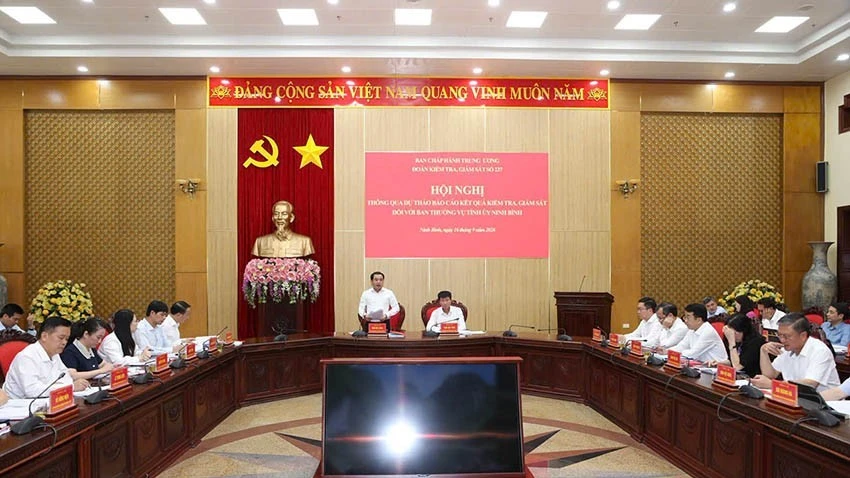
On September 16, a delegation from the Politburo and Secretariat of the Communist Party of Vietnam conducted an inspection and supervision mission with the Standing Committee of the Ninh Binh Provincial Party Committee. The meeting reviewed progress in cadre development and deployment amidst significant tasks like organizational restructuring, implementing the two-tier local government model, and preparing for the next Party congress. The Politburo emphasized Ninh Binh's strategic importance and urged enhanced cadre cultivation and oversight of power.
On September 16, a delegation from the Politburo and Secretariat of the Communist Party of Vietnam held a working session with the Standing Committee of the Ninh Binh Provincial Party Committee to approve the draft report on the results of inspection and supervision. The meeting was chaired by Comrade Tran Duc Thang, Politburo member and Secretary of the Hanoi Municipal Party Committee, Head of the delegation. The report indicated that the Standing Committee of the Ninh Binh Provincial Party Committee has focused on cadre work amidst complex conditions, including the merger of three provinces, the implementation of the two-tier local government model, and preparations for the 2025-2030 Party congresses. They have promptly reviewed and specified Central regulations, gradually perfecting regulations on cadre work to suit the new organizational structure. Cadre work has adhered to the Party's viewpoints, principles, and regulations, with innovations promoting decentralization and delegation of power linked with the responsibility of Party committees, leadership collectives, and heads. The cadre work process ensures publicity, transparency, and strict adherence to regulations. Emphasis has been placed on cadre planning, with regular reviews and supplements, closely linked with training and development. Attention has also been given to the deployment, arrangement, and utilization of cadres, with the cadre force generally developing their capabilities and strengths, successfully completing assigned tasks and contributing to the overall mission of agencies, units, and localities. Internal political security work has been prioritized, linked with power control and the prevention of corruption and negativity in cadre work. Cadre management methods have also seen innovation, particularly in decentralization and delegation of authority, linked with responsibility and performance-based evaluation, and the promotion of digital transformation. This has gradually enhanced the proactivity and responsibility of all levels in managing, deploying, and utilizing cadres, better meeting the requirements of managing the workforce after organizational restructuring and operating the two-tier local government model. The results achieved demonstrate that the Standing Committee of the Ninh Binh Provincial Party Committee has exercised its leadership role in a focused and unified manner for cadre work, proactively handling a large volume of work and numerous new and complex tasks arising during the province's merger, organizational restructuring, and the operation of the two-tier local government model. This has fundamentally ensured stability and continuity in cadre work, maintained principles, discipline, and order, contributing to the stability of the political system's organization and operation throughout the province after the restructuring. Concluding the conference, Comrade Tran Duc Thang acknowledged and praised the spirit of responsibility of the Ninh Binh Provincial Party Committee and its subordinate committees, agencies, and units for their thorough preparation of the draft report. Comrade Tran Duc Thang emphasized that Ninh Binh is identified as a province with an important position for the development of the region and the country, hence the crucial role of cadre work. He requested the Standing Committee of the Ninh Binh Provincial Party Committee to continue leveraging achievements, strictly implementing Central resolutions, regulations, and conclusions on cadre work. He urged for deeper analysis of difficulties to develop appropriate solutions for cadre work, especially at the grassroots level. He also called for continued review and perfection of the organizational structure, decentralization, delegation of power, and a synchronized system of cadre positions with clear responsibilities and tasks. Strong innovation in cadre planning and deployment is needed, especially considering that after the merger, the province has cadres trained in different environments, requiring suitable implementation mechanisms. The province needs to focus more on rotating, transferring, training, and developing cadres in practice between the provincial and grassroots levels. Furthermore, he stressed the importance of awakening the aspiration to contribute among all civil servants and public employees, especially young cadres and Party members, to achieve the best work results. He also highlighted the need to focus on attracting and utilizing high-quality and young cadres, with special mechanisms and attention, along with suitable attraction policies. Given the broad area and the significant workload decentralized to the grassroots, the province needs to strengthen inspection and supervision to accurately assess and grasp the situation, rectify, and promptly handle emerging situations at the grassroots. The province needs to modernize cadre work for evaluation, from top leadership downwards, to make work more practical and smoother. The inspection delegation noted the proposals from the Standing Committee of the Ninh Binh Provincial Party Committee to further perfect the report for submission to the Politburo and Secretariat.
Original source
Nhan Dan