General articles are free for 24 hours after publish.
Arboreal Bridges Aim to Reconnect Fragmented Tapanuli Orangutan Habitat
In Batang Toru, North Sumatra, Indonesia, the construction of arboreal bridges is being considered to reconnect fragmented habitats of the critically endangered Tapanuli orangutan, threatened by road development. Forest loss and habitat fragmentation endanger the species' genetic diversity.
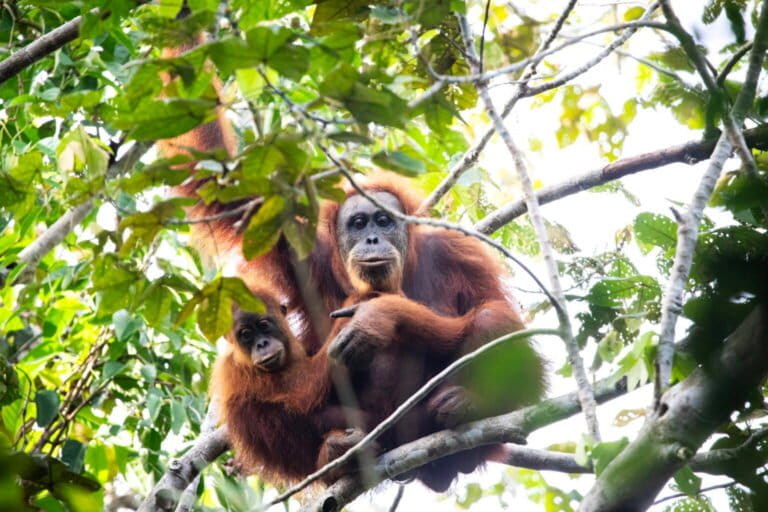
In the Batang Toru ecosystem of North Sumatra, Indonesia, the construction of arboreal bridges is being considered to reconnect the fragmented habitats of the critically endangered Tapanuli orangutan. Road construction and deforestation have divided the orangutan's habitat into isolated sections. This fragmentation forces arboreal species like orangutans to descend to the ground to move between areas, increasing their risk of being hit by vehicles, hunted, or coming into conflict with humans. In the Batang Toru ecosystem, the forest cover in the Hutaimbaru corridor has shrunk from 9,958 hectares in 2004 to approximately 8,981 hectares in 2024. Over 1,700 hectares of orangutan habitat have reportedly been lost in the last two decades. The Hutaimbaru corridor connects orangutan populations in the western and eastern blocks. If this connectivity is severed, gene exchange between individuals will be disrupted, and the risk of local extinction will increase. "Our main goal is to restore connectivity between the west and east blocks so that the corridor can function optimally," said Julius Paolo Siregar from Yayasan Ekosistem Lestari (Sustainable Ecosystem Foundation). However, the foundation emphasizes that arboreal bridges are not a substitute for forest protection. If natural corridors can still be maintained, habitat protection and restoration must remain the priority. New bridges are considered when open spaces, roads, or steep terrain cannot be crossed via the natural canopy. An example from Yayasan Tangguh Hutan Khatulistiwa (Resilient Forest Foundation of the Equator) in Pakpak Bharat Regency demonstrates how such bridges can work. Three forest areas inhabited by around 350 Sumatran orangutans are separated by several roads. Since 2023, the organization has installed several canopy bridges based on nest locations, food trees, and the strength of supporting trees. During monitoring from March 2025 to March 2026, 14 arboreal animal species used the bridges, with 374 crossings recorded. An orangutan first attempted to use a bridge in December 2025. After initially touching the edge and retreating, the same individual successfully crossed the entire bridge six days later. The foundation noted that orangutans are intelligent and can adapt to new modes of transit. This initiative with arboreal bridges holds the potential to aid wildlife movement in fragmented landscapes and contribute to the conservation of critically endangered species. Source: Mongabay Indonesia
Original source
Mongabay Indonesia