General articles are free for 24 hours after publish.
Gov't Rushes El Niño Response Amid Looming Drought
The Philippines is bracing for another El Niño episode, with significant concerns over its impact on agricultural production and water supply. The government is accelerating preparations, increasing funding for irrigation projects and promoting drought-resistant crops, while also providing support for farmers and fisherfolk. Water levels at Angat Dam, a crucial source for Metro Manila, have dropped to critical levels.
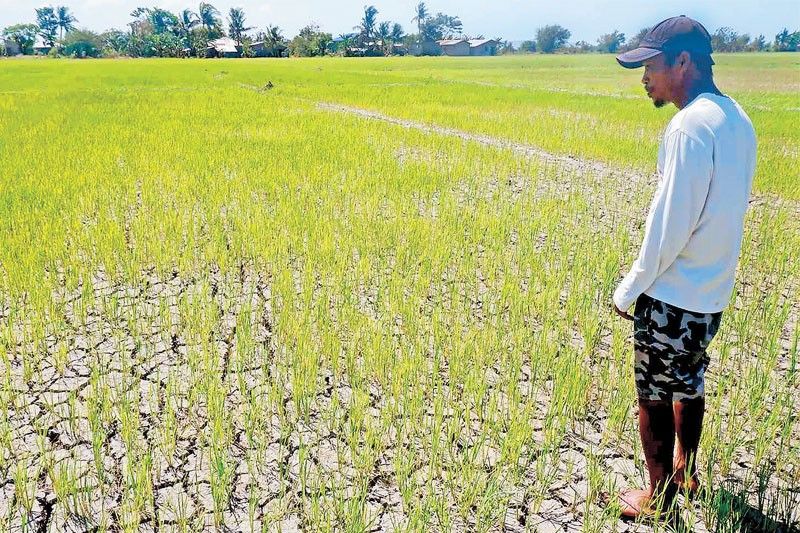
MANILA, Philippines — The country is once again facing another El Niño episode this year, this time hitting even more harder than the last, bringing little rains that would dry up fields and drain water reservoirs. With the threat of an incoming El Niño this year, the government has been scrambling to respond to the possible effect of the weather phenomenon, especially on the country’s food production and water supply. The climate disruption is now present over the tropical Pacific and could likely intensify over the next few months and persist until early next year, according to an advisory from the Philippine Atmospheric, Geophysical and Astronomical Services Administration (PAGASA). Based on the state weather bureau’s latest forecast, there is a 69 percent chance that a strong El Niño episode would likely emerge during the months of August, September or October. PAGASA also said there is also a 62 percent chance that a “very strong El Niño” would happen during the months of October and would last until January next year. The weather event would likely bring prolonged dry spells, drought and severe heat waves throughout various parts of the country. Higher than average ocean temperatures may also risk stronger typhoons in the country, despite fewer rainfall episodes. At the forefront of the incoming El Niño are the country’s farmers, whose livelihood hinges on a good harvest which could be threatened by dried-up fields and lower water supply for irrigation, causing shrinking yields and lower earnings. President Marcos has ordered relevant agencies to intensify preparations for the incoming drought and accelerate funding for irrigation and water-management projects to support farmers to cope with lower rainfall activity. Marcos also tasked the Department of Agriculture (DA) and the National Irrigation Administration (NIA) to support and provide technical assistance to farmers in transitioning to drought-resistant crops. “We have already advised some farmers to plant high-value commercial crops such as watermelon, ginger, ube, peanuts and eggplant instead of rice, which requires more water,” he said earlier. The government is also increasing funding to create more solar-powered irrigation pumps and water recycling systems in drought-prone areas, following the President’s orders. Agriculture Secretary Francisco Tiu Laurel Jr. earlier said the looming climate episode could cut the country’s rice production by 700,000 metric tons (MT) this year, or about 3.5 percent of the DA’s target harvest for the year. The DA said earlier that rice harvest could reach 19.87 million MT this year, a downgrade from the agency’s initial 20.3 million MT goal earlier in the year. “Based on our latest El Niño study, we checked our past experience in 2024 and indications showed that El Niño will be hitting hard in Luzon, while Visayas and Mindanao it doesn’t look like it will be affected that much,” Tiu Laurel said. There are 16 provinces in Luzon that could face drought episodes this year, including some of the country’s top rice producing areas, according to PAGASA’s climate model as of June 21. These include Nueva Ecija, the country’s single-largest rice producing province, generating 1.6 to two million MT of rice annually, data from the Philippine Statistics Authority (PSA) showed. Other rice production hubs include Isabela, Pangasinan and Cagayan, among others. The Philippines last experienced El Niño from late 2023 to mid-2024, which caused heavy damage to agriculture. Farm losses were estimated at P57.78 billion, with overall production dropping by 2.2 percent. The country’s crop output took the hardest hit, falling by 4.2 percent, according to a report from the PSA. “For those that will not be hit hard by El Niño, the DA will double down by providing more fertilizer and planting materials to increase production, while maintaining also our support for areas that will be affected,” he said. “What we lose there, maybe we can gain back here in the areas where there will be rain,” he added. The agriculture department has also reactivated its El Niño Task Force that would allow the agency to respond to the looming weather crisis on farmers and fisherfolk. It will also ensure the effective coordination of other government agencies. Tiu Laurel said that among the agency’s priority in response to the El Niño episode this year would focus on funding better water irrigation and expanding cold-storage networks. He added that the DA is targeting to allocate P1 billion as assistance to farmers and fisherfolk, P1.6 billion in funding for solar irrigation projects, while an additional P1 billion will be for more solar pumps for next year. Tiu Laurel had earlier ordered concerned DA officials to fast-track the construction of irrigation, water impounding facilities and climate adaptation projects to sustain the livelihood of farmers ahead of the incoming drought. The DA will also set up cold storage, blast freezers and logistics facilities to store and maintain farm produce and make distribution of aid more efficient. On the other hand, local water service providers, Maynilad Water Services Inc. and Manila Water Co. Inc. assured their customers of ample water supply ahead of the incoming weather change. Reduced rainfall activity has caused Angat Dam levels, Metro Manila’s major water source, to drop to below its 160-meter critical level, reducing water allocations for services. Current data showed that the dam was at 158.75 meter as of July 5. The National Water Resources Board (NWRB) has lowered water allocations for service providers to 48 cubic meters per second (cms) from 52 cms amid the dam level reduction. The West Zone concessionaire noted that it has scaled up its preparations for the incoming weather event through the construction of water treatment plants, new water facilities and deep wells to reduce the service provider’s dependence on Angat Dam. “Angat Dam remains our main raw water source, but we now have more supplemental sources, lower water losses, expanded storage, and improved network management capabilities to help manage tighter raw water conditions,” Maynilad COO Christopher Jaime Lichauco said. For its part, Manila Water, which supplies the East Zone, also assured its customers uninterrupted service, as it had augmented its water supply from Laguna Lake and its Wawa Dam facilities. The company said its Kaysakat Project is projected to add 220 million liters per day to water supply once it is completed by October, while the East Bay Phase 2 Water Supply Project will provide an additional 200 MLD once it its commissioned by September. Tiu Laurel said he expects the ongoing southwest monsoon to bring more rainfall and provide more water supply to the country’s dams, like the Angat Dam which has reached below critical levels. “We expect more rains before the real El Niño sets,” Tiu Laurel said, stressing that he does not see a reason yet to reduce w
Original source
Philstar Business