General articles are free for 24 hours after publish.
Ho Chi Minh City's 11.3 Million Motorbikes Stack Roads Four Levels High
Ho Chi Minh City, Vietnam's largest metropolis, grapples with severe traffic congestion due to its staggering 11.3 million motorbikes. To address this, the city is developing four-level interchanges, integrating elevated roads and underpasses, to manage the overwhelming traffic flow.
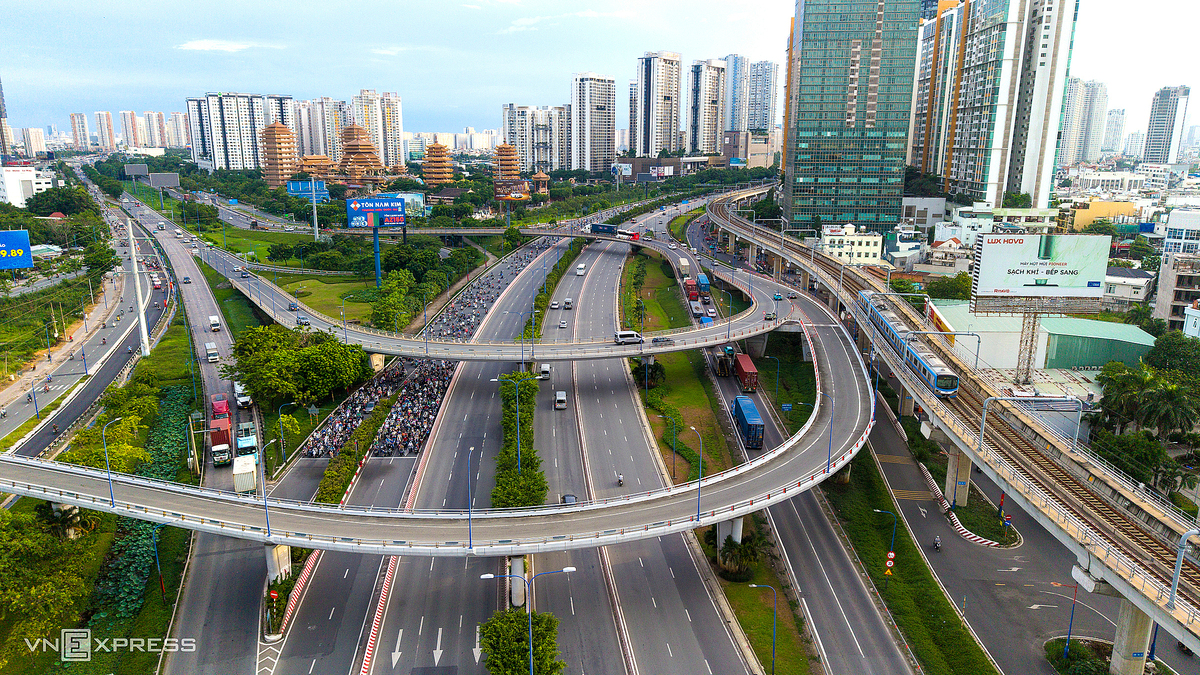
Ho Chi Minh City, Vietnam's largest economic hub, is grappling with the reality of over 11.3 million motorbikes, the highest fleet in the country, placing immense pressure on its transportation infrastructure. To tackle this challenge, the city is developing complex, multi-level interchanges, some reaching up to four levels high, integrating elevated roads and underpasses. The Cat Lai T-junction interchange, a crucial gateway on the city's eastern side, connects Hanoi Highway with Mai Chi Tho Boulevard. The Ben Thanh-Suoi Tien metro line runs overhead, creating a three-level interchange. This junction is a vital link connecting Ho Chi Minh City with southeastern provinces and the north. The interchange features two overpasses for left-turning traffic from Cat Lai Port (the country's largest), one overpass for left-turning traffic from the former Thu Duc City towards the port, and seven surface branches. This intricate modern traffic network defines the city's eastern gateway. Approximately 10 km away, the Tram 2 overpass is another key junction at the eastern gateway. Completed in the late 1990s, it links Hanoi Highway with National Highway 1A, providing access to the city center and Dong Nai Province. Its cloverleaf design, with four loops spanning 420 meters in diameter across 27 hectares, incorporates two open-top underpasses, an overpass, and the metro line, forming a four-level interchange. Another significant development is the interchange near Vietnam National University Ho Chi Minh City, completed in 2019. This project spans nearly 2 km and includes an open-top tunnel over 1 km long with eight lanes, alongside three overpasses facilitating vehicle turns. The metro line overhead forms a three-level interchange in the university district. These infrastructure investments are aimed at accommodating the burgeoning traffic demand driven by Ho Chi Minh City's rapid urbanization and economic growth. However, the sheer volume of motorbikes suggests that even these new infrastructures may face limitations in future congestion relief. Under Vietnam's one-party system, such large-scale infrastructure projects are driven by state planning, but their effectiveness hinges on balancing urban development with vehicle ownership. This, coupled with complex regional dynamics, particularly concerning China, makes infrastructure development a critical task for Vietnam as it strives to maintain economic growth.
Original source
VnExpress International