General articles are free for 24 hours after publish.
Hanoi's 100-Year Vision for Historic Heart Includes Triumphal Arch
Hanoi is soliciting public feedback on proposed adjustments to urban zoning plans for the Hoan Kiem Lake area and parts of the former Hoan Kiem District. The 100-year vision includes constructing a "Triumphal Arch" landmark, restoring historical structures, and enhancing green spaces within the historic center.
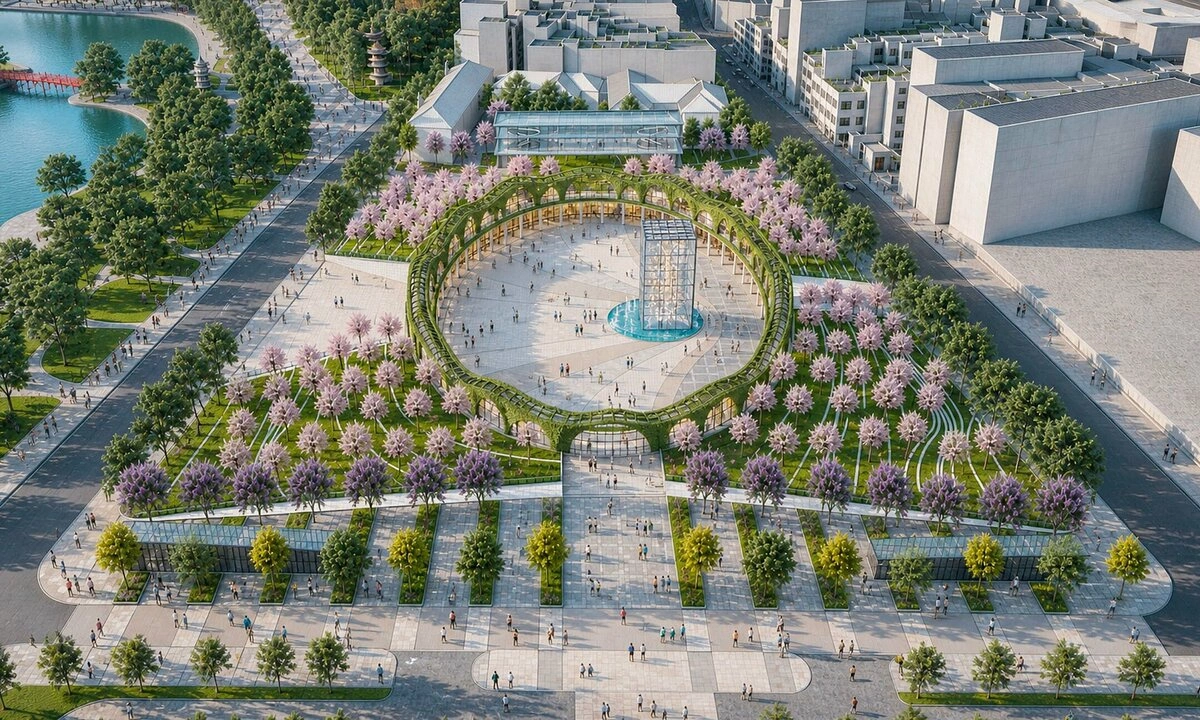
Hanoi is gathering public comment on a partial adjustment to its urban zoning plan (H1-1B) for the historic center, focusing on Hoan Kiem Lake and its surroundings, and parts of the former Hoan Kiem District (H1-1C). The study area spans 65.89 hectares, bordered by Cau Go Street to the north, Hang Trong Street to the west, Hai Ba Trung Street to the south, and Ly Thai To and Tran Quang Khai streets to the east. Hanoi's 100-year master plan designates the historic center, including Hoan Kiem Lake and its surroundings, as a space of significant historical, cultural, architectural, and scenic value crucial to the capital's core structure. The plan envisions the lake and its surroundings as a large square linking August Revolution Square and the Opera House, creating a "History, Culture and Arts" space. A prominent feature proposed is the construction of a landmark "Triumphal Arch" on the north side of the lake, within the expanded Dong Kinh Nghia Thuc Square. This structure, approximately 36 meters tall, is inspired by the spreading wings of a crane and conceived as a large-scale sculptural work tied to the square. Thoi Dai (Times) Park and Square sits on the eastern side of Hoan Kiem Lake. Planners are studying a network of squares and parks across the area around the city People's Committee headquarters, Ly Thai To flower garden, the Hanoi Post Office and Hoa Phong Tower. At the Hanoi Post Office, the plan calls for studying the removal of several architecturally unsuitable structures while exploring ways to evoke and recreate the distinctive form of the former Bao An Pagoda at the center of the post office grounds. The adjusted plan reorganizes the space around Ba Kieu Temple, adds a memorial to the capital's war martyrs and strengthens connections with the Dinh Le-Trang Tien area and suitable commercial and service spaces. Southeast of the lake, planners will study a small retail cluster combined with cafes and kiosks, emphasizing the Trang Tien axis running from Hoan Kiem Lake to the Opera House. Hang Hanh and Bao Khanh alleys in the future. Sidewalks and roadways here will be renovated and uniformly paved with stone, with flower beds and trees placed along the route to add greenery and give the space more continuity. The city will focus on upgrading and reorganizing Cau Go Street to improve its connection with Peace Square. The roadway and sidewalks will be paved with stone to match the square, creating a unified look and defining the walking space. Low shrubs, flower beds and taller trees will be added along the sidewalks for greenery and shade. The plan preserves the street's existing character while giving it a tidier, more harmonious and dignified appearance. The plan focuses on restoring and showcasing the Vu Thach communal house, temple and pagoda complex while improving access from surrounding streets. Buildings of value will be preserved, and the courtyards and landscaping upgraded to harmonize traditional architecture with the urban setting. West of the lake, planners will study extending Nha Tho Street to Hoan Kiem Lake to link with Le Thai To Street, creating an open space and a walking street. They will also study a high-end hotel created by restructuring the Hanoi Moi newspaper offices and printing house, the city's investigation police headquarters at 2 Trang Thi Street and neighboring sites, to serve tourism and economic development. The Opera Hanoi area comprises the capital's culture and arts space, basement levels, a History, Culture and Arts Center, an expanded theater complex, a traffic tunnel connecting to the riverbank, the National Museum of History, a financial center and August 19 Square. The Hoan Kiem Ward People's Committee, working with the Cua Nam Ward People's Committee, is collecting community feedback on the plan from Sept. 7 to 26. The documents are on public display at Hanoi Book Street on December 19 Street, the Hoan Kiem Ward People's Committee office at 126 Hang Trong Street, and the Hanoi Information and Exhibition Center at 93 Dinh Hoang Street. Under Vietnam's one-party system, such large-scale urban planning initiatives are approved by the central government, though public consultation processes have been increasingly emphasized in recent years. Balancing heritage preservation with modernization is a common challenge for Vietnam's rapidly growing cities, with growing awareness of cultural heritage protection, particularly given close ties with China.
Original source
VnExpress International