General articles are free for 24 hours after publish.
Cambodia Launches New Eye Health Strategy to Enhance Quality and Equity
Cambodia's Ministry of Health has launched a new national strategy to improve the quality, equity, and inclusivity of eye healthcare services. Supported by the Australian government and WHO, the initiative aims for implementation until 2031, underscoring its importance for public health and national development.
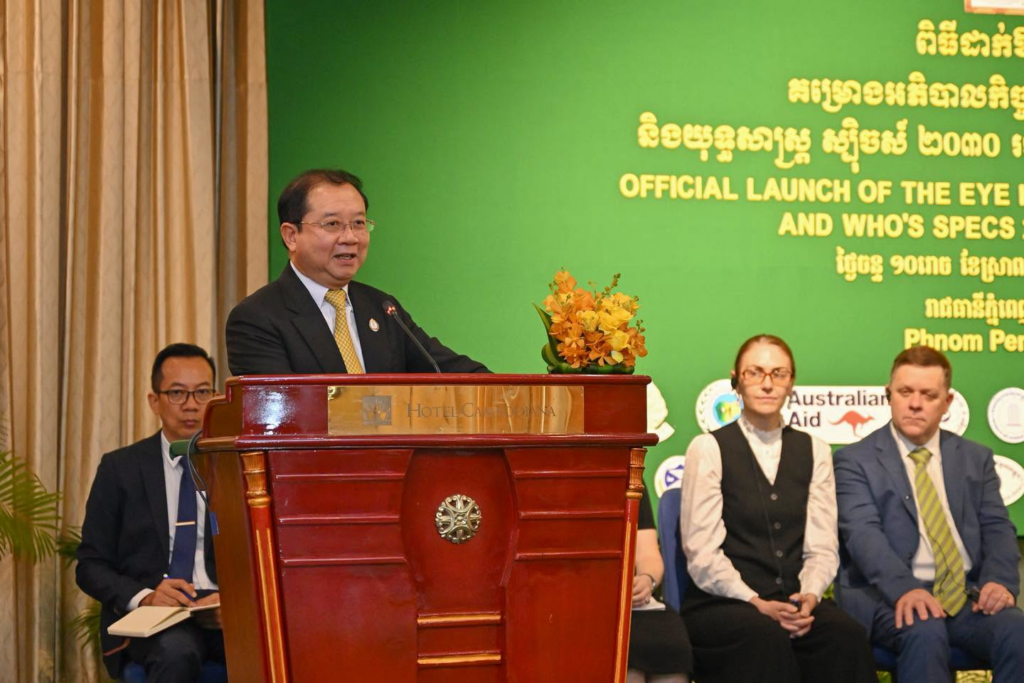
Professor Chheang Ra, Minister of Health, has called on all relevant parties to continue strengthening cooperation and partnership to ensure that every citizen can access quality, equitable, inclusive, and affordable eye healthcare services, and to jointly build a stronger Cambodian eye health system. This appeal was made during the official launch ceremony of the "Eye Health Governance Project 2026-2031" and the "WHO's SPECS 2030" strategy in Cambodia, presided over by Professor Chheang Ra and Mr. Derek Yip, Australian Ambassador to Cambodia, on September 7, 2026. On the occasion, the Minister of Health highlighted that eye health is a crucial part of the health system and a necessary factor for achieving Universal Health Coverage (UHC). Visual impairment and blindness not only affect the health and quality of life of citizens but also impact education, work productivity, family livelihoods, poverty reduction, and the nation's human capital development. Professor Chheang Ra affirmed that the implementation of the "Eye Health Governance Project 2026-2031" and the "WHO's SPECS 2030" strategy is another significant step in strengthening Cambodia's eye health system and a collective effort to ensure that every citizen, including those in rural and remote areas, can access quality, equitable, inclusive, and affordable eye healthcare services. The "Eye Health Governance Project 2026-2031" will contribute to strengthening governance, leadership, coordination, human resource development, service quality, data systems, and the management of the eye health system, focusing on ensuring quality, equitable, inclusive, and sustainable eye health services. Concurrently, "WHO's SPECS 2030" is integrated as a key strategic framework to support the expansion of refractive error correction services and eye healthcare. SPECS focuses on five main pillars: Services, Personnel, Education, Cost, and Surveillance. The Minister emphasized, "Eyes are truly an indispensable means of communication for absorbing understanding. When we help a child with eye problems who cannot see well, we may be helping the future of a child who could become the future of the nation. Eyes are not just about vision; they are related to all aspects of the spirit." The Minister appealed to all stakeholders to continue strengthening cooperation and partnership to jointly ensure that "no one is left behind" in accessing eye healthcare services and to build a stronger, quality, equitable, inclusive, and sustainable Cambodian eye health system. On behalf of the Ministry of Health, the Minister expressed his profound appreciation and gratitude to the Royal Government of Australia, the Australian Embassy in Cambodia, the Fred Hollows Foundation, the World Health Organization (WHO), and all development partners for their significant and continuous support for the development of the eye health sector in Cambodia. Source: Kampuchea Thmey Local
Original source
Kampuchea Thmey Local