General articles are free for 24 hours after publish.
India's Education Crisis: Exam Scams and Career Bottlenecks Fuel Youth Despair
A leaked exam paper for India's National Eligibility cum Entrance Test (NEET-UG) led to the education minister's resignation, but this incident highlights deeper systemic issues. The fierce competition for limited spots and the resulting youth suicides underscore fundamental problems within India's education system.
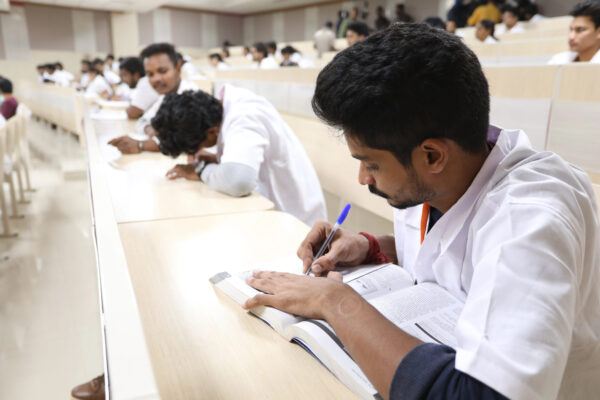
Read The Diplomat, Know The Asia-Pacific What India needs is deep systemic changes to its education system, economy, and more generally, the life that it offers its youth. Indian medical students writing an exam, March 2022. On July 25, student protests in India, led by the satirical Cockroach Janata Party (CJP), achieved their demand of forcing Dharmendra Pradhan, the minister of education in the Bharatiya Janata Party (BJP)-led government, to resign. The genesis of the protests, which had been ongoing for several weeks, was the leakage of question papers of the National Eligibility cum Entrance Test (Undergraduate), otherwise known as the NEET (UG), held on May 3. The exam was canceled and a re-exam was held on June 21. This caused enormous distress to students and parents, who had much at stake in clearing the exams and beginning the admissions process. At least a dozen students committed suicide after the test was canceled. In India, students spend years preparing for exams and attending coaching classes in order to have a shot at getting into a number of competitive professions with limited seats. These include medicine, law, management, the civil service, and even the police force, as shown in the recent award-winning Indian film “Homebound.” This is quite different from many Western countries, many of which have a more flexible labor market and allow entry into a profession at any point in life, so long as one completes the proper degree and licensing. It is not unheard of for someone to attend law school or medical school in their 40s. For many in India, especially the poorer sections of society or members of Dalit and backward castes, attaining success after clearing such an exam is their primary shot at upward mobility. Another recent Indian movie, “12th Fail,” became a sleeper hit by reflecting the aspirations of millions by showing how an individual, through hard work, ended up clearing the civil service exam after nearly a decade of grinding through college and coaching classes. Once appointed to the civil service, an individual with such a coveted government job is considered set for life, thus bringing honor and wealth to his or her family, not to mention better marriage prospects for relatives. But for every successful candidate, there are many more unsuccessful ones. And those who fail to clear exams — or never even take them, due to cancellations — often become despondent, having lost years of their lives. Up to 25,000 students in India committed suicide between 2014 and 2024. While at its core, the cancellation of the NEET exam in May was due to corruption — and the fight to get the education minister to resign was about holding someone responsible for the leak — this issue highlights larger problems and trends in India. If anything, the demands of the protesters were strangely narrow and seemed to miss the larger issue. A change in government is not the answer; what’s needed is a deep change in policy. Even if there was no corruption and there were no exam leaks, even if there were a different government in Delhi, there would still be millions of young Indians toiling away at rote memorization during the best years of their lives, competing for a small number of seats. Many would still not get into the profession of their choice and many, driven by poverty or family pressure, would still commit suicide. For exams that are ostensibly supposed to fill professions and the civil services on the basis of merit, over half the seats are not filled through open competition, but through quotas for various caste and tribal groups. Over the course of the past few decades, the percentage of spots reserved for different caste groups has ballooned, with widespread demand even among upper castes for reservations so as not to lose out on their perceived share of seats. India’s entire education system thus prepares individuals for a series of tests designed to restrict entry into professions that are defined by artificial scarcity. In the public sector, this artificial scarcity is a function of tight budgets and the need of many bureaucrats to maintain the prestige of their positions, which is enhanced by a limited number of appointments. India faces a shortage of police officers, for example, with 153 police officers for 100,000 people in 2023, well below the United Nations recommended ratio of 222:100,000. Nineteen percent of the Indian Administrative Service (IAS) is currently unfilled. India’s diplomatic corps is notoriously underfilled. The world’s most populous country should not have so much difficulty finding people to staff its bureaucracy. This issue has also manifested in the private sector. A country as large as India needs more doctors, lawyers, and judges as well, but entrance into the medical and legal professions is similarly constrained by the bottleneck of exams, accreditation, and not enough staff for specialized training. Thus, a large number of medical students must compete for a smaller number of internships and specializations before practicing medicine. India’s doctor to people ratio is 1:811, whilst that of the United States is 1:313. While the number of seats in many professions, such as the civil service and medicine, should be increased to match increased demand, and the nature of exams rethought, this is not enough. More people need more jobs across the board. India’s education system, by and large, does not emphasize research, critical thinking, or learning how to learn, all of which are especially important in preparing individuals for an information economy and encouraging the growth of the private sector and entrepreneurialism. The education methodologies and outcomes that drive learning, economic growth, and participation in civil society, should be placed at the forefront of India’s education system. The growth of industry and the private sector in general is important because they create many more high-paying jobs across industries than what the public sector can generate. This, in turn, would reduce the pressure on so many individuals to compete for a small number of stable and well-paying government jobs. An individual should not have to depend only on a government job to earn a decent livelihood. India’s private sector must expand, by necessity, to absorb its growing educated workforce, as it would be impossible for everyone to be a government employee. The recent protests made a few, well-defined minimalist demands: resignation of a minister, and compensation for the families of those who committed suicide. But underlying their demands and contributing to their ferocity is wider frustration with the opportunities and options available to youth. And while these frustrations focused primarily on education and jobs, the mobilization of youth demonstrates an increased dissatisfaction and willingness to protest for causes close to their hearts. These are individuals who have higher expectations for their lives, ha
Original source
The Diplomat Indonesia