General articles are free for 24 hours after publish.
Vietnam's Highway Safe Distance Rule Sparks Controversy Amid Driver Confusion
A new regulation on safe distances on Vietnam's expressways, effective late August, has caused confusion and concern among drivers. Experts are suggesting a shift to a time-distance rule due to the difficulty of measuring distances in meters and the potential for unintentional violations.
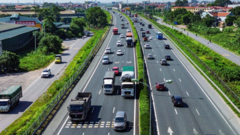
A regulation on safe distances on Vietnam's expressways, which came into effect at the end of August, has sparked significant controversy among drivers. The rule mandates specific distances, such as 35 meters at 60 km/h and 70 meters at 100 km/h. However, many drivers have voiced concerns about the difficulty of measuring these distances and the risk of unintentional violations. The regulation follows intensified enforcement by traffic police against "failure to maintain safe distance" on expressways since late August. Violators face fines ranging from 4 million to 6 million VND (approximately $160-$240 USD) and two penalty points on their driving licenses. If such a violation leads to an accident, the fine increases to 20-22 million VND (approximately $800-$880 USD), with ten penalty points deducted. Many drivers argue that it is extremely difficult to accurately gauge distances in meters while driving. They point out that in unpredictable situations, such as sudden braking by the vehicle ahead or sudden lane changes by other vehicles, maintaining the prescribed safe distance becomes nearly impossible. According to a VnExpress report, at 100 km/h, a vehicle travels about 28 meters per second, leaving drivers with very little time to visually estimate distances while also monitoring traffic and road conditions. In response, Vietnam's traffic police have stated that they are "only targeting drivers who intentionally reduce the distance and tailgate," but critics question the clarity of the criteria for "intentional" violations. International comparisons also highlight challenges with Vietnam's fixed-meter distance rule. Many countries in Europe and Southeast Asia, such as the UK, France, Singapore, Indonesia, and the Philippines, use a time-distance rule (e.g., 2 to 4 seconds), which drivers find easier to adhere to. Vu Quang Minh, former Vietnamese Ambassador to Germany and an expert on international transport infrastructure, noted in an opinion piece that Vietnam's and China's fixed-meter distance regulations have notable technical weaknesses. He criticized the steep increases in required distances as speed marginally increases, for instance, from 60 km/h to 60.1 km/h. He advocates for a shift towards the time-distance standard in the long term, making it a natural reflex for drivers on expressways. This issue can be viewed within the broader context of how regulations are implemented under Vietnam's one-party system and their practical impact on citizens' lives. As Vietnam continues its economic growth and infrastructure development, including expressways, the practicality and real-world applicability of new regulations are being scrutinized. There is a call for improved driver awareness and the development of effective and practical traffic laws. Source: BBC Vietnamese
Original source
BBC Vietnamese