General articles are free for 24 hours after publish.
Cambodia Rejects Thai Claims: Joint Statement is Not a Border Treaty
Cambodia has strongly refuted Thai claims that its military presence near the border is based on the December 27, 2025, joint statement, asserting it is not a border demarcation treaty and constitutes illegal actions contrary to international law and past agreements. This escalates the long-standing border dispute between the two nations.
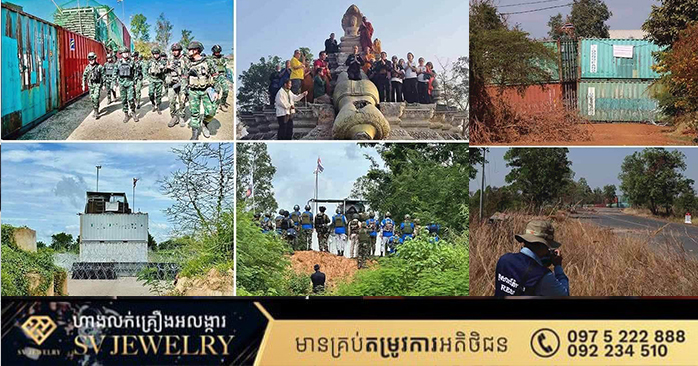
Cambodian Minister of Information, Net Pheaktra, has strongly refuted claims made by JIC Center Director Prapas Sonjaidee in the Thai newspaper The Nation, which asserted that the Thai army has never changed conditions on the ground based on the joint statement of December 27, 2025. Minister Pheaktra stated that this assertion is entirely contrary to the actual content of the joint statement, international law, and the reality on the ground. The minister criticized the claim, stating it was intentionally misleading and aimed to exploit national and international public opinion, creating a misconception that Cambodia had agreed to allow the Thai army to station troops in territories under Cambodia's sovereign and territorial integrity. He emphasized that the joint statement (ceasefire statement) of December 27, 2025, particularly paragraph 2, is not considered a border demarcation treaty with legal validity that supersedes the 1:200,000 scale map, which is a crucial part of the French-Siamese Convention and Treaties. Cambodia argues that this map serves as the title deed and definitive plan confirming Cambodia's legal ownership of areas where the Thai military has been illegally occupying and controlling. Cambodia accuses Thailand of using the joint statement as a pretext to station troops, control areas, and create a fait accompli through activities such as planting booby traps, deploying container boats, constructing trenches, clearing land for roads, digging canals, destroying citizens' homes and pagodas, building statues, and hoisting flags, all of which are illegal activities within Cambodian territory. These actions, Cambodia contends, are in direct violation of international law, the 1:200,000 scale map, the French-Siamese Convention and Treaties, the JBC Minute at Chanthaburi dated October 22, 2025, and other bilateral agreements, including the joint statement of December 27, 2025. The map inherited from the French colonial era is internationally recognized, including by Thailand. Therefore, unilateral maps drawn by the Thai military (such as L7017, L7018, or other unilateral maps) have no legal validity under international law and cannot replace the French-era map that both parties agreed upon. Furthermore, this map, as a title deed from the French era, is the final result of the demarcation work by the Indochina-Siam Boundary Commission, which was recognized by the International Court of Justice (ICJ) in 1962 and 2013. The court used this map as a crucial basis to order the Thai military to withdraw from the territory of the Kingdom of Cambodia, including the Preah Vihear temple area and the 4.6 square kilometer area, a command that Thailand has yet to fully comply with. Given that the joint statement is not a border demarcation treaty, both parties agreed to give the highest priority to the JBC mechanism and related technical mechanisms under the JBC. This mechanism is considered a highly effective means of de-escalation, as implemented in the past. The preamble of the joint statement clearly states the importance of permanently demarcating the border, and paragraphs 3 and 4 stipulate that both parties have agreed to promote JBC meetings, technical meetings, and the dispatch of joint survey teams to the actual ground, whose safety would be ensured through demining under the JBC mechanism. Accelerating the JBC mechanism is intended to resolve issues related to border demarcation on the ground, allowing Cambodian refugees to return to their homes and ensuring long-term stability and peace along the border. Therefore, interpreting only paragraph 2 and exploiting it, as the Thai military is doing, is completely contrary to the main objective of the joint statement, which is characterized as a ceasefire and not a border demarcation treaty that permits the Thai military to station troops and violate Cambodia's sovereignty. In other words, the joint statement is a mechanism created to de-escalate tensions, and paragraph 2 should not be interpreted as allowing one party to station troops and violate the other's sovereignty, which is a complete violation of international law, particularly the 1:200,000 scale map, a crucial part of the French-Siamese Convention and other bilateral agreements like the MOU 2000 and TOR 2003. Cambodia has never agreed to allow the Thai army to deploy troops and conduct illegal activities on Cambodian territory under any circumstances. Thus, Thailand must demonstrate genuine and sincere will, fully respecting and implementing the content of the joint statement, and translate this will into concrete actions on the ground, rather than making pleasant-sounding statements for public consumption without practical implementation. Borders are not changed by troop locations; a ceasefire stops the shooting but does not draw new maps. Source: CEN Cambodia
Original source
CEN Cambodia