General articles are free for 24 hours after publish.
Private Sector Revises 2026 GDP Growth Forecast Upward Amid Export and Investment Recovery
Thailand's leading private sector group has revised its 2026 economic growth forecast upwards, citing stronger-than-expected exports and private investment. However, challenges such as weaker domestic economic impact and widening industrial disparities were highlighted.
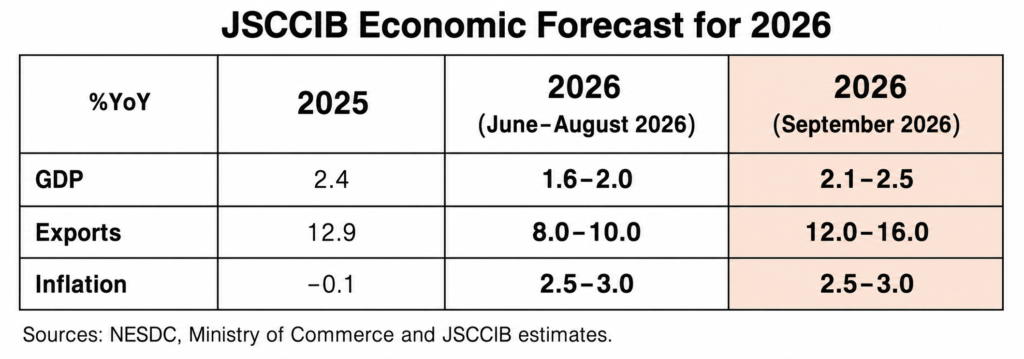
Thailand's leading private sector group has raised its 2026 economic growth forecast to 2.1%-2.5% from 1.6%-2.0%, citing stronger-than-expected exports and private investment. The Joint Standing Committee on Commerce, Industry and Banking (JSCCIB) also raised its export growth forecast to 12%-16% from 8%-10%, while maintaining its inflation forecast at 2.5%-3.0%. The revised growth range is broadly in line with the latest official projections. The National Economic and Social Development Council (NESDC) expects growth of 2.0%-2.5%, with a midpoint of 2.2%, while the Bank of Thailand forecasts 2.3%. The NESDC expects exports to rise by 15.1%, within the JSCCIB’s revised range, and private investment to expand by 9.6%. It forecasts private consumption growth of 2.6% and inflation of 1.5%-2.0%. The central bank’s inflation forecast is higher, at 2.8% for 2026, within the JSCCIB’s range. It expects core inflation of 1.5% and economic growth to slow to 1.8% in 2027. However, the JSCCIB said strong exports and investment were having a weaker impact on the domestic economy than in the past. Export growth of about 14% and investment growth of 10% previously corresponded with gross domestic product growth of 6%-7%, indicating that the country is capturing less domestic value because of its dependence on imported inputs. New investment is also generating fewer jobs, the committee said. It called for stronger links between foreign investment and domestic industries, citing data centres as an example. Every 100 megawatts of data-centre capacity represents more than 60 billion baht in investment, but local supply chains, clean-energy and water infrastructure, smart manufacturing and skilled workers must be developed to maximise the benefits. The NESDC has raised similar concerns, calling for greater use of domestic materials, employment of Thai workers, local procurement and technology transfers from foreign investment. It also urged authorities to ensure that data-centre development does not shift infrastructure costs to the public or threaten energy, water, environmental and data security. The JSCCIB said it had established a data-centre working group to help maximise the industry’s domestic benefits, including through investment in printed circuit boards and related upstream and downstream businesses. It also highlighted a widening K-shaped divide in the economy. Growth is concentrated in digital and artificial intelligence-related industries, including computers and semiconductors, dominated largely by Chinese, American and Singaporean companies. Industries such as automotive manufacturing, petroleum and construction materials face intense competition from imported goods. Over the past five years, production among Thai small and medium-sized enterprises in seven industries covered by the “Reinvent Thailand” initiative fell by an average of 8%, while output among foreign-owned companies declined by 19%, particularly Japanese businesses. The JSCCIB urged the government to improve industrial data by linking information from agencies including the Office of Industrial Economics, the NESDC and the Social Security Office. It said headline economic figures did not adequately reflect differences between industries, business sizes and company nationalities. The committee also warned that renewed conflict in the Middle East had pushed global crude oil prices to about US$95 per barrel in early September, up from US$84 in July. It called on the government to ease diesel export restrictions, saying excess inventories had forced refineries to cut production and reduced supplies of raw materials used by the petrochemical, plastics, rubber, chemical, automotive and packaging industries. The post Private-sector panel raises 2026 GDP growth forecast to 2.1%-2.5% appeared first on Thai Enquirer.
Original source
Thai Enquirer