General articles are free for 24 hours after publish.
South Korean President Lee Pursues AI Investment and South American Minerals
South Korean President Lee Jae-myung secured AI-related investments in Silicon Valley before visiting Brazil and Chile to sign mineral and trade agreements. The trip is part of a broader 'Global South diplomacy' aimed at diversifying Seoul's ties beyond the US, China, and Japan.
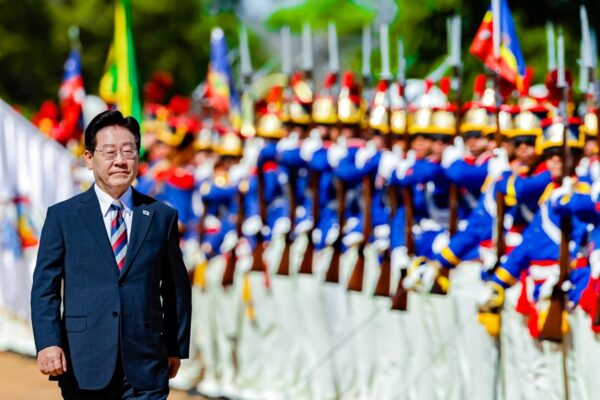
South Korean President Lee Jae-myung is nearing the end of the longest overseas trip of his 14-month presidency, an 11-day swing that carried him from Silicon Valley’s technology corridor to the mineral-rich economies of South America. Lee, who took office in June 2025, opened the tour with investment pledges from four of the world’s leading artificial intelligence companies, then flew on to Brazil and Chile where he secured trade and critical-mineral commitments from both countries. In the following days, he will head to Buenos Aires, the capital of Argentina, to have a summit meeting with Argentine President Javier Milei prior to his final stop in Frankfurt, Germany next week. The Latin American leg marked Lee’s first tour of the region. The presidential Blue House has framed the trip as part of broader “Global South diplomacy” push that is central to diversifying South Korea’s trade and diplomatic ties beyond the United States, China, and Japan. Brazil, Chile, and Argentina together form a market of some 280 million people with a combined gross domestic product of $3.7 trillion, roughly the size of the world’s seventh-largest economy, according to Seoul. Brazil and Argentina anchor Mercosur, the four-nation South American trade bloc that also includes Paraguay and Uruguay. The Lee administration has spent years trying to negotiate a trade agreement with the bloc. Lee began the trip on July 24 with separate meetings in San Francisco with Anthropic CEO Dario Amodei, OpenAI CEO Sam Altman, Nvidia CEO Jensen Huang, and Broadcom President and CEO Hock Tan. Kim Yong-beom, the policy chief for Lee, said the meetings were meant to advance South Korea’s three flagship megaprojects – a government investment push spanning semiconductors, AI data centers and physical AI that Lee announced earlier in his term. Speaking at the San Francisco AI Summit on July 25, Lee outlined plans for South Korea to serve as a stable supply base for AI infrastructure even amid a global chip shortage. He unveiled what his office called the San Francisco Declaration on AI, pledging that the country “will become a trusted production base and supply-chain partner for AI chips.” South Korean and U.S. companies translated the summit into deals worth a combined $950 billion over five years, headlined by a five-year, $200 billion arrangement between Samsung Electronics and Broadcom for the supply of advanced memory chips used in AI accelerators. Lee also met with representatives of six Silicon Valley venture capital firms at an investment meetup on July 25, where the National Pension Service separately signed a memorandum of understanding with a group of global venture capital firms to build channels into Silicon Valley startups. Lee arrived in Brazil on July 26 for a state visit at the invitation of Brazilian President Luiz Inácio Lula da Silva. It was Lee’s fifth meeting with Lula and the first state visit by a Korean leader to Brazil since Park Geun-hye’s in 2015. The two leaders held a summit on July 27 at the Alvorada Palace where they adopted a joint statement declaring 2026 the founding year of an upgraded strategic partnership between the two countries. South Korea and Brazil signed seven memoranda of understanding spanning industrial technology, space, energy, sports, education, film, and cybersecurity. The leaders also agreed to form a joint working group aiming to resume long-stalled negotiations on the Korea-Mercosur trade agreement, with a target of restarting talks by December. Brazil, which holds the world’s second-largest reserves of rare earth elements at roughly 21 million tons, emerged as a central focus of Lee’s larger tour, with officials citing critical mineral supply chains among the summit’s main outcomes. On July 29, Lee arrived in Santiago, Chile, becoming the first South Korean president to visit Chile since Park’s South America tour 11 years ago. At a joint news conference the following day, Lee and Chilean President Jose Antonio Kast agreed to revive the South Korea-Chile Free Trade Commission for the first time in a decade and to modernize their free trade agreement, which took effect in 2004. Lee said the two sides had agreed to expand trade and investment ties in pursuit of shared growth. The two governments also signed five memoranda of understanding on critical minerals and fighting transnational crime, including a partnership that elevates a joint minerals committee to the ministerial level to help secure copper and lithium supplies worth roughly $2.1 billion a year. Lee is scheduled to meet Argentina’s Milei on July 31 at the Casa Rosada presidential palace, following a wreath-laying ceremony at Plaza San Martín. It’s the first bilateral visit by a Korean president to Argentina in 22 years. Seoul said ahead of the meeting that the visit was expected to build a supply chain partnership around lithium, of which Argentina holds the world’s fourth-largest reserves, along with energy and food security cooperation. Lee is scheduled to close out the trip with a meeting with the Korean community in Frankfurt on August 2, before returning to Seoul the following day. Subscribe today and join thousands of diplomats, analysts, policy professionals and business readers who rely on The Diplomat for expert Asia-Pacific coverage. Get unlimited access to in-depth analysis you won't find anywhere else, from South China Sea tensions to ASEAN diplomacy to India-Pakistan relations. More than 5,000 articles a year. Already have an account? Log in. Mitch Shin is a chief correspondent for The Diplomat, covering the Korean Peninsula. He is also a non-resident research fellow at the Central European Institute of Asian Studies and associate fellow for the Swedish Institute of International Affairs. Get briefed on the story of the week, and developing stories to watch across the Asia-Pacific.
Original source
The Diplomat Indonesia