General articles are free for 24 hours after publish.
North Korea's Nuclear Program Appears to Be Expanding, Satellite Imagery and IAEA Reports Indicate
IAEA reports and satellite imagery analysis indicate North Korea's nuclear program is expanding on multiple fronts. Notably, a new uranium enrichment facility has been constructed at the Yongbyon nuclear complex, and existing facilities continue to operate, raising serious concerns for the international community.
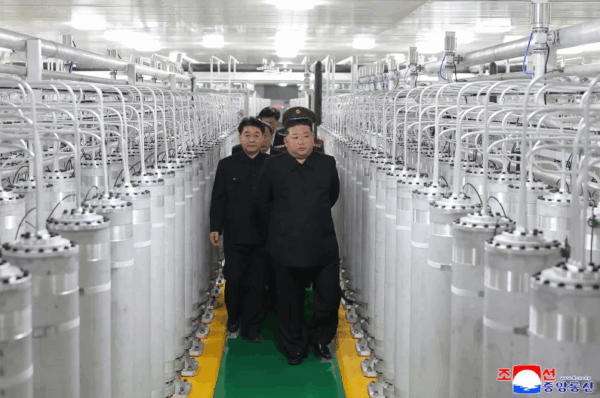
In late 2026, a combination of satellite imagery and open-source analysis, corroborated by reports from the International Atomic Energy Agency (IAEA), paints a picture of a North Korean nuclear program visibly expanding on multiple fronts. The IAEA issued a report to its Board of Governors in August 2026, documenting the construction of a second uranium enrichment facility at North Korea’s main Yongbyon nuclear complex. This new facility is estimated to house up to 28 centrifuge cascades, complementing the already operating expanded annex at the Kangson enrichment site. The IAEA identified the new two-story building by comparing satellite images taken during its construction with state media photographs from a June 2026 visit by Kim Jong Un, which showed centrifuges and cascades similar to those at known enrichment sites. IAEA Director General Rafael Grossi stated that the continued operation of the Kangson and Yongbyon facilities, coupled with the reported further expansion of weapons-grade nuclear material production, was “a cause for serious concern.” It is important to note that the IAEA has not had inspectors on the ground in North Korea since 2009, and its assessments are built entirely from commercial satellite imagery and open-source materials, including North Korean state media. Independent monitors tracking Yongbyon have documented near-continuous water discharge from the 5-megawatt-electric (MWe) reactor, North Korea’s original plutonium producer. This activity is consistent with it running through what is now believed to be its seventh irradiation cycle since October 2024. Periodic steam activity at the Radiochemical Laboratory suggests reprocessing campaigns are ongoing. A separate site review by Daily NK reached similar conclusions, also noting renewed discharge activity at the long-delayed Experimental Light Water Reactor (ELWR) after a shutdown period. Concurrently, demolition of the old, unfinished 50 MWe reactor at Yongbyon continues in parallel with new construction. A review by 38 North covering 2025 activity framed this expansion as a direct response to political direction. Kim Jong Un had described that year as decisive for “bolstering up the nuclear forces,” and the satellite record showed the 5 MWe reactor running steadily since January 2025. 38 North also flagged pre-operational testing of the ELWR, a probable summer reprocessing campaign, and construction of what are assessed to be new enrichment and waste-storage buildings. North Korea’s declared and suspected enrichment infrastructure now spans at least two locations at Yongbyon (the original uranium enrichment plant and the new building identified in August) plus the Kangson facility outside Pyongyang. The 2024 annex expansion at Kangson appears to have become operational around January 2026. Nonproliferation researchers have long argued that clandestine centrifuge halls are comparatively easy to conceal, making the more reliable way to bound North Korea’s enrichment capacity to track its uranium supply rather than guess at hidden buildings. An academic study in 2021 using satellite-based land-use analysis around the Pyongsan uranium mill concluded that North Korea’s tailings output implies it could produce substantially more milled uranium than it is believed to currently be enriching, meaning supply is not the constraint on how fast the program could grow. Unlike uranium enrichment, North Korea’s plutonium supply chain runs through a small number of well-mapped facilities. It starts at the Pyongsan Uranium Concentrate Plant, roughly 45 kilometers from the DMZ, which remains the country’s only confirmed source of yellowcake. Uranium ore is processed there into oxide concentrate before being shipped to Yongbyon for conversion into reactor fuel. That fuel feeds the 5 MWe reactor, whose spent fuel rods are then reprocessed at Yongbyon’s Radiochemical Laboratory to extract weapons-grade plutonium. This lab is believed to be responsible for the totality of North Korea’s plutonium stockpile to date, estimated by outside experts to support somewhere in the range of dozens of warheads. The ELWR adds a second, more ambiguous track. Rated at 100 megawatts-thermal, it began sustained operation in late 2023 after a decade of delay. The ELWR has since gone through at least one documented shutdown-and-restart cycle, with Grossi telling the IAEA board of direction in November 2025 that it had “likely been shut down” in early August of that year, after months of stable running. As noted above, the ELWR is believed to have restarted once again. A light-water reactor of this design is not optimized for weapons-grade plutonium production the way the graphite-moderated 5 MWe unit is, and North Korea has publicly framed it as an electricity source. Even so, should it reach stable, full-power operation, outside analysts assess it would function as a supplementary plutonium source layered on top of the existing reactor, meaningfully increasing Yongbyon’s total fissile material output. The reactor most often described in older reporting as North Korea’s “second 200-megawatt reactor” is not at Yongbyon at all, but roughly 20 kilometers away at Taechon. Construction of this larger, 200 MWe graphite-moderated, gas-cooled unit began in the late 1980s as the planned full-scale successor to the 5 MWe design but was frozen under the 1994 U.S.-North Korea Agreed Framework, at which point North Korea had manufactured none of the reactor’s required graphite blocks. The most recent detailed satellite review of the site, by 38 North in 2019, found administrative and support-building upgrades but no changes to the derelict reactor structure itself or its generator hall. The analysts concluded that renewed construction was less likely than signaling or preparation for eventual inspections. No subsequent commercial satellite analysis has documented a resumption of reactor construction at Taechon; as of 2026 it remains, by all available open-source evidence, an abandoned shell. The reason Taechon still draws attention despite decades of dormancy is the scale of what it was designed to do. At full design output, a 200 MWe graphite-gas reactor of this type could produce on the order of 220 kilograms of weapons-grade plutonium per year – enough, by some open-source estimates, for 25 to 40 additional nuclear weapons annually, dwarfing the output of the 5 MWe reactor that has anchored North Korea’s plutonium stockpile for four decades. In practice, most nonproliferation analysts consider a Taechon restart unlikely in the near term: the design i Information source: The Diplomat Indonesia
Original source
The Diplomat Indonesia