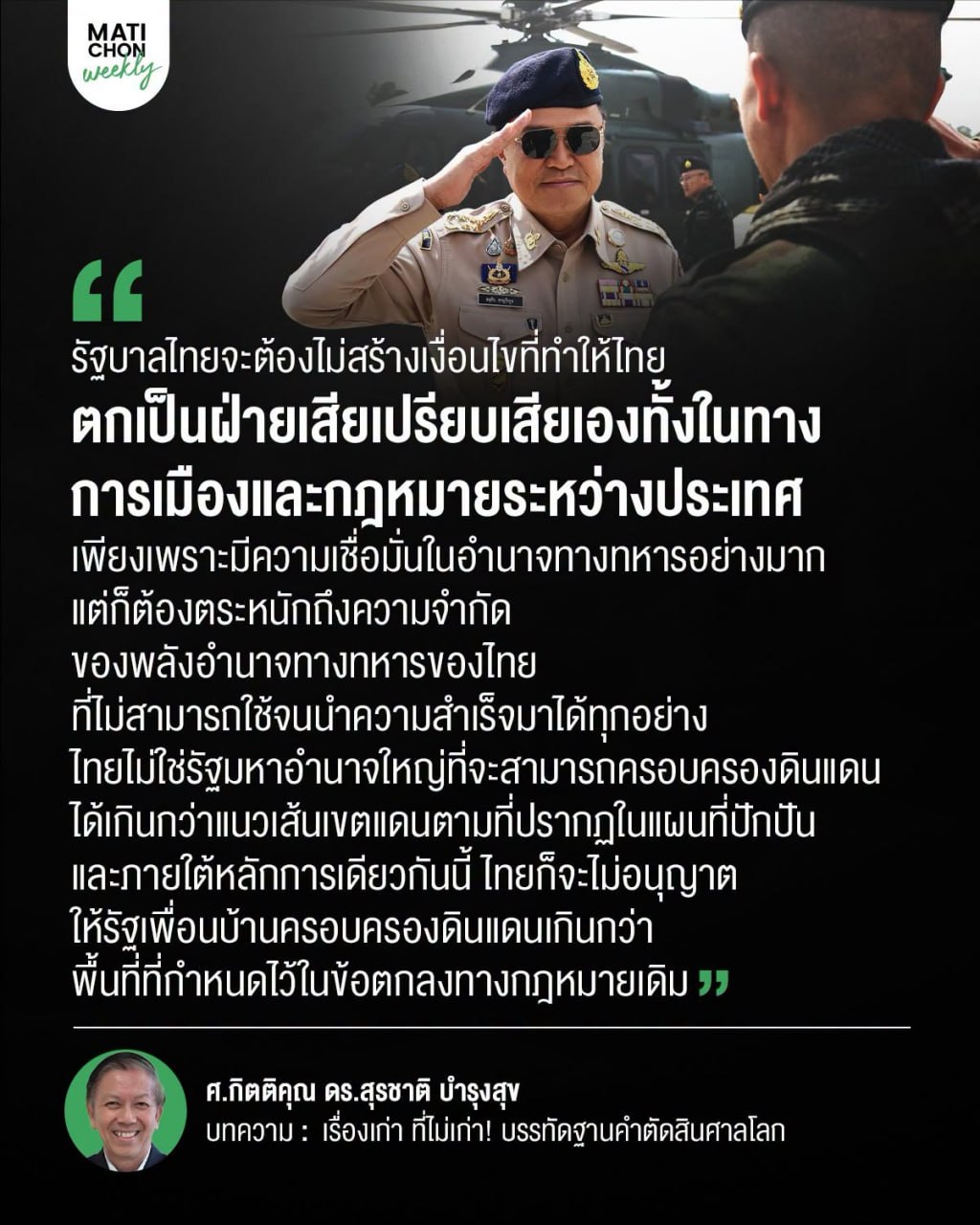
Hun Sen Shares Thai Expert's Article, Urging Re-evaluation of Preah Vihear Ruling
Cambodian Senate President Hun Sen shared an article by a Thai international relations and security expert on the Preah Vihear temple border dispute. The article emphasizes the significance of the 1962 International Court of Justice (ICJ) ruling and calls for peaceful resolution of border issues between the two nations.
On July 9, 2026, Cambodian Senate President Samdech Techo Hun Sen shared an article by Surachart Bamrungsuk, an expert in international relations and security from Thailand. The article, titled "An Old Story That Is Not Old: The Verdict Determined by the Decision of the International Court of Justice," focuses on the 1962 International Court of Justice (ICJ) ruling concerning the Preah Vihear temple. In a post on his social media, Samdech Techo Hun Sen stated his interest in the article and his intention to share it, translated unofficially, for the understanding of both Cambodian and Thai citizens. He indicated that he would refrain from adding further commentary. The article highlights that a primary objective when two countries demarcate their borders is "to achieve security, certainty, and clarity." It argues that this objective cannot be met if the established border line remains subject to debate or demands for revision at any time. It emphasizes that the core of the border dispute between Thailand and Cambodia is related to the Preah Vihear temple case. Thailand has previously faced the ICJ twice regarding this matter, in 1962 and again in 2013, with the Thai government having accepted the outcomes of both rulings. The article warns that Thailand must be vigilant and absolutely avoid creating conditions that would force a third return to the International Court. Specifically, the article stresses the significance of the 1962 ruling and the importance of treaties and maps in resolving border disputes. It suggests that while the content of this ruling may be largely forgotten in Thai society, it is crucial for understanding current border issues. The ruling is presented as a decisive factor concerning the border line between Thailand and its neighbors, acting as a successor state to colonial powers. Furthermore, the article quotes the ICJ's stance that if a border line can be challenged or revised at any time based on perceived inaccuracies in the original treaty, such protests will inevitably continue without end. This implies that international society does not wish to see border disputes prolonged indefinitely. Even if current leaders believe the original documents have flaws, they cannot be used as a pretext to dismantle them if they were jointly ratified by representatives of both states in the past. The article concludes that the ICJ's decision aims to prevent border conflicts from escalating into war. Agreements on border lines are intended "to reduce and eliminate all tense situations, and to achieve territorial stability based on certainty and clarity," not to create disputes as a bitter legacy for future generations. It reaffirms the court's desire to maintain the "status quo" of the border line, established through treaties and maps implemented by both states. Information Source: AKP Khmer
多角的分析
この記事は直接的な経済的影響には触れていないが、国境紛争の長期化は、両国間の貿易、投資、観光などの経済活動に不確実性をもたらす可能性がある。特に、プレアヴィヒア寺院周辺地域は観光資源としての潜在力を持つが、国境問題の不安定さは開発を阻害する要因となりうる。フン・セン氏がこの記事を共有したことは、カンボジアがタイとの関係において、過去の紛争を建設的な対話を通じて解決し、経済発展の安定化を図りたいという意向の表れとも解釈できる。
投資家にとって、国境紛争の再燃や長期化は、地域全体の政治的リスクを高める要因となる。特にタイとカンボジアに跨る地域への投資は、紛争の進展次第で資産価値の変動や事業継続のリスクに直面する可能性がある。フン・セン氏によるこの記事の共有は、過去の判決を尊重し、現状維持を促すことで、投資環境の安定化を図ろうとする動きと見ることができる。ただし、タイ国内の世論や政治動向によっては、このメッセージがどのように受け止められるかが注目される。
この記事は、プレアヴィヒア寺院を巡る国境紛争という歴史的な問題を、現代のタイとカンボジアの市民に再認識させることを目的としている。フン・セン氏がこの記事を共有したことは、両国民に対し、過去の判決の重要性を理解し、国境問題に対する冷静な判断を促す意図があると考えられる。特に、国境地域に住む住民にとっては、国境の安定は生活の安全と経済活動に直結するため、この問題の平和的解決は社会的な安定に不可欠である。若年層にとっては、歴史的な紛争は遠い過去の出来事のように感じられる可能性があり、この記事は彼らに問題の継続的な重要性を伝える機会となる。
フン・セン上院議長がタイの専門家の記事を共有したことは、カンボジア国民に対して、タイとの国境問題、特にプレアヴィヒア寺院に関する過去の国際司法裁判所(ICJ)の判決の重要性を再認識させる意図がある。この記事は、国境紛争が「安全保障、確実性、明確さ」の達成を妨げ、紛争の長期化やエスカレーションのリスクを高めることを示唆している。国民は、この過去の判決が現在の国境問題解決の鍵となりうることを理解し、両国間の平和的かつ安定的な関係構築への期待を抱くかもしれない。特に、国境付近の住民にとっては、国境の安定は生活の安全と経済活動の基盤となるため、この問題への関心は高い。
背景・歴史的文脈
プレアヴィヒア寺院を巡るカンボジアとタイの国境紛争は、1962年の国際司法裁判所(ICJ)による判決で一時終結した。しかし、2008年に同寺院がユネスコ世界遺産に登録されたことを契機に、寺院周辺の領土問題が再燃。2013年には再びICJで審理が行われ、寺院周辺地域の管理に関する判断が下された。今回のフン・セン氏による記事共有は、これらの過去の判決と、現在も続く国境問題の文脈の中で理解されるべきである。特に、タイ国内における国境問題への認識や、両国関係の政治的力学が背景にあると考えられる。
原文ソース
AKP Khmer