General articles are free for 24 hours after publish.
Cambodia's Information Minister: Ceasefire Cannot Establish New Cambodia-Thailand Border
Cambodia's Minister of Information stated that the December 2025 ceasefire agreement between Cambodia and Thailand is not a boundary treaty and cannot be used to alter the internationally recognized border, refuting any claims of territorial changes based on the accord.
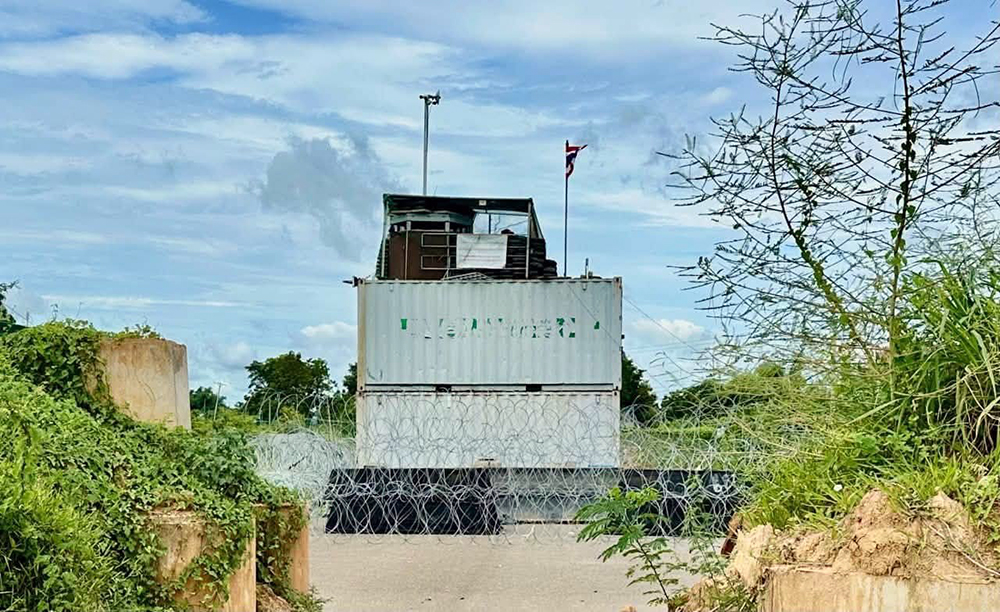
Cambodian Minister of Information H.E. Neth Pheaktra has clarified that the Joint Statement on ceasefire arrangements between Cambodia and Thailand, established on December 27, 2025, is not a boundary treaty and cannot serve as a basis for altering the internationally recognized border. The minister issued a statement on Facebook on August 31, refuting interpretations by the Thai side. In response to remarks made by Lieutenant General Prapas Sonjaidee, Director of Thailand’s Joint Information Centre (JIC), asserting that troops should remain in agreed positions and that Thailand has never altered conditions on the ground based on the Joint Statement, Minister Pheaktra stressed that such an interpretation fundamentally contradicts the statement's substance, international law, and factual evidence on the ground. He cautioned that this interpretation risks misleading domestic and international public opinion by creating a false impression that Cambodia has agreed to allow Thai forces to be deployed within Cambodia's sovereign territory. Minister Pheaktra emphasized that the Joint Statement, particularly its Paragraph 2, is not a boundary treaty and cannot be construed as having the legal effect of superseding the 1:200,000 map series, which forms an important part of the instruments associated with the Franco-Siamese boundary settlement. These maps constitute crucial legal and historical evidence for boundary delimitation and cannot be displaced by a temporary military arrangement designed to cease hostilities. Therefore, Thailand cannot invoke the Joint Statement as a legal basis for maintaining control over Cambodian territory or for creating a fait accompli through unilateral activities such as installing barbed wire, deploying shipping containers, constructing bunkers and trenches, building roads, clearing land, demolishing civilian homes and religious structures, erecting statues, or raising national flags on Cambodian territory. These actions are incompatible with the applicable international legal framework, the relevant 1:200,000 maps, Franco-Siamese treaties and conventions, the records of the Joint Boundary Commission (JBC) meeting in Chanthaburi on October 25, 2025, relevant bilateral arrangements, and the Joint Statement itself. The maps originating from the Franco-Siamese boundary process form part of the historical and legal framework relevant to the boundary between Cambodia and Thailand. In this context, maps prepared unilaterally by one side, including military map series such as L7017, L7018, or other unilateral cartographic products, cannot, by themselves, modify or replace a boundary arising from legal instruments and arrangements binding upon both parties. The maps produced through the Franco-Siamese boundary process were also of particular significance in the proceedings before the International Court of Justice (ICJ) concerning the Temple of Preah Vihear. In its 1962 Judgment and its 2013 Judgment on interpretation, the Court addressed the legal consequences relating to the Temple and the surrounding area falling within the scope of those judgments, including Thailand’s obligation to withdraw its military, police or other guards or keepers from Cambodian territory as determined by the Court. It is important, however, to be precise: the 1962 and 2013 ICJ Judgments concerned the Temple of Preah Vihear and the area falling within the scope of those judgments; they should not be construed as having delimited the entire Cambodia–Thailand boundary. Indeed, it is precisely because the Joint Statement of 27 December 2025 is not a boundary treaty that both sides accorded high priority to the Joint Boundary Commission (JBC) and the relevant technical mechanisms operating under it. These mechanisms remain essential for addressing boundary-related matters and reducing tensions between the two countries. The preambular provisions of the Joint Statement underscore the importance of achieving a definitive resolution of boundary issues. Paragraphs 3 and 4 further reflect the parties’ agreement to advance JBC meetings, technical discussions and the deployment of joint survey teams to relevant areas on the ground, with their safety facilitated through mine-clearance activities conducted within the relevant JBC framework. Accelerating the work of the JBC is intended to address outstanding boundary-demarcation issues on the ground, facilitate the safe return of displaced Cambodian civilians to their homes, and contribute to lasting peace and stability along the Cambodia–Thailand border. Accordingly, isolating Paragraph 2 from the rest of the Joint Statement and interpreting it as conferring territorial rights on the basis of military positions fundamentally distorts the object and purpose of the agreement. The Joint Statement is, in essence, a ceasefire and de-escalation arrangement. It is not a boundary treaty, nor does it authorize Thai forces to establish sovereignty, acquire territorial rights, or undertake activities infringing upon Cambodia’s sovereignty merely by remaining in particular military positions. Put differently, maintaining military positions for the purpose of stopping hostilities is a temporary security arrangement. It does not constitute recognition of sovereignty, recognition of a boundary, or the transfer of title to territory. Paragraph 2 therefore cannot reasonably be interpreted as authorizing one party to use a ceasefire arrangement to consolidate military control over territory claimed by the other party. Any boundary-related interpretation must be considered within the broader applicable legal framework, including the Franco-Siamese treaties and conventions, the relevant 1:200,000 maps, and subsequent bilateral instruments and mechanisms, including the 2000 Memorandum of Understanding and the 2003 Terms of Reference. Cambodia has never agreed that Thai forces may use the ceasefire arrangement as authorization to deploy, consolidate their presence, or undertake unlawful activities on Cambodian territory. A temporary cessation of hostilities cannot be transformed into a source of territorial title. Thailand should therefore demonstrate genuine commitment and good faith by fully implementing the Joint Statement and translating its commitments into concrete conduct on the ground, rather than relying on selective interpretations that may serve a public narrative but are inconsistent with the purpose of the ceasefire arrangement. Military positions may be frozen to stop the shooting, but borders are neither frozen nor redrawn according to where troops happen to stand. A ceasefire stops the shooting, but it does not redraw the map.
Original source
AKP Cambodia