General articles are free for 24 hours after publish.
Japan and South Korea Vie Again for US Navy Frigate Contract
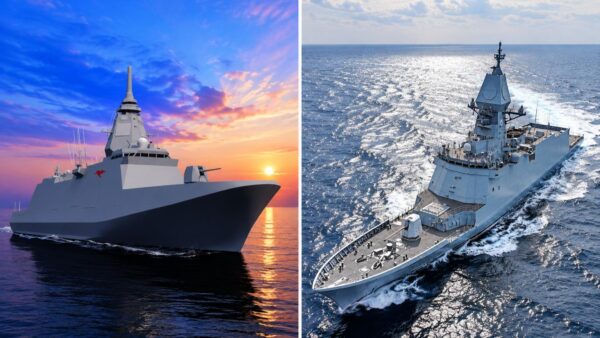
The US Navy's potential selection of a new frigate design has reignited defense industrial competition between Japan and South Korea. Both Japan's upgraded Mogami-class and South Korea's Chungnam-class frigates are reportedly under consideration, testing their respective technological prowess and production capabilities.
The U.S. Navy’s reported interest in foreign frigate designs has opened a new front in Japan-South Korea defense industrial competition. USNI News reported on September 1 that the White House and Navy are considering three allied designs: Japan’s upgraded Mogami class, known as the New FFM or 06FFM; South Korea’s Chungnam class; and Turkiye’s Istanbul class. Up to two ships could be built overseas before production shifts to U.S. yards. The idea did not come from nowhere. As Naval News reported in June, the Pentagon’s fiscal year 2027 budget proposal included $1.85 billion for an effort involving foreign warship designs, with Japan and South Korea at the center of the discussion. Japan’s top naval officer has now publicly welcomed the reported U.S. interest. Asked by The Diplomat at a September 8 press conference about the New FFM’s reported inclusion in the U.S. review, Japan Maritime Self-Defense Force (MSDF) Chief of Staff Adm. Saito Akira stressed that he was not in a position to comment on individual U.S. Navy shipbuilding plans. But if the United States or other countries were considering adopting platforms used by the MSDF, he said, “We see this as reflecting a high level of trust in and appreciation for equipment that embodies the advanced technologies of our ships.” “I am frankly pleased,” Saito said, adding that if Japan received requests for cooperation on such matters, “we would respond proactively.” The reported competition has encouraged a view that Seoul is the real front-runner and Japan’s New FFM merely a stalking horse. Hanwha acquired Philly Shipyard in 2024, giving a South Korean company a direct U.S. shipbuilding foothold. U.S. officials have repeatedly visited South Korean yards, and in December 2025 U.S. President Donald Trump said the Navy would work with Hanwha on a new frigate. But that conclusion does not necessarily follow. Trump’s remarks referred to cooperation on the U.S. Navy’s FF(X), a U.S.-designed frigate concept based on the Coast Guard’s National Security Cutter. That was not a decision to adopt South Korea’s Chungnam design. USNI News’ September 1 report described a separate review of foreign designs and identified no favorite. Moreover, Hanwha is not the company most closely associated with the Chungnam class. The detailed design and lead ship were handled by HD Hyundai Heavy Industries, while Hanwha Ocean and SK Oceanplant are building follow-on ships. Thus, Hanwha’s U.S. shipyard investment does not automatically translate into an advantage for the Chungnam design. Nor has Washington’s shipbuilding outreach been limited to South Korea. Then-Navy Secretary John Phelan visited Japan in April 2025, meeting Saito and other Japanese defense officials and touring Japan Marine United. The U.S. Navy said Phelan visited JMU to learn about industry best practices and encourage investment in American shipyards. Asked whether Phelan or other U.S. Navy officials had previously expressed specific interest in or praise for the Mogami class or New FFM, Saito declined to disclose details, saying only that he regularly exchanges views with U.S. Navy counterparts on a broad range of issues, including defense equipment, capability enhancement, and operational cooperation. South Korea nevertheless has some important advantages in the U.S. competition. Its major shipbuilders have substantial production capacity, while Hanwha already has a direct U.S. shipbuilding presence at a time when Washington faces serious shipbuilding delays and capacity constraints. That U.S. footprint also fits the administration’s “Finland model”: initial construction overseas followed by investment and production in the United States. Yet Japan’s New FFM should not be dismissed. There is already a precedent for Japanese-South Korean frigate competition. In 2024, Australia identified Japan’s Mogami class and South Korea’s FFX Batch II and III, among other designs, as exemplars for its future general-purpose frigate. Canberra later narrowed the field to Mitsubishi Heavy Industries and Germany’s TKMS before selecting the upgraded Mogami – the New FFM – in August 2025. Now the two Asian competitors could find themselves facing each other again in the United States, with the New FFM and South Korea’s Chungnam class – the FFX Batch III design – both reportedly under consideration. The New FFM is expected to feature a 32-cell vertical launch system, long range, stealth-oriented design features, and reduced manning – attributes relevant to the U.S. Navy as it seeks a frigate that can relieve Arleigh Burke-class destroyers of lower-end missions. None of this guarantees a Japanese win. Both designs would require adaptation to U.S. Navy combat systems, weapons, communications, cybersecurity, and information-security requirements. Congress also remains wary of building U.S. warships overseas. The better reading, then, is that South Korea has an industrial head start, not a guaranteed design victory. Hanwha’s U.S. footprint and South Korea’s shipbuilding capacity make it a formidable contender. But those factors do not prove that the Chungnam class is the Navy’s preferred frigate, nor that Japan’s New FFM is merely a stalking horse. Washington is effectively weighing two questions: which ally can best help rebuild the U.S. shipbuilding industrial base, and which frigate design best fits the fleet. South Korea’s U.S. investments give it important advantages on the first. On the second, the competition remains very much open. Subscribe today and join thousands of diplomats, analysts, policy professionals and business readers who rely on The Diplomat for expert Asia-Pacific coverage. Get unlimited access to in-depth analysis you won't find anywhere else, from South China Sea tensions to ASEAN diplomacy to India-Pakistan relations. More than 5,000 articles a year. Already have an account? Log in. Takahashi Kosuke is Tokyo Correspondent for The Diplomat. Get briefed on the story of the week, and developing stories to watch across the Asia-Pacific.
Original source
The Diplomat Indonesia