General articles are free for 24 hours after publish.
Pasemah Megaliths: Traces of Prehistoric Society Coexisting with Nature
The Tinggi Hari megalithic site in Lahat Regency, South Sumatra, is part of the Pasemah civilization spanning 8,000 hectares. Approximately 1,165 megalithic artifacts have been found, notably situated near water sources.
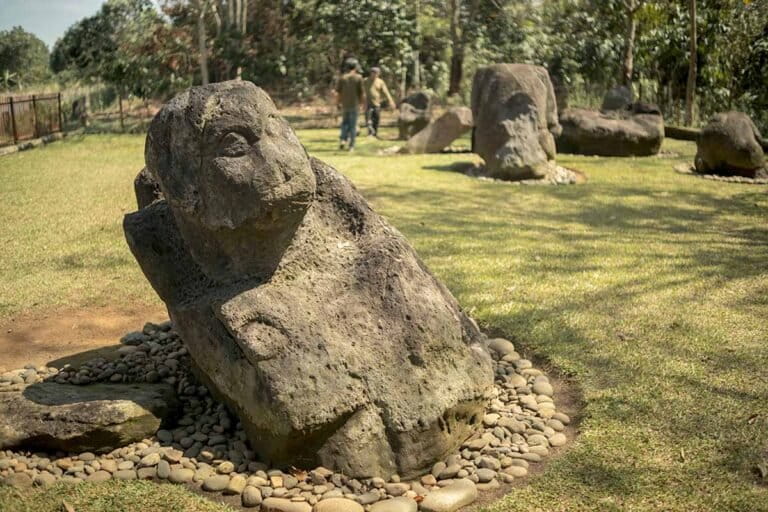
The Tinggi Hari site in Lahat Regency, South Sumatra, Indonesia, preserves precious traces of the prehistoric Pasemah civilization, which flourished thousands of years ago. Located in the Gumay hills, approximately 400 meters above sea level, this area offers a glimpse into the lives of prehistoric humans. The Tinggi Hari site comprises three main areas: Tinggi Hari I, II, and III, scattered across the hills. Here, diverse stone artifacts have been discovered, including anthropomorphic statues, menhirs (standing stones), flat stones, mortars, pestles, and tetraliths (four-stone structures). These constitute only a part of the vast Pasemah civilization, which spanned approximately 8,000 hectares across Lahat Regency, Pagaralam City, and Empat Lawang Regency. To date, 85 statues, 25 stone chambers, and hundreds of stone mortars and pestles have been identified. Notably, many of these megalithic structures are situated near water sources such as rivers, lakes, and swamps. Mario Andramartik, a member of the Lahat Regency Cultural Heritage Expert Team, points out, "Many megalithic sites in the Pasemah region are found not far from water sources." This suggests that prehistoric people valued water resources and lived their lives in harmony with their benefits. Furthermore, the facial features of the discovered anthropomorphic statues are interesting when compared to Austronesian populations, potentially explaining Austro-Melanesian characteristics. Features such as round, long faces, curly hair, large eyes, flat noses, and thick lips convey the physical appearance of the people of that era. The Pasemah civilization developed a diverse range of megalithic forms, including statues, menhirs, monoliths, triliths (three-stone structures), tetraliths, flat stones, dolmens (megalithic tombs), stone mortars, stone pestles, engraved stones, ring stones, stone chambers, paintings within stone chambers, and burial urns, totaling 15 distinct types. These sites are not merely relics of the past but valuable heritage that conveys to the present day the wisdom and culture of prehistoric people who lived in harmony with their natural environment and pursued sustainable lives. Source: Mongabay Indonesia
Original source
Mongabay Indonesia