General articles are free for 24 hours after publish.
Rethinking Beijing's Tibet Fears: Domestic Awareness Over International Pressure
A self-immolation outside the UN highlights the limits of international engagement on Tibet. Experts suggest Beijing's greatest fear isn't global condemnation, but rising awareness within China, particularly among the Han population.
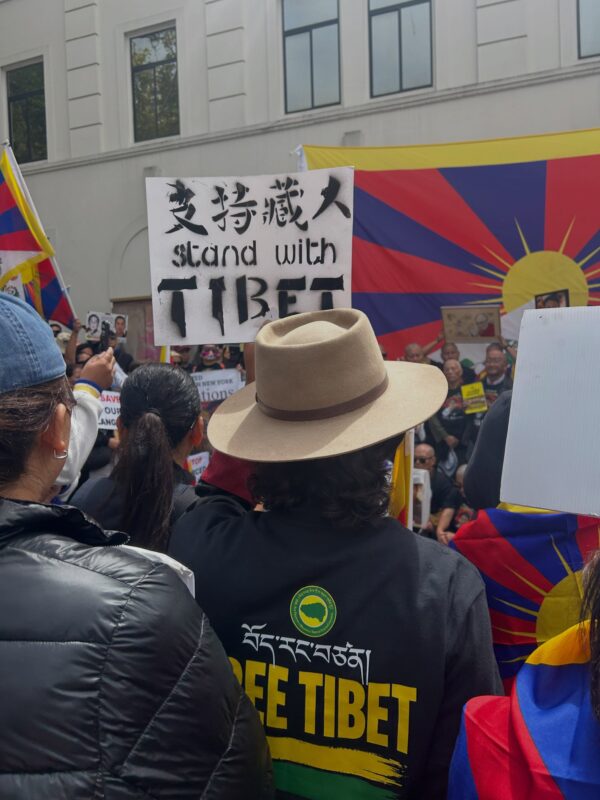
Read The Diplomat, Know The Asia-Pacific Beijing’s real vulnerability is not international action. It’s rising awareness within the Chinese population. Members of Chinese Youth Stand for Tibet attend a rally outside China’s consulate in San Francisco, the U.S., Aug. 20, 2026. On July 2, Lobga Rangzen, a Tibetan man who had taken the word meaning “independence and freedom” as his name, set himself on fire outside the United Nations headquarters in New York. His act came one day after China’s Ethnic Unity and Progress Promotion Law took effect. In a video posted before his death, he denounced the law as an erasure of Tibetan identity and called on Tibetans-in-exile to take up their responsibility. He chose the spot deliberately, too. Tibetans have looked to the U.N. for redress since 1950, when Tibet’s appeal first went to the new global body. The General Assembly passed resolutions on Tibet in 1959, 1961, and 1965. The 1961 resolution explicitly invoked Tibetans’ right to self-determination. Yet after the People’s Republic took China’s U.N. seat in 1971, the issue vanished from the organization’s agenda. Rangzen’s self-immolation was an indictment of six decades of silence. For weeks after his death, Tibetan communities across the globe marched and demonstrated. CNN, Radio Free Asia, and others covered it; the U.N. secretary-general’s spokesperson offered condolences, and the U.S. State Department reaffirmed its support for Tibetans. Then, within days, the coverage vanished. No government went beyond boilerplate statements of sympathy. For decades, the Central Tibetan Administration’s envoys and Tibetan human rights organizations have worked in Geneva, Washington, and Brussels with extraordinary persistence, winning legislation like the Resolve Tibet Act. Beijing’s position has never varied: Tibet is an “inalienable part of China.” The one channel that did exist, nine rounds of talks with the Dalai Lama’s envoys between 2002 and 2010, produced nothing, and those talks have been moribund for over 15 years. The strategy of seeking international support to enact change in Tibet has run its course. The world has heard Tibetans cry out since 1959. Sympathy has calcified into routine: statements, condemnations, calls for dialogue. There is little prospect that external pressure alone will move the Chinese Communist Party on Tibet, and no government has shown any willingness to go beyond words. But Beijing fears a different kind of pressure, one that comes from inside the Chinese-speaking world. China’s Real Fear A year ago, Chinese state security police in Changsha detained Zhang Yadi, a 22-year-old Han Chinese student who had been studying in France, on suspicion of “inciting separatism.” Her offense: writing and editing for Chinese Youth Stand for Tibet (华语青年挺藏会), a bilingual Han-Tibetan exchange platform I founded. Zhang was born and raised in Hunan, Mao’s home province, to Han parents. Nearly all of our members are also ethnically Han. Many people asked why a Han Chinese person would risk prison for Tibetans. The more useful question is why Beijing treated a small volunteer media project as a state security threat and detained a college student over it. The CCP understands that its rule in Tibet rests not only on security spending but on the acquiescence of the Han majority – an acquiescence manufactured through decades of disinformation. Since 1959, state propaganda has taught Chinese citizens that old Tibet was a barbaric serf society, that the Dalai Lama was its greatest slaveholder. One particularly enduring myth holds that Tibet’s Buddhist monks made drums out of human skin. A hit 1990s song to that effect, “Sister Drum” (阿姐鼓), was written by a Han composer who knew the story only secondhand, from siblings who had traveled to Tibet. Chinese internet users still cite the song as evidence of Tibetan savagery. According to the CCP’s preferred narrative, the People’s Liberation Army was Tibet’s savior, and occupation is liberation. Ordinary Chinese people don’t defend the CCP’s Tibet policy out of malice; most sincerely see no case against it. Han acceptance of this narrative is the foundation for CCP rule in Tibet – but it is more fragile than it looks. In 2025, the Tibet Autonomous Region (TAR) raised just 31.8 billion yuan in local revenue against 310 billion in spending. Central transfers of 253.88 billion yuan, more than 80 percent of the budget according to the TAR’s budget reports, filled the gap, funding both livelihood programs and a vast stability-maintenance apparatus. And that budget excludes spending in the Tibetan areas of Qinghai, Sichuan, Gansu, and Yunnan. There is already simmering resentment of these policies. On the Chinese internet, a segment of Han nationalists already ask why the government grants ethnic minorities college-entrance bonus points and what it derides as “super-citizen treatment.” As China’s economy slows, complaints about the fiscal burden are growing sharper. That resentment is combustible, as ready to turn on minorities as on the CCP. The party can ignore foreign condemnation, but not a public at home that calls into question Beijing’s rule in Tibet. Han Chinese who speak fluently to that public, using the Chinese language and Chinese platforms, are the CCP’s nightmare on the ethnic frontier. More and more Han Chinese resent CCP policies in Tibet. Our aim is to redirect the questions they are already asking. Instead of “why are we paying for them?” we ask: “What is this money actually buying, and who does it benefit?” The Dalai Lama grasped the importance of Han Chinese partnerships decades ago. He appointed Chinese liaison officers at Tibetan offices worldwide and built his Middle Way Approach partly around winning Chinese hearts. But the CTA’s Chinese-language capacity has withered; the Chinese sections of exile institutions have become marginal afterthoughts. Our group, Chinese Youth for Tibet, formed organically on the Chinese-language internet, among young people fluent in its idiom. Tibetans welcomed us because that gap had gone unfilled for so long. Falling Between “Two Desks” Other Han Chinese have taken up the cause before. Grace Wang, a Duke student, was buried in nationalist abuse in 2008 for merely trying to mediate between pro-Tibet and pro-China protesters. The late historian Li Jianglin, born into a Communist family, spent years recording exile Tibetans’ oral histories; her “Tibet in Agony” reconstructed why the Dalai Lama fled in 1959. In July, police in Lhasa detained Zhang Yi, a pro-democracy activist since 1989, for displaying a photograph of the Dalai Lama at Sera Monastery, and formally arrested him on July 28. One by one, Han Chinese keep arriving at a shared sense of historical responsibility. My moment came in 2018, while teaching at a Tibetan middle school; the government forcibly closed that school two years ago. Yet groups like Chinese Youth for Tibet fall into an institutional blind
Original source
The Diplomat Indonesia