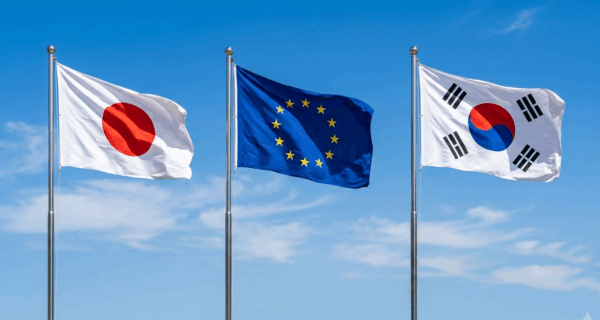
EU-Japan-South Korea Cooperation Is Indispensable Now
Diplomacy
2026年7月17日
8
The Diplomat Indonesia

General articles are free for 24 hours after publish.

EU-Japan-South Korea Cooperation Is Indispensable Now

Share
AI Summary

The EU, Japan, and South Korea face converging challenges including geopolitical instability, economic dependence, US policy uncertainty, and intersecting security threats. Strengthening trilateral cooperation, termed 'institutionalized hedging,' is deemed essential to complement each other's strengths and diversify risks.

Read The Diplomat, Know The Asia-Pacific The trilateral is more feasible – and more important – than ever before. For decades, South Korean strategy rested on a stable hierarchy within the international order. The alliance with the United States provided security; Seoul then managed relations with Japan, Europe, China, and regional institutions around that anchor. The alliance remains indispensable, but Seoul can no longer assume that this foundation will stay stable. The evidence is visible in the way Washington now deals with allies. In 2025, the United States initially announced sharply differentiated “reciprocal” tariffs on South Korea, Japan, and the European Union. Negotiations later produced a 15 percent baseline framework for all three, but the process mattered as much as the final rate. Trade access, industrial investment, defense procurement, and alliance politics were increasingly handled as one bargaining package. Allies were not exempt from economic pressure because they were allies. At the same time, Europe and Asia have been building connections that would have seemed highly ambitious a decade ago. The European Union signed security and defense partnerships with Japan and South Korea in November 2024. This year, the EU and Japan launched a defense-industry dialogue, while the EU and South Korea signed a digital trade agreement and began implementing cooperation on maritime security, cyber and hybrid threats, information manipulation, space, and the defense industry. The strategic map is becoming more networked. The network, however, remains uneven. Japan already has a mature economic partnership with the EU and rapidly expanding defense-industry ties. EU-South Korea relations are deepening, but they still lack the density and regular strategic consultation found in EU-Japan ties. A trilateral format would therefore do more than add another meeting: it would reduce asymmetry among three partners whose capabilities are increasingly complementary. South Korea, Japan, and the EU now face four converging challenges and pressures. The first is demographic. South Korea is aging faster than any other OECD society; Japan’s working-age population has been shrinking for decades; and the EU’s fertility rate reached a new low in 2024. Demography is not a social-policy sidebar. It affects defense recruitment, industrial capacity, fiscal room, technological adoption, and the ability to sustain long-term commitments. Each actor is experimenting with immigration, automation, workforce policy, and welfare reform, but the security implications remain largely compartmentalized. The second is concentrated economic dependence. None of the three can or should decouple from China. Yet South Korea’s experience after the THAAD deployment, Europe’s debates over economic coercion, and China’s export controls on gallium, germanium, and other strategic inputs have shown that interdependence can be converted into leverage. De-risking therefore requires more than national stockpiles. It requires shared risk maps, compatible certification, co-investment in alternative suppliers, and advance consultation before export controls or industrial subsidies create collateral damage among partners. The third challenge is U.S. volatility. The United States is still the only actor capable of providing extended nuclear deterrence to South Korea and Japan, and NATO remains central to European defense. But dependence on U.S. power now coexists with uncertainty about U.S. policy. The classic alliance dilemmas of abandonment and entrapment are no longer opposite ends of a spectrum. Today, U.S. allies fear both being left out and being drawn into bargains or contingencies they did not shape. The fourth pressure is the collapse of the old geographic separation between European and Asian security. North Korean munitions, missiles, and troops have supported Russia’s war against Ukraine. Moscow, in turn, has provided Pyongyang with political cover, economic support, and the prospect of military know-how. What happens on a European battlefield is changing the military balance on the Korean Peninsula. A regional response to a cross-regional threat is structurally inadequate. This is the case for an EU-Japan-South Korea strategic dialogue. This framework should not be described as strategic autonomy, equidistance, or a hedge against the United States. A better term would be institutionalized hedging: risk diversification through standing, rule-based consultation among allies and partners that remain anchored in the broader U.S.-led system. The proposal is more feasible than ever before. Japan-South Korea relations have improved significantly in recent years. The January 2026 summit in Nara and the reciprocal summit in South Korea in May demonstrated continuity across leadership changes in both countries since June 2025. The EU already has free-trade, digital, green, and security frameworks with both countries. The task is not to invent three new bilateral relationships; it is to connect existing ones. The dialogue should begin modestly, through a Track 1.5 process involving officials, experts, and industry. Its early agenda must be concrete and specific: a joint critical minerals and supply chain risk assessment; consultation on export controls and investment screening; cooperation on AI, cyber resilience, and digital standards; exchanges on demographic and defense workforce adaptation; and shared monitoring of North Korea-Russia military cooperation. Successful projects could then be elevated to ministerial working groups. Two design choices are essential. First, the initiative must remain function-driven. It is not NATO, not the Quad, and not an anti-China coalition. Its purpose is to reduce vulnerability without demanding economic separation. Second, it should be complementary to relations with Washington and transparent about that purpose. Horizontal networks strengthen alliances when they help allies absorb shocks, coordinate positions, and arrive at consultations with greater capacity. For South Korea, the need is particularly acute. Japan already has the G7, a mature economic partnership with the EU, and expanding European defense ties. Seoul’s international weight has grown faster than its institutional depth. An EU-Japan-South Korea dialogue would help close that gap. Horizontalizing alliances is not a vote of no confidence in the United States. It is insurance for the moments when the United States wavers, overreaches, or changes course. The postwar hierarchy cannot simply be preserved by demanding more reassurance from Washington. Its resilience will depend on whether allies can build connective tissue among themselves before the next crisis forces them to improvise. This essay is one of four to emerge from discussions at an international conference jointly organized by the Seoul Forum for International Affairs and the Hae Ran Series of Korea University’s Institute for Interdiscipl

0

Original source

The Diplomat Indonesia

原文を読む