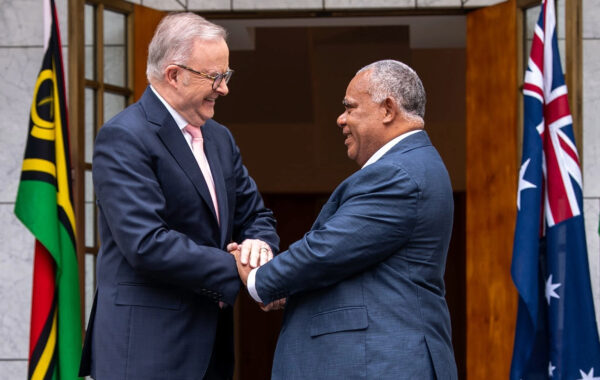
Australia and Vanuatu Sign Security Pact to Counter China's Influence
Diplomacy
2026年6月30日
7
The Diplomat Indonesia

Australia and Vanuatu Sign Security Pact to Counter China's Influence

AI サマリー

Australia and Vanuatu have signed the Nakamal Agreement, a new security pact. Australia aims to strengthen its regional leadership amidst concerns over China's growing influence, but the agreement respects Vanuatu's independence.

Read The Diplomat, Know The Asia-Pacific The Nakamal Agreement between Australia and Vanuatu may be weaker than Canberra’s other regional pacts, but it remains significant in checking China’s influence. This week, Australian Prime Minister Anthony Albanese and his Vanuatu counterpart, Jotham Napat, signed the Nakamal Agreement, a new security relationship between the two countries. While this is the latest in a series of agreements that Canberra has struck with Pacific Island countries, it is noticeably weaker – in Australia’s eyes – than the others, given Vanuatu’s strong streak of independence and desire to remain open to potential opportunities with other major regional actors. The motivating force behind Australia’s series of regional agreements is Canberra’s concern about Chinese influence in the Pacific. Australia has sought to formally entrench its position as the security partner of choice, and to give itself a veto over foreign (read Chinese) involvement in critical infrastructure projects in the region like ports, airports, and telecommunications systems that could potentially have dual-use purposes. However, domestic resistance in Vanuatu to Australia’s agenda meant that the agreement was initially delayed, and then revised into one more palatable to Port Vila. The final version removes the proposed restraints on third-party investment in Vanuatu. Instead of requiring Australian approval for foreign participation in critical infrastructure, the agreement only requires consultation with Australia – although crucially there is a commitment for this infrastructure to be “free from militarization, any form of foreign interference or unauthorized access.” Even if this may not entirely calm Canberra’s anxieties about Chinese investment in the region, it still provides Australia with significant input into sovereign decisions in Vanuatu. Despite this softening, the agreement establishes Australia as Vanuatu’s primary security partner. This includes commitments to ongoing cooperation in policing, maritime security, disaster response, and institutional capacity-building – reinforcing Australia’s role as the main security provider and development partner in the Pacific. The agreement also includes provisions aimed at strengthening coordination on humanitarian assistance and crisis response, which are particularly important given Vanuatu’s vulnerability to cyclones, earthquakes, and other natural disasters. Central to negotiations was the issue of labor mobility. Vanuatu citizens have access to Australia Pacific Australia Labor Mobility Scheme (PALM), but Port Vila had been keen to expand labor rights in Australia, seeing it a key opportunity for both skills enhancement and remittances. However, despite Australia still having a shortage of agricultural labor, Canberra remains cautious about expanding work rights outside of the PALM scheme. Primarily, Australia was concerned about the potential effects of Vanuatu’s citizenship-by-investment scheme, and how this may create pathways to Australia for people not properly vetted if labor mobility were expanded. The Nakamal Agreement contains the provision that “Vanuatu shall develop effective mechanisms to differentiate citizenship-by-investment from other forms of citizenship.” For Australia, the Nakamal Agreement is part of a broader strategy to maintain influence in the Pacific amid increasing competition with China. Canberra has been constructing a web of new security relationships in the region that are designed to maintain its primacy. Recent security agreements have been signed with Papua New Guinea, Tuvalu, and Nauru. An upgrade to the Vuvale Partnership with Fiji is being negotiated, and the Solomon Islands’ new prime minister, Matthew Wale, has signaled an intention to negotiate a new comprehensive strategic treaty. Australia is increasingly combining security cooperation with development assistance, climate change resilience, and the PALM scheme into a comprehensive regional engagement strategy designed to build multifaceted habits of cooperation. The Nakamal Agreement includes long-term financial commitments from Australia, reportedly amounting to hundreds of millions of dollars over the coming decade, which are intended to support infrastructure, governance, and capacity-building in Vanuatu. This reflects a recognition that economic development and climate resilience are central to maintaining Australia’s influence in the region. However, as the Nakamal Agreement demonstrated, there is a limit to how ideal in Canberra’s eyes these security pacts can be. Defending their sovereignty is paramount to Pacific Island countries. Although these may be small states, they have proved adept at being able to use strategic competition in the region to secure their interests. Australia may be a trusted partner keen to invest what it can in the region, but this doesn’t mean that Pacific Island countries should limit themselves to exclusivity with Canberra. Negotiations are never going to produce optimal outcomes. It is likely that Canberra was aware going into negotiations that a veto over third-party investment in Vanuatu’s critical infrastructure was likely to be asking too much. The compromise of consultations on such investments remains a significant strategic win. While the Nakamal Agreement reaffirms Australia’s position as Vanuatu’s primary security partner, there is a need to be wary in Canberra that overplaying its hand may undermine its position as it continues to enhance its regional primacy. Subscribe today and join thousands of diplomats, analysts, policy professionals and business readers who rely on The Diplomat for expert Asia-Pacific coverage. Get unlimited access to in-depth analysis you won't find anywhere else, from South China Sea tensions to ASEAN diplomacy to India-Pakistan relations. More than 5,000 articles a year. Already have an account? Log in. Grant Wyeth is a Melbourne-based political analyst specializing in Australia and the Pacific, India and Canada. Get briefed on the story of the week, and developing stories to watch across the Asia-Pacific.

多角的分析

経済的影響

ナマカル協定におけるオーストラリアからの長期的な財政支援(数億ドル規模)は、バヌアツのインフラ、統治、能力構築に直接的な経済的恩恵をもたらす。これは、単なる安全保障協力にとどまらず、経済開発を通じた地域への影響力維持というオーストラリアの戦略を示唆している。一方で、バヌアツの投資による市民権取得制度と労働移動の連携に対するオーストラリアの懸念は、両国間の経済的相互依存における潜在的なリスク要因であり、将来的な労働市場への影響や、バヌアツ経済における外国直接投資の質と量に影響を与える可能性がある。

投資家心理

この協定は、バヌアツの重要インフラへの投資機会において、オーストラリアの関与が不可欠となることを示唆している。投資家、特に中国系企業にとっては、直接的な投資のハードルが上がる可能性がある。オーストラリアは、自国の関与を前提としたインフラ開発を推進する意向であり、これは、透明性や国際基準に沿った投資環境を求める投資家にとってはプラスに働く可能性がある一方、迅速な意思決定や柔軟な投資条件を求める投資家にとっては、新たな制約となることも考えられる。協定に含まれる「非軍事化」条項は、インフラ投資のリスク評価において重要な要素となる。

社会的影響

ナマカル協定は、バヌアツ国民のオーストラリアへの労働移動、特に労働者の権利拡大という点で、社会的な側面も持つ。バヌアツ市民にとっては、技能向上と本国送金による生活水準の向上という期待がある。しかし、オーストラリア側の慎重な姿勢は、これらの機会が限定的になる可能性を示唆しており、バヌアツ国内の若年層や労働力層の期待との間に乖離が生じる可能性がある。また、投資による市民権取得制度に関する条項は、バヌアツ国内における「市民」とは何か、その資格と恩恵の分配に関する社会的な議論を喚起する可能性がある。

市民の声

バヌアツ市民、特に労働力としてオーストラリアへの移住を希望する人々にとって、この協定は希望と同時に不確実性をもたらす。オーストラリアの労働力不足は、彼らにとって機会となる一方で、労働権の拡大が限定的であるという事実は、期待通りの待遇や機会が得られない可能性を示唆している。また、協定における「投資による市民権取得」と通常の市民権取得の区別に関する条項は、バヌアツ国内で、誰が真の市民であり、どのような権利を持つべきかという、市民間の公平性やアイデンティティに関する議論を深めるきっかけとなるかもしれない。

背景・歴史的文脈

太平洋地域における中国の影響力拡大は、2010年代後半から顕著になった。特にソロモン諸島との安全保障協定締結は、オーストラリアと米国に強い危機感を与え、地域における中国の軍事的・経済的プレゼンスへの警戒を一層強めた。これに対し、オーストラリアは、パプアニューギニア、ツバル、ナウルなど、次々と太平洋島嶼国との安全保障・開発協定を締結し、地域における影響力を維持・強化する戦略を加速させている。バヌアツとのナマカル協定は、こうしたオーストラリアの広範な地域戦略の一環であり、中国の進出を牽制しつつ、バヌアツの独立性を尊重する形での関係構築を目指したものである。

原文ソース

The Diplomat Indonesia

原文を読む