General articles are free for 24 hours after publish.
Galapagos' 'Mini Godzilla': The Marine Iguana, a Seaweed Eater
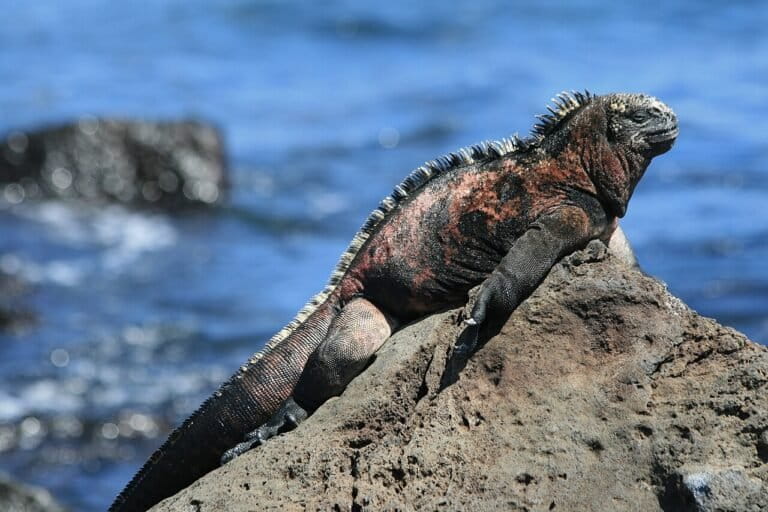
Residing in the Galapagos Islands off the coast of Ecuador, the marine iguana's dark skin and spiky dorsal scales evoke comparisons to 'Godzilla.' Despite its fearsome appearance, this reptile is a herbivore, feeding primarily on seaweed.
Residing in the Galapagos Islands, over 900 kilometers off the coast of Ecuador, is a unique reptile often dubbed a 'mini Godzilla.' This is the marine iguana (Amblyrhynchus cristatus), an endemic species characterized by its dark gray skin, a row of pyramid-shaped scales along its back, and sharp claws, giving it a formidable appearance. Despite its fearsome look, the marine iguana is not a carnivore but a herbivore, feeding primarily on algae and seaweed. It is the only lizard species that forages in the sea, diving to depths of up to 30 meters in search of food. These iguanas can grow up to 1.2 meters long, with a flattened tail aiding their agile swimming. As ectothermic animals, marine iguanas rely on ambient temperatures for thermoregulation. Consequently, they cannot stay in cold water for extended periods and must return to land to bask in the sun after diving. Their bodies also possess glands that help filter and excrete excess salt, a crucial adaptation for their marine lifestyle. The iguana's reliance on algae makes it highly vulnerable to changes in sea temperature. During events like El Niño, rising water temperatures can cause a decline in their primary food sources, red and green algae, while brown algae, which are harder to digest and potentially toxic, may proliferate. Food scarcity can lead to significant population declines for the marine iguana. Source: Mongabay Indonesia
Original source
Mongabay Indonesia