General articles are free for 24 hours after publish.
Cambodia's SDF Highlights Skills Development for Economic Growth at Productivity Seminar
Cambodia's Skills Development Fund (SDF) emphasized the importance of industry-aligned skills training and outcome measurement at a labor productivity seminar. The fund has supported over 100,000 trainees through public-private co-financing, achieving an 88% employment rate and 89% employer satisfaction, while also investing in digital and advanced technologies.
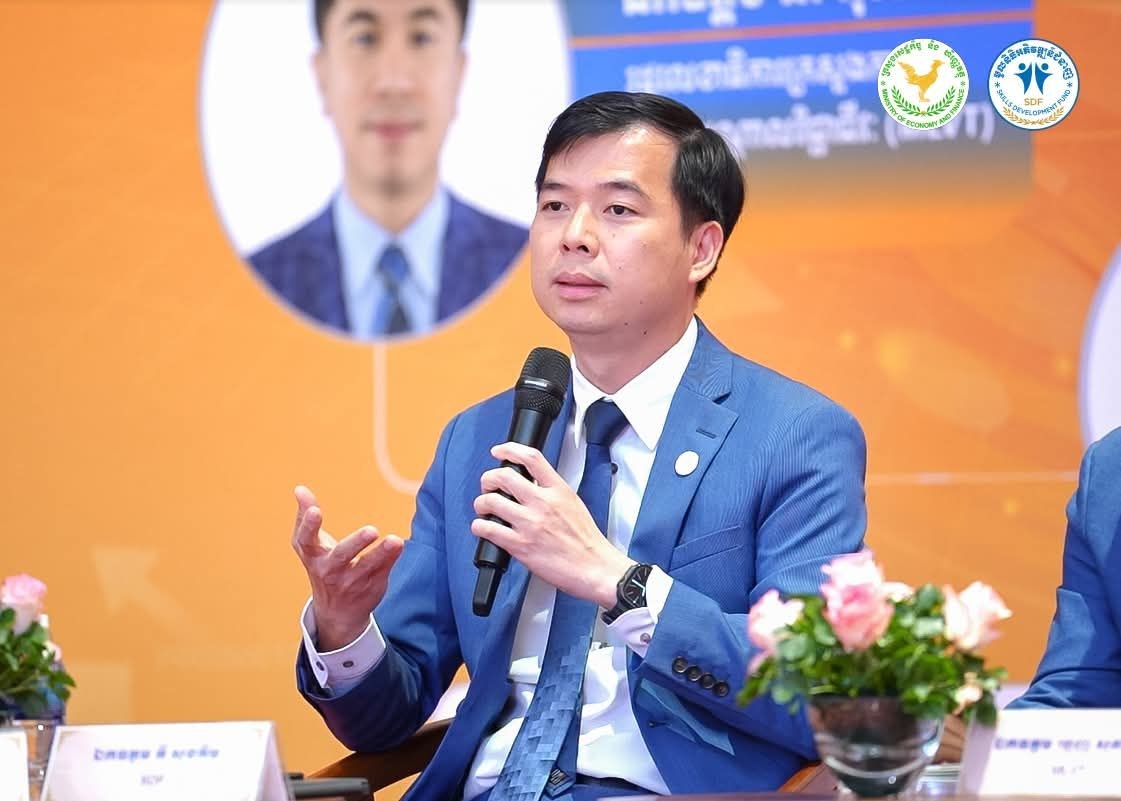
Mr. Ki Sokkim, Executive Director of the Skills Development Fund (SDF) of the Ministry of Economy and Finance, participated as an honorary guest speaker in the "2026 Labor Productivity Seminar." The seminar was organized by the Ministry of Labor and Vocational Training as part of the 2026 National Labor and Productivity Fair, held on September 13, 2026, at the Koh Pich Convention and Exhibition Center. During the discussion on the theme "Skills and Labor Productivity for Sustainable Economic Growth," Mr. Ki Sokkim emphasized that the "true value of training lies not only in the number of trainees or certificates but in the actual employment, increased income, and tangible improvement in business productivity." The SDF acts as a co-financing mechanism between the state and the private sector, transforming practical business challenges into solutions for skills, employment, and productivity. The SDF's strategies and key results in promoting productivity and skills development include: 1) Training responsive to industry needs: SDF starts from "business problems," with the private sector identifying the actual skill requirements. As of early September 2026, SDF has approved training for over 101,500 trainees, with total training costs amounting to approximately $50.8 million USD. SDF contributes an average of 54%, while the private sector contributes 46% towards enhancing skills, developing new skills, and pre-employment training. 2) Measuring actual labor productivity and outcomes: SDF monitors results from problems to final business impacts. Results show an 88% employment rate, a 96% completion rate, and an 89% satisfaction rate from employers. 89% of enterprises reported increased productivity or business outcomes, and 83% achieved positive returns on investment, helping to increase individual employee income by an average of 27% after SDF-supported training. 4) Support for digital and technological skills: The digital sector received approximately 21% of the approved training budget, supporting 17,859 trainees in advanced technological skills such as AI, data analytics, and automation. Concurrently, SDF collaborates with international partners, sending 166 Cambodian master trainers to receive high-level technological training in areas like Electric Vehicle Repair and Maintenance, Industrial Robotics, Digital Construction, and PLC in China. The goal is to transfer this knowledge to at least 2,000 students and workers by 2029. "The true value of partnership is transforming it into practical action." The Skills Development Fund (SDF) is committed to continuing close cooperation with the private sector to meet skill demands in both quality and quantity, aligning with industry needs to build a highly productive workforce and contribute to sustainable economic growth. By: Noy Noon (Source: SDF) © All rights reserved by National Khmer News Agency 2018
Original source
AKP Khmer