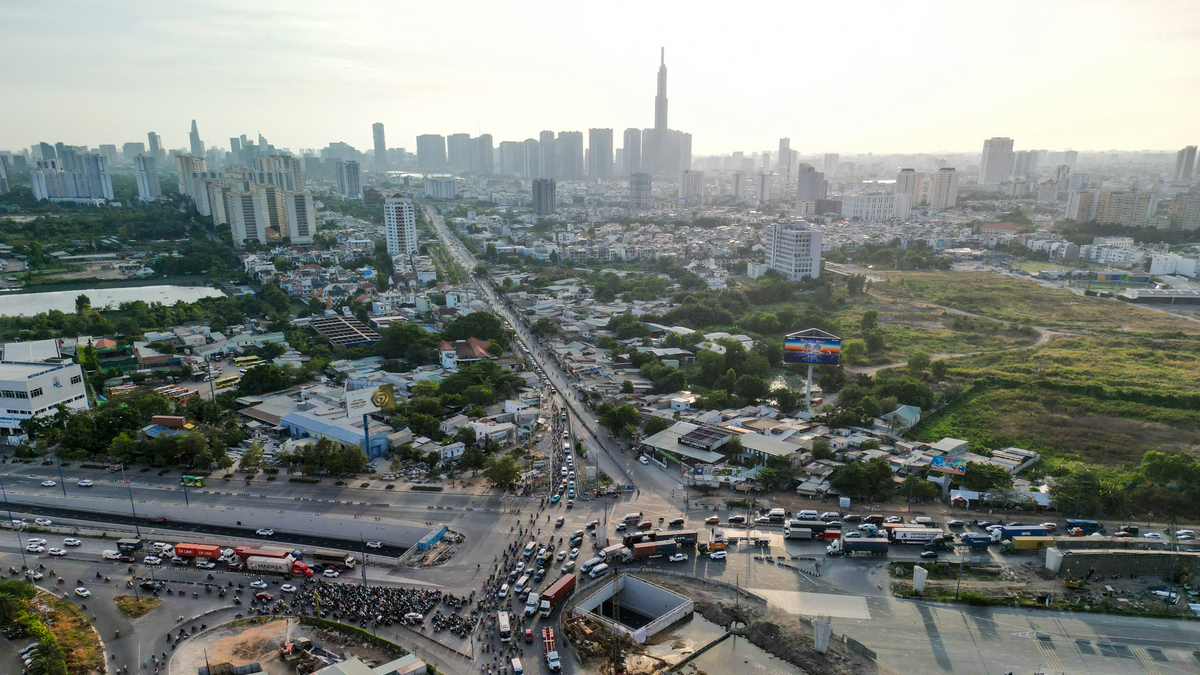
Ho Chi Minh City's Largest Interchange Faces Year-Long Delay Due to Land Acquisition Issues
The An Phu intersection project in Ho Chi Minh City, with a total investment of over VND 3.4 trillion (approx. $133 million), has had its completion deadline pushed back to the third quarter of 2027 due to a delay in acquiring 2.2 hectares of land. This marks the second postponement for the project.
The completion of the An Phu intersection project in Ho Chi Minh City, one of the city's largest infrastructure developments, has been postponed by another year due to ongoing land acquisition issues. The project, with a total investment exceeding VND 3.4 trillion (approximately $133 million), now targets completion in the third quarter of 2027. This marks the second delay for the An Phu intersection, which was initially slated for completion by the end of 2025 and later rescheduled to the second quarter of this year. A representative from the Ho Chi Minh City Traffic Construction Investment Project Management Board, the project's investor, cited the primary reason for the delay as the failure to hand over more than 2.2 hectares of land along Luong Dinh Cua Street. This parcel is crucial for the construction of the N1.2 elevated bridge section, which will connect Luong Dinh Cua Street to the Ho Chi Minh City-Long Thanh-Dau Giay Expressway. The 2.2-hectare area involves approximately 64 households and organizations requiring compensation and relocation. The land is simultaneously linked to three other projects: the An Phu Development Urban Area, the expansion of Luong Dinh Cua Street, and the An Phu intersection itself. Legal complexities surrounding compensation and land clearance have persisted for over a decade, creating a significant bottleneck for all related construction efforts. Following a site inspection and directives from the Chairman of the City People's Committee in March, the city issued a plan for compensation, support, and resettlement for this land parcel, mandating its completion by November 30 this year. Once the land is cleared, contractors will proceed with relocating technical infrastructure such as electricity and water supply to commence construction of the N1.2 bridge and widen Luong Dinh Cua Street. If the land is handed over as planned, the N1.2 bridge section is expected to be completed within approximately five months. The entire An Phu intersection is projected to be finished by the second quarter of 2027, with final handover and settlement in the third quarter of the same year. For components not affected by land acquisition, the investor stated that contractors are focusing on construction to enable partial operation. The N4 bridge, allowing right turns from Dong Van Cong Street onto Mai Chi Tho Street, is anticipated to open by the end of July. The N1.1 bridge, enabling left turns from Mai Chi Tho Street towards Vo Nguyen Giap Street onto the Ho Chi Minh City-Long Thanh-Dau Giay Expressway, is scheduled for operation in early October. Ancillary works, including landscaping and the installation of cameras and auxiliary structures, are targeted for completion in November. The An Phu intersection project broke ground in 2022 with an investment exceeding VND 3.4 trillion. The project features a three-level design, including an underpass and multiple overpasses connecting surrounding major roads. Several sections have already been completed and opened to traffic, such as the overpass for right turns from the expressway onto Mai Chi Tho, the two-way underpass connecting Mai Chi Tho to the expressway, the left-turn bridge from Mai Chi Tho into Dong Van Cong, and the Ba Dat and Giong Ong To bridges. Located at the eastern gateway of Ho Chi Minh City, the An Phu intersection connects the Ho Chi Minh City-Long Thanh-Dau Giay Expressway with Mai Chi Tho, Luong Dinh Cua, Nguyen Thi Dinh, and Dong Van Cong streets. It also serves as a crucial link to Cat Lai Port and connects to Dong Nai province, frequently experiencing severe traffic congestion, especially during peak hours. The continued delays raise concerns about increased traffic pressure at the eastern gateway, particularly with the Long Thanh International Airport expected to commence operations later this year. Information Source: VnExpress
多角的分析
アンフー環状交差点プロジェクトの遅延は、ホーチミン市東部玄関口の交通インフラ整備における構造的な課題を浮き彫りにしている。2.2ヘクタールという比較的小さな用地取得に10年以上を要し、複数のプロジェクトが絡む複雑な状況は、ベトナムにおける大規模開発プロジェクトの実行における典型的なリスク要因を示唆している。これは、インフラ投資の効率性と、それが地域経済の成長に与える影響の観点から懸念材料となる。特に、ロンタン国際空港の開港が近づく中、この遅延は物流や観光客の移動にも影響を与える可能性がある。
投資家にとって、この遅延はプロジェクトのROI(投資利益率)に直接的な影響を与える。建設期間の長期化は、追加の資金調約コストや、当初見込んでいた収益化の遅れを意味する。特に、ベトナムのインフラプロジェクトは、用地取得や許認可プロセスにおける予見不可能な遅延が頻繁に発生するため、投資家はプロジェクトの初期段階からリスク管理を徹底し、バッファを持った計画策定が不可欠である。また、複数のプロジェクトが絡む土地問題は、単一のプロジェクトだけでなく、関連プロジェクト全体の進行にも影響を及ぼしうるため、包括的なアプローチが求められる。
2.2ヘクタールの用地には64の世帯と組織が存在し、10年以上にわたり補償・立ち退き問題が解決されていない状況は、住民の生活に多大な影響を与えている。長期にわたる不確実性は、住民の不安を増大させ、地域社会の安定を損なう可能性がある。また、この遅延は、東部玄関口の交通渋滞を悪化させ、通勤や物流の効率を低下させることで、市民の日常生活やビジネス活動にも間接的な影響を及ぼしている。公共事業の遅延が、住民の生活の質や経済活動に与える負の影響は大きい。
ホーチミン市東部玄関口の住民や通勤者は、アンフー環状交差点の遅延によって、慢性的な交通渋滞の悪化という直接的な影響を受けている。特に、ラッシュアワーには、この地域を通る主要道路での移動時間が大幅に増加し、日常生活に支障をきたしている。また、ロンタン空港の開港が近づくにつれて、この地域への交通量が増加することが予想されるため、将来的な交通状況への懸念も高まっている。10年以上続く用地取得問題は、住民の不満や行政への不信感につながる可能性もある。
背景・歴史的文脈
アンフー環状交差点プロジェクトは、ホーチミン市の東部地域における交通インフラのボトルネック解消を目指して2022年に着工した。総投資額3兆4000億ドン(約210億円)という巨額プロジェクトであり、ホーチミン市-ロンタン-ダウゼイ高速道路と主要幹線道路を結び、カッライ港やドンナイ省へのアクセスを改善する役割を担う。しかし、プロジェクトの根幹をなす2.2ヘクタールの用地取得が、10年以上にわたり進展していない。この土地は、複数の開発プロジェクト(アンフー開発都市区、ルオン・ディン・クーア通り拡幅、アンフー環状交差点)にまたがっており、住民や組織の移転補償に関する法的な複雑さが、遅延の主因となっている。市当局は解決に向けた計画を打ち出しているが、過去の経緯から、その実行には不確実性も残る。
原文ソース
VnExpress