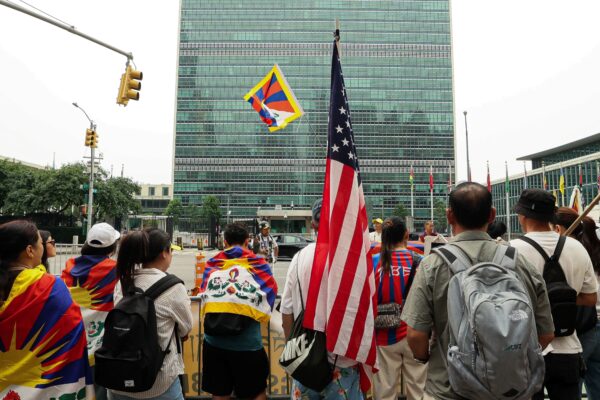
Tibetan Self-Immolation Outside UN Highlights Fading International Focus on Tibet
Diplomacy
2026年7月22日
5
The Diplomat Indonesia

General articles are free for 24 hours after publish.

Tibetan Self-Immolation Outside UN Highlights Fading International Focus on Tibet

Share
AI Summary

A Tibetan activist's self-immolation outside the UN headquarters has highlighted the declining international attention to the Tibet issue. Limited responses from the UN and governments have underscored the long-standing frustration within the Tibetan community.

On July 2, Lobga Rangzen, a 52-year-old Tibetan activist, set himself on fire outside the United Nations headquarters in New York. Dressed in traditional Tibetan clothing and planting a Tibetan flag, his final act was livestreamed on Facebook, intended to draw attention to Tibet’s decades-long struggle under Chinese rule. This incident is the first known self-immolation by a Tibetan on U.S. soil. Rangzen was born in Tibet and fled to India in the 1990s, where he lived as a monk before immigrating to the United States in 2006. He became an active member of New York’s Tibetan community. His protest came one day after China implemented its Law on Promoting Ethnic Unity and Progress. Amnesty International stated that this legislation further institutionalizes assimilation policies targeting Tibetans, Uyghurs, and other ethnic minorities, while expanding the legal basis for transnational repression. Despite Rangzen’s choice of a prominent international diplomatic symbol, the response from the United Nations was limited. A UN press briefing spokesperson described the incident as "absolutely tragic" and expressed condolences, but did not mention Tibet or the political message behind the protest. Beyond this brief acknowledgment, neither the United Nations nor most governments issued substantive public responses. For many Tibetans, this silence reinforced their frustration. Tenzin Dorjee, a researcher at the Tibet Action Institute and lecturer in political science at Columbia University, stated, "The UN is the institution that is supposed to represent the international community’s promotion of peace, defense of human rights, and protection of cultural rights. I think he went to the UN because it was an appeal to the international community." He added, "The fact that the UN spokesperson refused to mention Tibet reaffirms the suspicion of the Tibetan community that the UN has been silent on the Tibet issue." Amnesty International was among the few international human rights organizations to publicly respond, with Sarah Brooks, Amnesty International’s deputy regional director for Asia, stating, "Self-immolation as a protest by Tibetans has persisted for many years, and it does not happen in a vacuum. It reflects the depth of desperation felt by people who see no other way to draw attention to ongoing human rights violations." New York Mayor Zohran Mamdani also acknowledged Rangzen’s protest, writing on X, "No one should feel that such a desperate act is the only way to make the world listen. New York stands for the dignity and human rights of all people." Although Rangzen’s self-immolation garnered international headlines immediately after July 2, attention quickly faded. Nevertheless, demonstrations continued, with Tibetans in New York gathering regularly outside the United Nations and the Chinese Consulate, and solidarity protests organized in India, Europe, and across the United States. For many activists, the brief media attention underscored the challenge of keeping Tibet on the international agenda. Three Tibetan youth activists from Students for a Free Tibet chained themselves to the UN headquarters entrances, demanding a public address on Rangzen’s protest and human rights concerns in Tibet. They blocked UN vehicles before being arrested on charges of disorderly conduct and refusal to disperse. Hundreds of Tibetans gathered outside the UN in support. Tsela Zoksang, campaigns director at Students for a Free Tibet, one of those arrested, stated, "His final act took place outside of the United Nations, a building that generations of Tibetans have stood outside of for 67 years in exile, calling on it to uphold its mandate of protecting peace, freedom, and human rights. In the case of Tibet, it has failed miserably." Dorjee views the UN's responses as "inadequate, for sure, but they are not ineffective." He points to the General Assembly’s adoption of resolutions on Tibet and UN human rights experts raising concerns in 2023 over the separation of an estimated one million Tibetan children into state-run boarding schools. While these interventions have produced few immediate policy changes, Dorjee argues that even limited statements from international institutions "deny legitimacy to the Chinese government" and "deny legitimacy to Chinese rule over Tibet." Many Tibetan advocates and scholars believe the UN’s muted response reflects a broader trend: Tibet’s steady recession from the UN’s political agenda alongside China’s growing influence within international institutions. This concern extends beyond Tibetan advocacy groups, as evidenced by a March 2026 report by the U.S. House Select Committee on the Chinese Communist Party, which argued that Beijing has expanded its influence across international organizations. Information Source: The Diplomat Indonesia

0

Original source

The Diplomat Indonesia

原文を読む