General articles are free for 24 hours after publish.
Unique Halmahera Goby 'Stiphodon annieae' Faces Declining Numbers, Highlighting Urgent Need for Estuary Ecosystem Conservation
The endemic 'Stiphodon annieae' goby fish, discovered in Indonesia's Halmahera, is showing a declining population. This unique species relies on both freshwater rivers and the sea for its life cycle, making the connection between these ecosystems crucial for its survival.
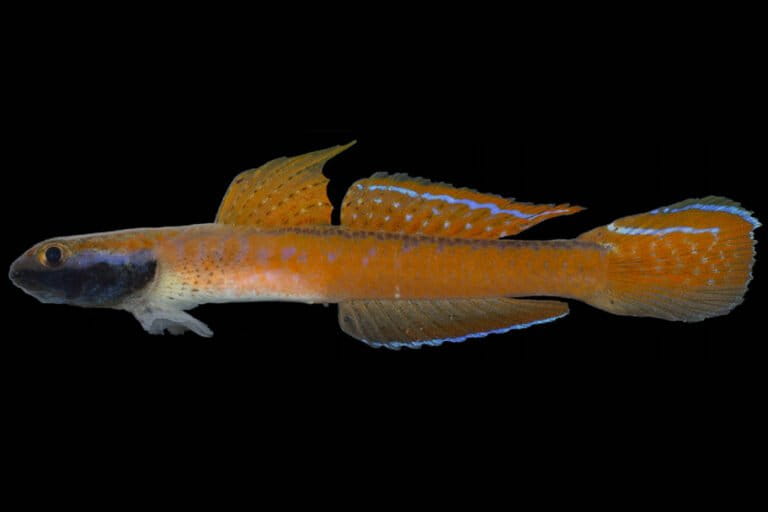
The population of the endemic freshwater fish Stiphodon annieae, discovered in Halmahera, North Maluku, Indonesia, is reportedly declining, according to local researchers. This fish possesses a unique life cycle as an amphidromous species, relying on both freshwater rivers and the sea. Stiphodon annieae was first identified on January 22, 2010, in the Wosea River, Sawai Village, Central Weda, Central Halmahera. This discovery was the result of joint research by the Indonesian Institute of Sciences (BRIN) and the Muséum National d’Histoire Naturelle in Paris, France. Physically, S. annieae is characterized by 14 pectoral fin rays and nine dorsal fin rays, with a scaleless head and neck. Male individuals can be distinguished by their bright red coloration with blue spots and patterns on their backs. The primary uniqueness of this fish lies in its amphidromous life cycle. Eggs hatch in rivers, and the larvae are then carried by the current to the sea. After developing, the fish return to freshwater habitats and live there until they mature and reproduce. This means their survival is dependent on an unbroken connection between rivers and the sea. North Maluku waters are a significant area for goby fish distribution. Several rivers in Central Halmahera, such as the Sagea River, Ake Sawai River, DAS Kobe River, and the Muara Sungai Waibulen, are habitats for various Halmahera endemic fish, including S. annieae. However, Iwan Kader, a lecturer at the Faculty of Fisheries, Khairun University Ternate, stated that S. annieae is becoming increasingly difficult to find, indicating a potential decline in its population. Initially, S. annieae was thought to have a very narrow distribution range, being known only from Halmahera. Subsequent research, however, found the fish in Luwuk Banggai, Central Sulawesi, approximately 500-600 kilometers west of Halmahera. The research team collected 23 specimens from three unconnected coastal rivers in Luwuk Banggai. This finding suggests that S. annieae may have a wider distribution than initially believed. The decline in S. annieae populations could be a sign of broader environmental issues affecting both riverine and marine ecosystems, such as habitat degradation, pollution, or fragmentation. Ensuring the health of both environments is crucial for the future of this unique fish species.
Original source
Mongabay Indonesia