Kindness at Kulen Health Centre: A Traveler's Unforgettable Experience
Health
2026年7月25日
4
Phnom Penh Post

General articles are free for 24 hours after publish.

Kindness at Kulen Health Centre: A Traveler's Unforgettable Experience

Share
AI Summary

A traveler recounts an unexpected encounter at a small health center in Kulen, Cambodia, while en route to Ratanakiri. Despite language barriers, the author and her son were deeply touched by the selfless kindness of both staff and fellow patients, experiencing the profound human warmth of Cambodia.

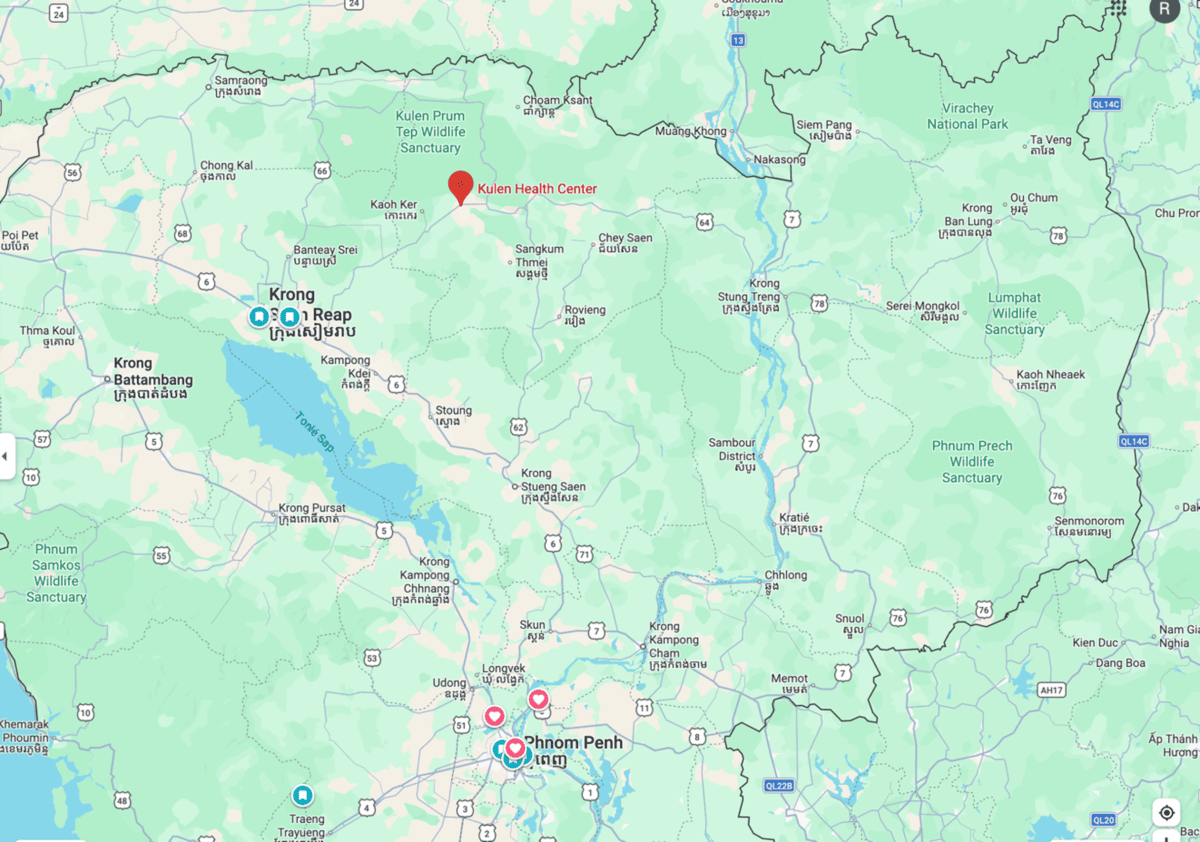
My son and I left Siem Reap just after sunrise, embarking on a seven-hour car journey to Ratanakiri, a province we had never visited before. Our early start was intended to ensure we arrived before dark and had time to settle in. Over breakfast, my son quietly mentioned he wasn't feeling well, but dismissed it as a "morning thing." He insisted he was fine, so we proceeded with our journey. About an hour later, he asked to stop. Then another stop. Then another. Each time, he looked paler and more tired. The quiet anxiety that grips travelers in Southeast Asia when hours away from the nearest city, with an unwell child and no knowledge of the closest doctor, began to set in. We passed villages, but no large towns for a considerable distance. We stopped at a small pharmacy and inquired about a nearby clinic. The pharmacist directed us to Kulen Health Centre. At that moment, our holiday plans vanished, replaced by a simple hope for help. The health centre was situated within a large compound, featuring several small buildings. A nurse greeted us with a warm smile and quickly called for a doctor, who appeared almost immediately. He examined my son and checked his blood pressure, which was 90 over 60. The doctor calmly explained our options: medication or admission for observation. Unsure of what to do in this unfamiliar place, my initial thought was to take medicine and continue driving towards a larger town with more extensive medical facilities. The doctor provided three days' worth of medicine. When I asked about the cost, he simply smiled and said, "It is free." My son, now exhausted and drained, whispered, "I just want to lie down." I asked if there was a place for him to rest. The doctor gently replied, "If he needs to lie down, we should admit him." With little choice, we followed him to a smaller building. Inside was a room with several beds, most occupied. Fortunately, one bed was available. The moment my son saw it, he lay down without looking around. That was when I realized this was more than just an upset stomach. I asked about intravenous (IV) fluids. The doctor suggested waiting to see if the medicine worked, but given our long drive ahead, I asked to proceed. He understood. The room was warm, lacking air conditioning, and the ceiling fan was too distant to be effective. Without a word, the woman in the next bed handed me her krama. She smiled and showed me how to use it as a fan and to gently keep flies away from my son. Initially, they thought we were a couple, but when they realized we were mother and son, something shifted. Someone brought me a chair. Another found me a bottle of water. Periodically, patients would approach, gently place a hand on my son's forehead to check his temperature, offer a reassuring smile, and return to their beds. No one was obligated to do this, yet they did. Only a few could speak a little English, and my Khmer is very limited. We couldn't have a proper conversation, yet we understood each other perfectly, not through language, but through kindness. What I remember most were their eyes, conveying a silent message: "We know you're worried." "We know you're far from home." "Your son will be alright." "We're here." This reassurance was more profound than any medicine could offer. A short while later, she returned with what appeared to be a brand-new standing fan, still in its packaging, along with an extension cord. She unpacked it, plugged it in, and placed it beside my son's bed. It was powerful enough to cool not only him but several beds around us. I often think about that fan. I wanted to ask where it came from, but I couldn't bring myself to, fearing she might have bought it specifically for us, a gesture I wouldn't know how to repay. Instead, I accepted her kindness with a grateful heart. About an hour later, my son woke up and vomited twice. Strangely, this seemed to be the turning point. For the first time that morning, he smiled and said, "I'm hungry." I managed to find some grilled fish nearby – soft, simple, and exactly what he needed. With medicine, food, and rest, color slowly returned to his face. When we were ready to leave, I asked the nurse about the bill. "Ten dollars," she replied. "For everything?" She nodded. Curious, I asked about the other patients. She explained that those with a government health card received free treatment, while others paid ten dollars. I looked around the room; only four other patients needed to pay. I quietly asked the nurse if I could cover their medical fees as well. She looked at me with surprise. "Are you sure?" "I'm very sure." Compared to everything they had already given us, it felt like the smallest gesture I could make. I asked her not to announce it, trusting her completely. A few moments later, she walked back into the ward and happily announced that the medical fees for the four patients had been paid. I wished the ground would swallow me. I quietly slipped into the nurse's office, hoping to avoid attention. Instead, I heard voices: "Auk-kun..." And another. Soon, the whole room was thanking us. I stepped back out, smiled awkwardly, and bowed my head. I wished I could speak enough Khmer to convey my true feelings: that they had already given us far more than I could ever repay. Before we left, the doctor handed my son a small health card, explaining that we could present it at any public health center for medical assistance during the rest of our journey through Cambodia. Holding that card, I felt a sense of reassurance I hadn't realized I needed. We still had hours of driving ahead, but somehow, I no longer felt alone. It wasn't just a medical card; it was the doctor's quiet way of saying, "Continue your journey." "If you need us again, we're here."

0

Original source

Phnom Penh Post

原文を読む