General articles are free for 24 hours after publish.
India, China Agree to Continue Border Talks, Identify Less Contentious Areas
India and China have agreed to identify and demarcate less contentious areas of their disputed border as a step toward resolving their long-standing dispute, following special representative talks in Beijing. The establishment of new military hotlines was also decided, aiming to ease tensions.
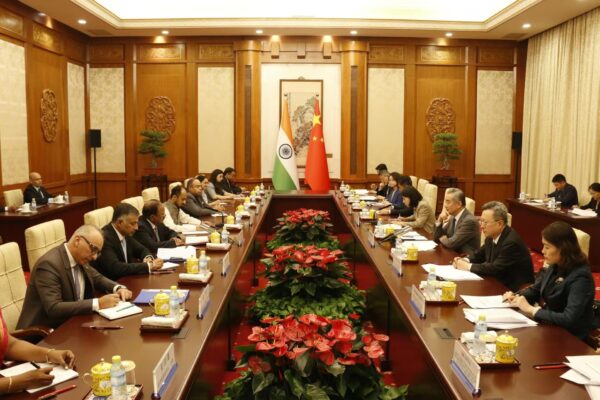
India and China have taken a limited step forward toward resolving their longstanding border dispute, agreeing to work on identifying and demarcating less contentious sections of their contested border. This agreement was part of the broader process toward resolving the dispute, as stated in a joint statement released on August 26, following the 25th Meeting of Special Representatives on the India-China Boundary Question held in Beijing. The talks involved India's National Security Advisor Ajit Doval and China's Foreign Minister Wang Yi, who serve as the special representatives for the boundary talks mechanism established in 2003. At the meeting, both sides also agreed to establish two new military hotlines in the eastern and middle sectors of their border and two new meeting points for military commander-level interactions to promptly address any tensions that arise along their 3,500 km-long border. This move aims to foster progress in bilateral relations, which had sunk to a six-decade low following the June 2020 Galwan clash. The joint statement emphasized that "any situation on the ground would be addressed promptly through existing diplomatic and military channels," highlighting a focus on stabilizing the border and defusing tensions before they impact the larger relationship. A key outcome was the agreement to "improve understanding of LAC [Line of Actual Control] in appropriate areas, for better border management," which is significant given that differing perceptions of the border's location have been a primary source of friction. Both countries reiterated their commitment to maintaining peace and tranquility along the border and creating "an atmosphere for healthy and steady development of bilateral relations." India has consistently maintained that peace on the border is a prerequisite for progress in other areas of bilateral engagement, such as economic ties. The talks occur against a backdrop of a global order perceived as increasingly unstable, with the United States seen as an inward-looking and unreliable partner. India, which previously viewed the U.S. as a hedge against China's growing assertiveness, has been affected by recent protectionist measures. Consequently, India is pursuing an "America Plus" strategy, which includes outreach to countries like Japan, the European Union, Russia, and China. C. Uday Bhaskar, Director at the Society for Policy Studies think tank in New Delhi, noted that a joint statement after such talks is "rare" and that the eight-point text agreed upon signals "political intent at the highest level to lock in stability ahead of a packed fortnight." However, he also pointed out that the delay in issuing the document reflects the "deeply embedded wariness" that defines current China-India relations. The Doval-Wang talks set the stage for upcoming meetings between Chinese President Xi Jinping and Indian Prime Minister Narendra Modi at the Shanghai Cooperation Organization (SCO) Summit in Bishkek (August 31-September 1) and the BRICS Summit in New Delhi (September 12-13). Xi is expected to visit India for the BRICS meet, marking his first visit since 2019. Efforts to de-escalate tensions along the LAC began in 2024 with the announcement of troop pullback from close proximity in Eastern Ladakh. While troops are disengaged, they have not yet returned to peacetime positions, meaning deployments have not been fully de-escalated. Furthermore, both countries are exploring new avenues to facilitate business-to-business exchanges, with India aiming to attract Chinese investments. Some announcements related to this could be made during Xi's visit to New Delhi. Information source: The Diplomat Indonesia
Original source
The Diplomat Indonesia