General articles are free for 24 hours after publish.
Bangkok Port to Relocate to Rayong, Aiming for Commercial Development and Logistics Efficiency
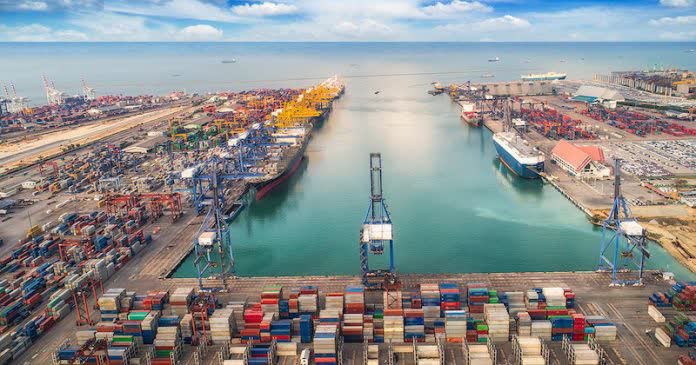
The Thai government aims to fully relocate Bangkok Port (Khlong Toei) operations to Laem Chabang in Rayong province. This move is intended to boost commercial development in the port area and increase revenue for the Port Authority of Thailand (PAT). Certain operations, like fresh food transport, will be studied individually.
Deputy Prime Minister and Transport Minister Phiphat Ratchakitprakarn confirmed the government's goal to fully cease operations of Bangkok Port in Klong Toei and shift them to Laem Chabang in Rayong province. This move is intended to allow for commercial development of the area, thereby generating significantly more revenue for the Port Authority of Thailand (PAT) than is currently possible. However, for certain operations such as the transport of fresh food or fruit requiring rapid handling, each case will be studied individually. PAT management has been instructed to review the original intent behind the construction of Laem Chabang port to determine whether it was built to consolidate all transport operations or solely to alleviate the burden on Bangkok Port. Regarding the relocation of 26 communities surrounding Bangkok Port, residents have initially raised no objections to moving. However, PAT must provide replacement housing and carry out the relocation in phases, a process that requires time for building housing and the actual movement of residents. This policy will be initiated under the current administration, though tangible results may materialize either during this term or the next, depending on the appropriate timeframe. Phiphat confirmed the move of Bangkok Port while inaugurating the “Laem Chabang–Nong Khai” freight train service. TPI Polene PCL (TPIPL) provided a locomotive for the test run, which demonstrated the capacity to haul up to 24 wagons (amounting to 48 twenty-foot equivalent units {TEUs}) on the round trip between Laem Chabang and Nong Khai. SRT Governor Anan Phonimdaeng said this round-trip trial serves as a pilot project to gather data on actual expenses—such as fuel and track access fees—in order to evaluate costs and operational efficiency, as well as to review service rate structures. This preparation paves the way for future private sector access to SRT tracks under an “Open Access” system. Such a move would not only lower cost barriers for operators but also generate additional track access revenue for SRT. Currently, SRT operates a fleet of approximately 200 locomotives, with about 120 in active service. Of these, around 60 are aging units that have been in operation for over 40 years; and plans are already underway to procure 50–60 replacement locomotives. Future increases in transport volume will rely primarily on private sector participation in train operations. Phiphat said that while trains currently utilise diesel locomotives, the goal is to convert or upgrade the existing fleet of approximately 200 diesel units to electric (EV) traction systems. SRT is currently in discussions and conducting trials with TPIPL. Additionally, plans are being made to coordinate with the Electricity Generating Authority of Thailand (EGAT) and the Provincial Electricity Authority (PEA) to extend power transmission lines to the railway network, piloting the initiative on the Laem Chabang–Nong Khai route. Using diesel locomotives could reduce transport costs by approximately 10%; however, successfully transitioning to an electric system could cut costs by as much as 20% to 30%. Beyond lowering the nation’s overall logistics costs and boosting global competitiveness, this shift promotes a “Green Logistics” image and addresses environmental concerns. Mr. Jirorot Sukolrat, director-general of the Office of Transport and Traffic Policy and Planning, noted that rail transport still requires a feeder system—using trucks to move goods from factories to rail stations. Currently, rail transport accounts for only about 2% of Thailand’s transport sector, whereas road transport accounts for 80%. Although long-distance rail transport costs roughly half as much as road transport—approximately 1 baht per ton-kilometre—”first-mile” and “last-mile” costs remain an issue that requires further testing to overcome structural limitations.
Original source
Thai Newsroom