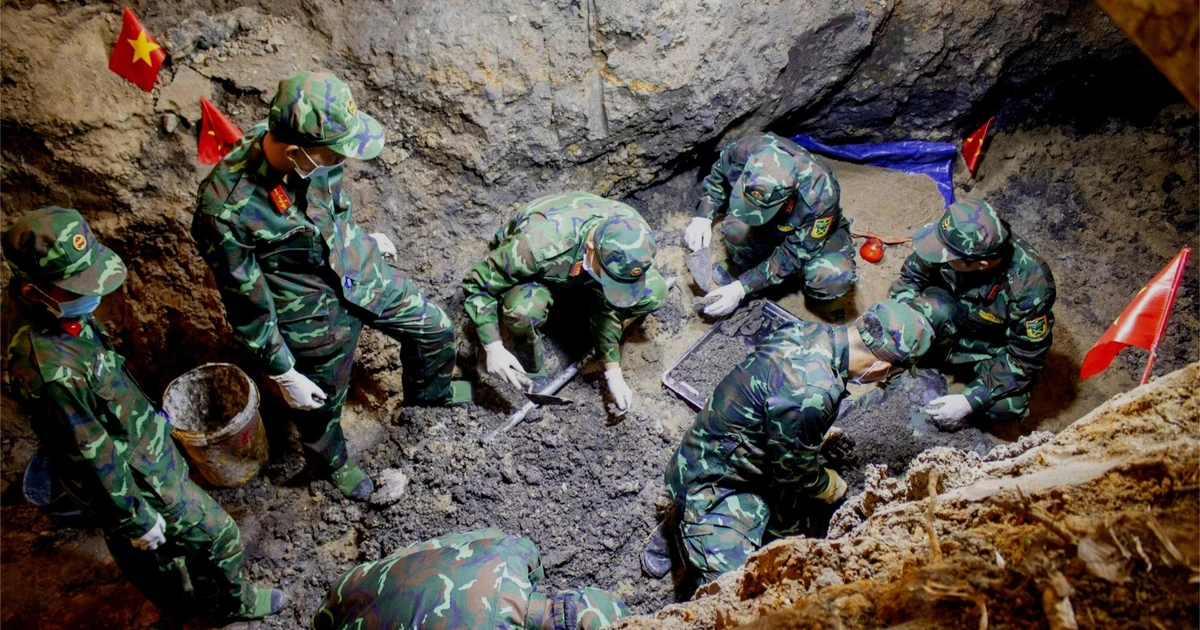
Two more martyrs' remains unearthed at Le Thi Rieng Park in Ho Chi Minh City
Ho Chi Minh City has discovered two more sets of martyrs' remains at Le Thi Rieng Park, bringing the total collected to 11. The remains are believed to belong to soldiers who died during the 1968 Tet Offensive.
Ho Chi Minh City's military command announced on July 7 that two more sets of martyrs' remains were unearthed during the ongoing collection efforts at Le Thi Rieng Park. This brings the total number of remains collected at the site to 11. According to the City Military Command, the two sets of remains found on this occasion were not accompanied by any personal effects. The team is currently expanding the excavation area to facilitate further search and recovery operations. At the scene, military personnel are meticulously excavating layers of soil and carefully collecting bone fragments and artifacts according to professional procedures. All discovered items are cleaned, classified, preserved, and used for identification purposes to help determine the identities of the martyrs. Lieutenant Colonel Ly Minh Van, political officer of Team K74, stated that the task force is committed to respecting the heroes and martyrs, conducting scientific and rigorous searches with the determination to find every single one, and helping the fallen soldiers return to their families, comrades, and homeland. The search operations are being carried out under the directive of Prime Minister Le Minh Hung, emphasizing absolute caution and meticulousness in every step. This is because even the slightest trace or preserved artifact can serve as a crucial basis for identifying the martyrs. Previously, based on documents and artifacts found during the initial excavation, the authorities had preliminarily identified martyr Huynh Van Quen, a deputy platoon leader of Battalion 1, Long An, who sacrificed his life during the General Offensive and Uprising of Xuan Mau Than 1968 near Chu Y Bridge. Immediately following this, on the morning of July 7, units coordinated with the Tay Ninh Provincial Police to collect DNA samples from two of the martyr's younger brothers to facilitate identification of the remains as soon as possible. Major General Nguyen Thanh Trung, Political Commissar of the City Military Command, stated that the collection work at Le Thi Rieng Park will continue under the principle of "proceeding with certainty, starting with the easy and moving to the difficult; exercising caution and meticulousness, ensuring absolute safety." This effort aims to further clarify the remaining traces of the General Offensive and Uprising of Xuan Mau Than 1968 and fulfill the responsibility of gratitude towards the Heroes and Martyrs. Source: Nhan Dan
多角的分析
このニュース自体に直接的な経済的影響は限定的ですが、戦没者遺骨の収集・特定活動は、国家が過去の戦争の犠牲者に対して負う責任の一環と見なされます。ベトナム経済は急速な成長を遂げていますが、こうした歴史的・社会的な課題への対応は、国民統合や社会安定に寄与する側面があり、間接的に経済活動の基盤を支えると考えられます。また、遺骨の特定にはDNA鑑定などの先端技術が用いられる可能性があり、関連技術分野への波及効果も考えられます。
投資家にとって、このニュースは直接的な投資機会やリスクを示すものではありません。しかし、ベトナム政府が戦没者への敬意と責任を果たす姿勢は、長期的な社会安定と国民の士気に影響を与える可能性があります。これは、ベトナム市場への投資を検討する上で、政治的・社会的な安定性という間接的な要因として考慮されるかもしれません。特に、海外からの投資家は、ベトナムの歴史的背景や社会的な価値観を理解することが重要です。
レ・ティー・リエン公園での戦没者遺骨収集は、ベトナム戦争(抗米戦争)などの過去の紛争で犠牲となった兵士とその家族への追悼と、国家による責任遂行の表れです。今回発見された遺骨は、1968年のテト攻勢で犠牲になった兵士のものである可能性が高く、その身元特定は、長年待望していた家族にとって大きな意味を持ちます。DNA鑑定による身元特定は、現代の科学技術が過去の悲劇に寄り添い、遺族の心を癒す役割を果たしています。これは、ベトナム社会が戦争の傷跡と向き合い、平和と和解を追求する一環と言えます。
ホーチミン市市民、特に過去の戦争で家族を失った人々にとって、戦没者遺骨の発見と身元特定は、長年の悲願達成の可能性を秘めています。レ・ティー・リエン公園という都市部の公共空間での発見は、多くの市民の関心を集め、戦争の記憶や犠牲者への追悼の念を共有する機会となります。遺骨の丁寧な取り扱いや、DNA鑑定による身元特定への期待は、市民の平和への願いと、国家への信頼感を深める要素となり得ます。一方で、まだ特定されていない多くの戦没者がいることも、社会的な課題として認識されています。
背景・歴史的文脈
ベトナムでは、長年にわたり、特にベトナム戦争(抗米戦争)やその他の紛争で犠牲となった兵士の遺骨収集・特定活動が続けられています。1975年のベトナム統一後、政府は「恩返し」政策の一環として、行方不明となった兵士の遺骨を家族に引き渡すための大規模な捜索・収集事業を推進してきました。1968年のテト攻勢は、戦争の激しさと多くの犠牲者を生んだ重要な転換点であり、その時期に犠牲となった兵士の遺骨が、都市開発が進むホーチミン市内の公園などから発見されることは珍しくありません。DNA鑑定技術の進歩により、身元不明の遺骨の特定が可能になり、多くの遺族に希望を与えています。
原文ソース
Nhan Dan