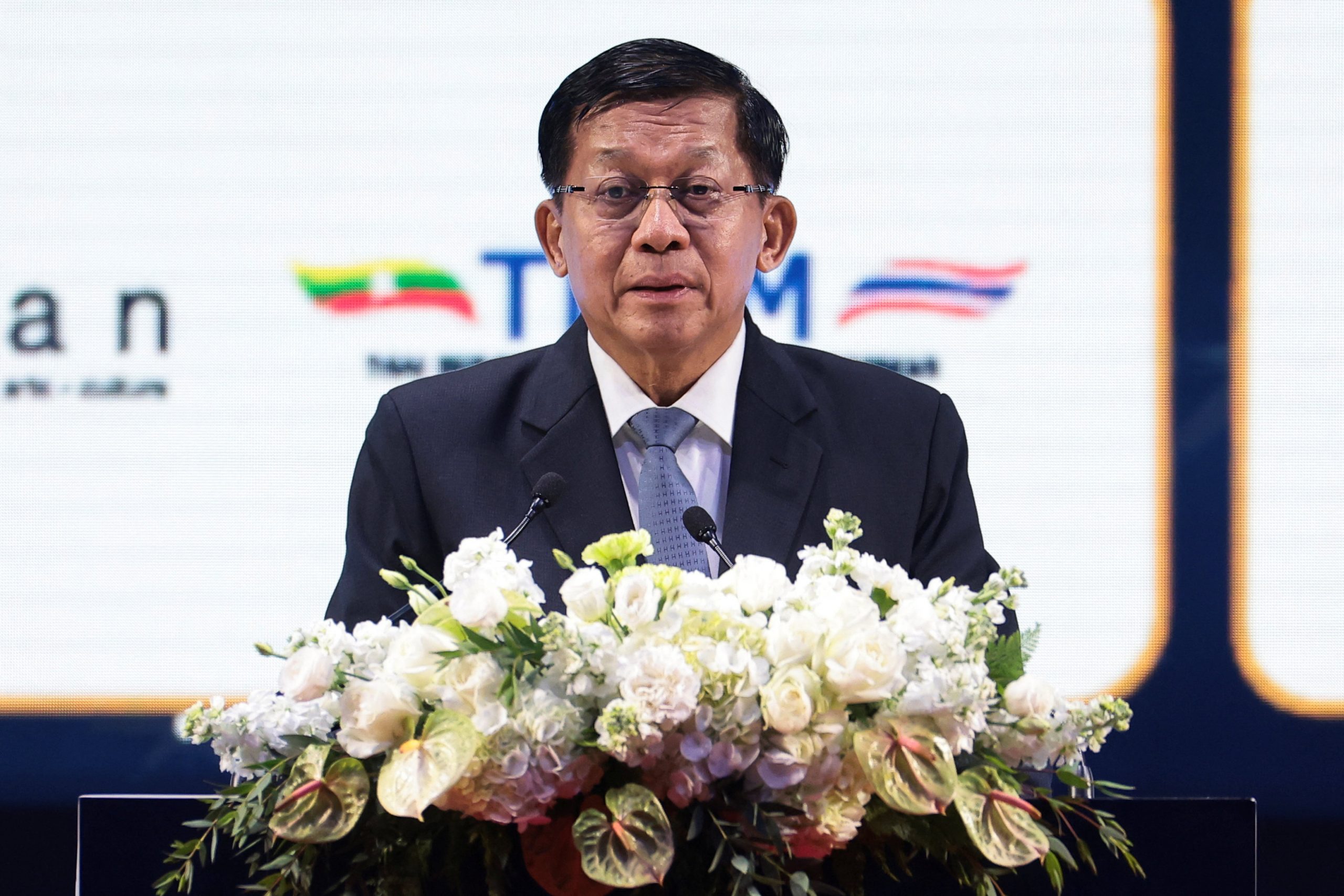
Min Aung Hlaing makes pitch to investors in Thailand over ‘land bridge’
Myanmar regime leader Min Aung Hlaing co-chaired the opening of the Thailand-Myanmar Business Forum 2026 on Aug. 6, at the Queen Sirikit National Convention Center (QSNCC) in Bangkok, Thailand, where he proposed position
This article requires PRO
This article is outside the free access window or is a special report. PRO unlocks it and the full archive.
Related articles
- Victory in hand - Min Aung Hlaing’s official trip to Thailand has strengthened his de facto governance plan
The recent official trip of Myanmar military leader Min Aung Hlaing to Thailand has shaken up the situation and further strengthened the military coup leader's plan to legitimize his de facto rule. As a result of the trip, which he made to Bangkok from August 6 to 7 at the invitation of Thai Prime Minister Prayut Chan-o-cha, ASEAN is now in a difficult situation. Thailand's decision to roll out the red carpet for the Myanmar military leader appears to be based on a pragmatic approach, grounded in two reasons. Firstly, Bangkok hopes to address important bilateral common interests between Thailand and Myanmar, ranging from border security, cracking down on scam camps, and the issue of migrant workers, to promoting trade and economic relations. Secondly, Bangkok acknowledges that ASEAN's five-point consensus, which aims to restore peace and democracy in Myanmar and release political prisoners, has completely failed. The military junta's 2026 parliamentary elections have also openly abandoned and rejected it. Therefore, from Bangkok's perspective, ASEAN is under pressure to adopt a new approach. However, Myanmar observers see a major problem. Min Aung Hlaing, who staged a coup in 2021, overthrew Daw Aung San Suu Kyi's democratically elected government, and attempted to seize power by creating a historic fraudulent election for the presidency, will fully exploit this opportunity to legitimize his position and continue fighting his people, blocking free democratic choices. Many critics, from Myanmar nationals to a Thai opposition MP, have pointed this out. The human rights group Justice For Myanmar also criticized the trip for granting "fake legitimacy" to Min Aung Hlaing and the ruling generals. This is part of the plan. According to democracy activist Igor Blazevic, Myanmar's fraudulent elections have only served to strengthen Min Aung Hlaing's grip on Myanmar's institutions. In particular, by forming the "State Administration Council," an organization outside the constitution without a parliamentary vote, he has gained extensive control over the military, judiciary, executive, and legislative branches. Blazevic pointed out that this action is aimed at the long-term sustainability of the military dictatorship, according to the Myanmar Lawyers Council. There is a clear point. Min Aung Hlaing knows that he has the backing of major powers such as China, Russia, and India, and is adept at maneuvering by exploiting the differences among ASEAN members regarding Myanmar issues. Although the Philippines currently holds the ASEAN chairmanship, there has been little progress in resolving the Myanmar crisis. Part of that maneuver involves Daw Aung San Suu Kyi. Before the trip to Thailand, Min Aung Hlaing allowed Daw Aung San Suu Kyi, 81, who is serving an 18-year prison sentence for multiple charges, to meet with the International Committee of the Red Cross (ICRC). This meeting yielded the expected result. The Thai government responded positively. Mr. Don Pramudwinai, Deputy Prime Minister and Minister of Foreign Affairs, welcomed the report, which included photos of the recent meeting between Daw Aung San Suu Kyi and the head of the ICRC in Myanmar, following a private meeting between ASEAN foreign ministers and the Myanmar foreign minister in Bangkok on July 12, and ahead of Min Aung Hlaing's upcoming trip to Thailand. Mr. Don Pramudwinai said that his government expects the Myanmar government to take further positive steps towards lasting peace and stability in Myanmar. Positive words. But what do they mean? Min Aung Hlaing is strengthening his position and the role of the Myanmar military to rule the country in the long term. This is the military's long-standing effort to lead the country. In a speech delivered to the Naypyidaw parliament last week, Min Aung Hlaing, marking his first 100 days as "President," defended the achievements of the military-backed administration, rejected the ASEAN five-point consensus as merely Brunei's stance, and outlined a five-year roadmap focused on national security, constitutional amendments, and special elections. The Myanmar military leader presented the following published plan, which includes "Key Priority Tasks" and a "Two-Phase Roadmap Plan." He outlined a five-year strategy that includes two years of accelerating security and stability and three years of rapid national development. He informed the parliament that a submission containing 43 proposed amendments to the 2008 constitution, drafted by the military, had been submitted. This submission includes special elections. The plans include holding special elections in 2027 in 102 townships that were excluded in previous voting phases due to armed conflict. He rejected the ASEAN five-point consensus, stating that it was merely a statement from former chairman Brunei, not a collective agreement of all member states, and accused some regional members of discrimination. Regarding issues of conflict and conscription, he confirmed that the military's conscription law remains in effect and that security forces will be continuously reinforced to combat opposition and revolutionary groups. Regarding peace talks, while pursuing our domestic solution for conflict, the government...
- Min Aung Hlaing's trip to Thailand, a victory to boost legitimacy
The recent official visit to Thailand by Myanmar junta leader Min Aung Hlaing has bolstered his efforts to gain legitimacy for his illegal rule, further complicating the political situation. Min Aung Hlaing's visit to Bangkok on August 6 and 7, at the invitation of Thai Prime Minister Srettha Thavisin, is likely to present ASEAN with a new challenge on how to proceed with the Myanmar issue. There are two main possible reasons why Thailand accorded the Myanmar junta leader a state welcome. The first is Bangkok's desire to directly address crucial issues between Thailand and Myanmar, such as border security, combating online scam centers, the issue of Myanmar migrant workers, and promoting trade and economic relations. The second is that Thailand may have come to believe that ASEAN's Five-Point Consensus, aimed at restoring peace and democracy in Myanmar and releasing political prisoners, is no longer feasible. The Pyidaungsu Hluttaw in Nay Pyi Taw has also indicated that it no longer accepts the consensus in practice, leading Thailand to believe that a new approach to the Myanmar issue is needed. However, Myanmar analysts have pointed out a major problem. Min Aung Hlaing, who overthrew the democratically elected government led by Daw Aung San Suu Kyi in a 2021 coup, has since created a "sham" election to maintain his power as the leader of a pseudo-civilian military regime. The state welcome with a red carpet in Thailand could be an opportunity for Min Aung Hlaing to further legitimize his rule. Many, from Myanmar citizens to Thai opposition MPs, have criticized the visit. Justice For Myanmar also criticized Thailand's welcome as giving "false legitimacy" to Min Aung Hlaing and the military generals. An effort to consolidate power long-term? According to analyst Igor Blazevic, the Myanmar junta's sham election has further consolidated Min Aung Hlaing's control over state institutions. He points out that the Union Consultative Council of the military junta was formed without a parliamentary vote, and this body has become an extra-constitutional organization that has broadened Min Aung Hlaing's influence over the military, judiciary, executive, and legislative sectors. Blazevic states that the Myanmar Bar Council has also assessed that this action is aimed at perpetuating military dictatorship as a permanent rule. One thing is clear: Min Aung Hlaing is adept at exploiting opportunities in political maneuvering, securing support or cooperation from powerful countries like China, Russia, and India, and also exploiting the divisions among ASEAN member states regarding the Myanmar issue. Currently, the Philippines holds the ASEAN chairmanship, but no significant progress has been made on the Myanmar issue. Aung San Suu Kyi's role is also being used as a pawn. Prior to Min Aung Hlaing's visit to Thailand, allowing the International Committee of the Red Cross (ICRC) to meet with 81-year-old Daw Aung San Suu Kyi is also being considered a political maneuver. Daw Aung San Suu Kyi has been sentenced to 18 years in prison based on charges and lawsuits, and is currently being held under house arrest. After news and photos of the ICRC's meeting with Daw Aung San Suu Kyi emerged, the Thai government responded positively. Thai Deputy Prime Minister and Foreign Minister Sihasak Phuangketkeow welcomed the information and photos of the meeting between Daw Aung San Suu Kyi and the head of the ICRC in Myanmar. In particular, the Thai government viewed the developments following the informal meeting between ASEAN foreign ministers and the Myanmar foreign minister in Bangkok on July 12, and Min Aung Hlaing's visit to Thailand, as a positive situation. Sihasak said that the Thai government expects the Myanmar government to continue to take further positive steps to achieve lasting peace and stability in Myanmar. However, the main question is what lies behind these positive words. Min Aung Hlaing's Five-Year Plan It is speculated that Min Aung Hlaing is trying to consolidate his power and the power of the Myanmar military for the long term, and to maintain the pattern of decades of military rule in the country. In his speech at the 2026 Hluttaw in Nay Pyi Taw last week, marking his first 100 days as "President," Min Aung Hlaing defended the actions of the military-backed administration. Furthermore, he dismissed ASEAN's Five-Point Consensus as merely Brunei's stance and unveiled a five-year plan focusing on national security, constitutional amendments, and special elections. His plan includes key priorities and a two-stage roadmap. He stated that security and stability will be accelerated in the first two years, followed by accelerated national development in the next three years. He also said that 43 proposed amendments to the 2008 constitution have been submitted to the Hluttaw. It was also announced that special elections are planned for 2027 in 102 townships where voting was not possible due to armed conflicts during previous election phases. Min Aung Hlaing stated that ASEAN's Five-Point Consensus is not a collective agreement of all member states but merely a statement from the previous chairman, Brunei, and accused some ASEAN member states of discrimination. The Conscription Law Will Remain in Effect In the areas of conflict and conscription, conscription