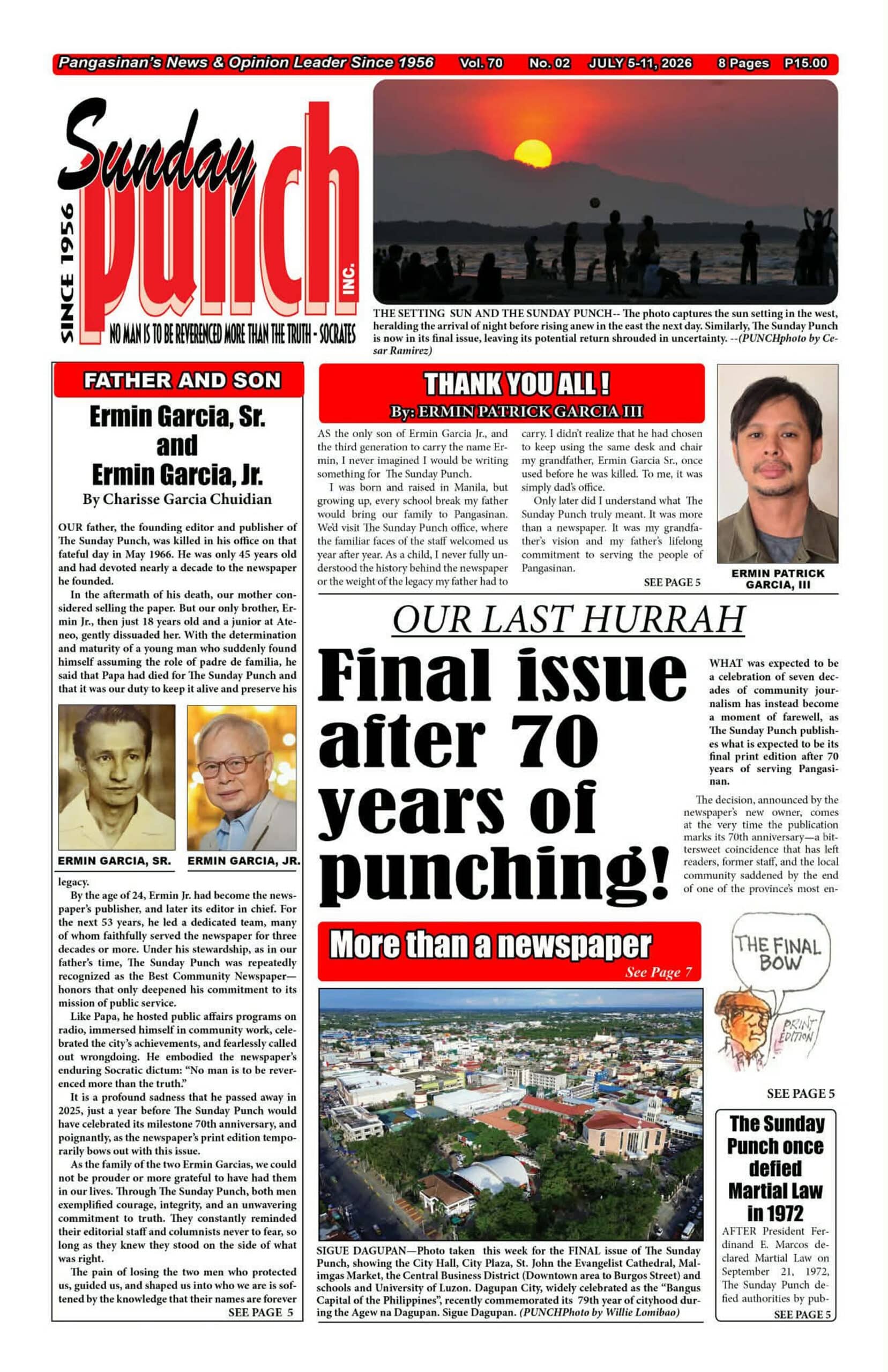
Pangasinan's Longest-Running Newspaper, The Sunday Punch, Ceases Publication After 70 Years
The Sunday Punch, Pangasinan's longest-running community newspaper, has published its final edition on July 5-11, 2026, after a 70-year run. Declining advertising revenues and a shift to online content are cited as likely reasons for its closure.
DAGUPAN CITY—After seven decades of chronicling the lives, triumphs, and struggles of Pangasinenses, The Sunday Punch, Pangasinan’s longest-running community newspaper, has published its final edition, closing a remarkable 70-year chapter in local journalism. Its farewell issue, dated July 5–11, 2026, carried the poignant banner headline: “Our last hurrah: Final issue after 70 years of punching.” The lead story opened with a bittersweet message: “What was expected to be a celebration of seven decades of community journalism has instead become a moment of farewell as The Sunday Punch publishes what is expected to be its final print edition after 70 years of serving Pangasinan.” Instead of the usual lineup of news stories, the commemorative issue was devoted entirely to the newspaper’s history, memories shared by its staff, and tributes from readers, public officials, and community members whose lives it documented through the decades. The paper’s closure was announced by its new owner, who has not been made public and who acquired the publication from the late Ermin Garcia Jr., its longtime publisher and editor in chief who died in July 2025 at the age of 77. The newspaper’s new owner did not issue a statement explaining the decision to cease publication. However, a staff member said the closure was likely driven by the same challenges confronting many print newspapers today, including declining advertising revenues, rising operating costs, and a shrinking readership as more people turn to online content. Another employee said the staff was caught off guard when they were informed less than a month ago that the newspaper would stop operations. “It’s really painful,” an administrative staff member said, reflecting the sentiment shared by many employees. “It comes at a time when the paper marks its 70th anniversary—a bittersweet coincidence that has left readers, former staff, and the local community saddened by its end,” the farewell banner read. For those who worked in its newsroom, The Sunday Punch was more than a newspaper—it was a lifelong mission. Eva Visperas, who joined the publication as a reporter and columnist in 1991, said the discipline, integrity, and values instilled by Garcia Jr. remain among the greatest gifts of her journalism career. “It is a treasure that we will carry until our last breath,” she said. Visperas also recalled the staff’s unwavering commitment to ensuring every issue reached its readers. “Not a single issue was missed. Neither rain nor floodwaters, earthquakes, massive flooding, nor even the COVID-19 pandemic stopped us,” she said. Founded in 1956 by Garcia Sr., The Sunday Punch built its reputation on fearless community journalism. That commitment to truth came at a tragic cost. On May 20, 1966, Garcia Sr. was shot dead inside the newspaper’s editorial office by a politician and two armed companions after refusing to stop the publication of a report exposing the official’s alleged involvement in a payroll-padding scheme. In a 2016 column, Garcia Jr. recounted that a Lingayen town councilor arrived at his father’s office on a stormy day determined to suppress the story. “The politician, a protégé of a Malacañang senior official, was armed and so were two of his henchmen. He pumped three bullets into my father’s chest when my father flatly rejected his demand. These were the firsthand accounts of my father’s visitor in his office that time and two of his office staff,” Garcia Jr. wrote. Garcia Sr.’s sacrifice and steadfast defense of press freedom were later honored with a street in Cubao bearing his name—a lasting tribute to a journalist who gave his life in pursuit of the truth. As The Sunday Punch falls silent after 70 years, it leaves behind more than bound volumes of old newspapers. For its readers, it leaves a legacy woven into the history of Pangasinan—a trusted chronicler of its people, a steadfast guardian of accountability, and a community voice that never missed an issue until its final goodbye.
多角的分析
地方紙の廃刊は、広告収入の減少と運営コストの上昇という、印刷メディア業界が直面する構造的な問題を示唆している。特に地方では、デジタルメディアへの移行が広告主の予算配分を変化させ、伝統的なメディアの収益基盤を侵食している。The Sunday Punchのケースは、地域経済の広告予算の縮小が、長年地域に根差した情報源の維持を困難にしている現実を浮き彫りにしている。
The Sunday Punchの廃刊は、印刷メディア、特に地方紙への投資リスクの高まりを示している。広告収入の不安定化、読者層の高齢化、デジタルシフトへの適応の遅れは、投資家にとって大きな懸念材料となる。新たなオーナーが事業継続を断念した事実は、このセクターの収益性への不確実性を示唆しており、将来の投資判断において慎重なリスク評価が求められる。
The Sunday Punchの廃刊は、パンガシナン州の地域社会における情報へのアクセスとコミュニティの結束に影響を与える。長年、地域住民の生活、文化、政治を記録してきた新聞がなくなることで、地域固有の物語や声が失われる可能性がある。また、報道の自由を守るために犠牲を払った歴史を持つ新聞の終焉は、ジャーナリズムの役割と地域社会におけるその重要性について、住民に再考を促す機会となるだろう。
パンガシナン州の市民、特に長年The Sunday Punchを購読してきた人々にとって、この廃刊は地域社会の重要な一部の喪失を意味する。彼らは、地域に密着したニュースや、自分たちの生活や関心事を反映した報道にアクセスする手段を失うことになる。また、かつては地域社会の不正を暴き、説明責任を追求する役割を担ってきた新聞が姿を消すことは、市民の権利意識や情報へのアクセスに対する不安をもたらす可能性がある。
背景・歴史的文脈
The Sunday Punchは1956年に創刊され、70年間にわたりパンガシナン州の地域社会を報道してきた。その歴史は、フィリピンにおける報道の自由とジャーナリストの安全という、根深い問題と切り離せない。1966年には、創刊者のエルミン・ガルシア・シニア氏が、政治家の不正を報じたために暗殺されるという悲劇に見舞われた。この事件は、ジャーナリストが真実を追求する上で直面する危険性を象徴している。その後、同紙はエルミン・ガルシア・ジュニア氏のもとで、恐れを知らないコミュニティ・ジャーナリズムを継承したが、近年、印刷メディア業界全体が直面する経済的困難、特に広告収入の減少とデジタルメディアへの移行という波に抗いきれず、廃刊に至った。
原文ソース
Inquirer NewsInfo