Indonesia Joins FIT-P, Bolstering Economic Resilience
Economy
2026年7月27日
5
The Diplomat Indonesia
Relations
🇮🇩Indonesia🇸🇬Singapore

General articles are free for 24 hours after publish.

Indonesia Joins FIT-P, Bolstering Economic Resilience

Share
AI Summary

Indonesia has joined the Future of Investment and Trade Partnership (FIT-P), a bloc of 19 countries. The agreement aims to strengthen supply chains and remove non-tariff barriers, expected to enhance Indonesia's economic resilience.

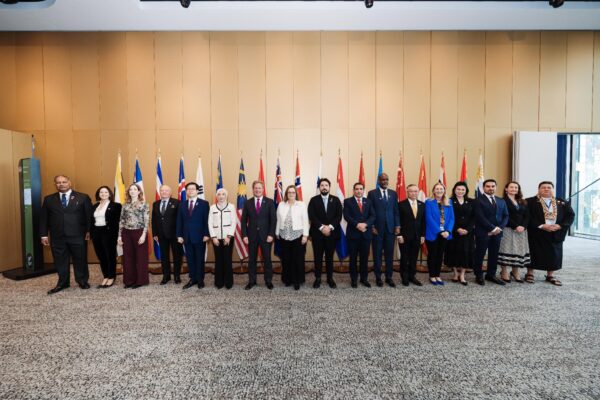
Read The Diplomat, Know The Asia-Pacific The Future of Investment and Trade Partnership, with 19 members and counting, is championing open and fair trade at a time when others are retreating. Ministers and delegates pose for a group photo at the Future of Investment and Trade Partnership meeting in Auckland, New Zealand, July 17, 2026. On July 17, an important meeting on global trade and economic cooperation took place in New Zealand: Ministers and delegates from 21 countries across Asia, Latin America, Europe, the Pacific, the Middle East and Africa gathered to advance work on the Future of Investment and Trade Partnership (FIT-P). The meeting went largely unnoticed but deserves more attention. FIT-P – an innovative trade arrangement where members agree to collaborate on strengthening supply chains, removing non-tariff barriers, integrating new technologies, and facilitating investment – is growing its membership, creating new models for cooperation, and building economic resilience in today’s turbulent trade world. Its economic heft may not be giant but this new group, representing close to 20 percent of global goods trade, is championing open and fair trade at a time when others are retreating. Launched in September 2025, this global initiative was spearheaded by four trade-dependent countries: Singapore, Switzerland, New Zealand, and the United Arab Emirates. Each of these core members quietly recruited some of their usual economic friends, and FIT-P landed on the world stage with 14 members, including Chile, Morocco, Norway, Uruguay, Rwanda and Brunei, which are eager to try something new. In the course of just 10 months, five new members have joined: Malaysia and Paraguay in November, and South Korea, Peru, and Thailand signing on at the recent Auckland meeting. Samoa and Fiji also attended the Auckland meeting as observers. This momentum reflects a growing interest on the part of many countries in reaching for new instruments and new ways of working together in the midst of the myriad of global trade challenges countries face today. It also supports the new emphasis on trade diversification – a key pillar of many countries’ economic security and economic resilience strategies today. It doesn’t mean that these countries are necessarily moving away from the big economies of the United States, China, or the EU; rather it embodies the realities of today that having all your eggs in one or two baskets is not the best strategy for sustained economic growth. The world’s biggest economies are not a part of FIT-P, and this initiative may not be grabbing the headlines with new tariff rates or rules. In fact that is by design and possibly also part of its attraction. Its focus is on bringing small and medium-sized economies together to tackle the trade challenges of a modern world in creative and practical ways and enhance investment flows. Smaller countries are often nimbler, can adapt more quickly, and are more outward looking in their approach. This is not to say they are free from protectionist tendencies, but they usually recognize that they cannot solve all their problems and grow their economy to its full potential without access to and inputs from markets abroad. Furthermore, this is no ordinary free trade agreement – there are no legally binding obligations, and countries are not trading market access commitments. Instead, FIT-P is designed to be a dynamic platform where members pledge to adhere to the rules-based trading system and collaborate on specific, practical initiatives that facilitate trade and investment. Importantly, countries can pick and choose which specific FIT-P initiatives they sign up to. When FIT-P was launched, the founding members used words like “agile,” “flexible,” and “adaptable” to describe their approach – not your usual terms for trade agreements. Reflecting this approach, the Auckland meeting concluded with three different declarations on practical steps to tackle non-tariff barriers, to harness the power of digital technology to facilitate trade, and to build economic resilience to address economic security risks. Various members signed up to each declaration separately. This flexible approach may well be the direction we see more of in the future, especially given the difficulties the World Trade Organization (WTO) has in concluding agreements these days. While subsets of WTO members have embarked on plurilateral agreements on specific topics, like digital and investment facilitation, these agreements have met serious challenges in Geneva. The FIT-P approach reverses this sequent. Its members recognize from the get-go that not everyone will be joining all commitments – and this is part of the deal. It reflects a more practical way forward and ensures that those who are not ready to move forward with certain commitments do not hold back those who are ready. The FIT-P group also provides a new forum for countries that support open and rules-based trade to meet, to discuss the latest developments and challenges in the global trading order, and to develop effective responses – and fast. For small countries in particular, providing this space for discussion at the ministerial level, where creative ideas can be tested and hopefully flourish, is an important end goal in and of itself. This forum can also serve as a catalyst for broader multilateral action. For example, it may well be easier to first conclude commitments in certain areas among this smaller, trade-reliant group of countries, which can then, over time, be taken up by others. At a time when the global trading order is under increasing strain, FIT-P appears to go against the grain, championing the rules-based system and the value of working together with smaller sets of countries. As its numbers grow, its “pick-and-choose” model for plurilateral trade partnerships serves as a useful test case for perhaps a more effective way to achieve increased economic integration. Subscribe today and join thousands of diplomats, analysts, policy professionals and business readers who rely on The Diplomat for expert Asia-Pacific coverage. Get unlimited access to in-depth analysis you won't find anywhere else, from South China Sea tensions to ASEAN diplomacy to India-Pakistan relations. More than 5,000 articles a year. Already have an account? Log in. Jane Mellsop is the director of trade, investment, and economic security at the Asia Society Policy Institute in Washington, DC. Get briefed on the story of the week, and developing stories to watch across the Asia-Pacific.

0

Original source

The Diplomat Indonesia

原文を読む