General articles are free for 24 hours after publish.
Sara Duterte Trial: Constitutional Interpretation Debated on Voter Count
During the Philippine Senate impeachment trial, former Supreme Court justices presented differing views on how to calculate the "two-thirds" vote required for conviction. Opinions diverged on whether to count all incumbent senators or only those able to participate in the proceedings.
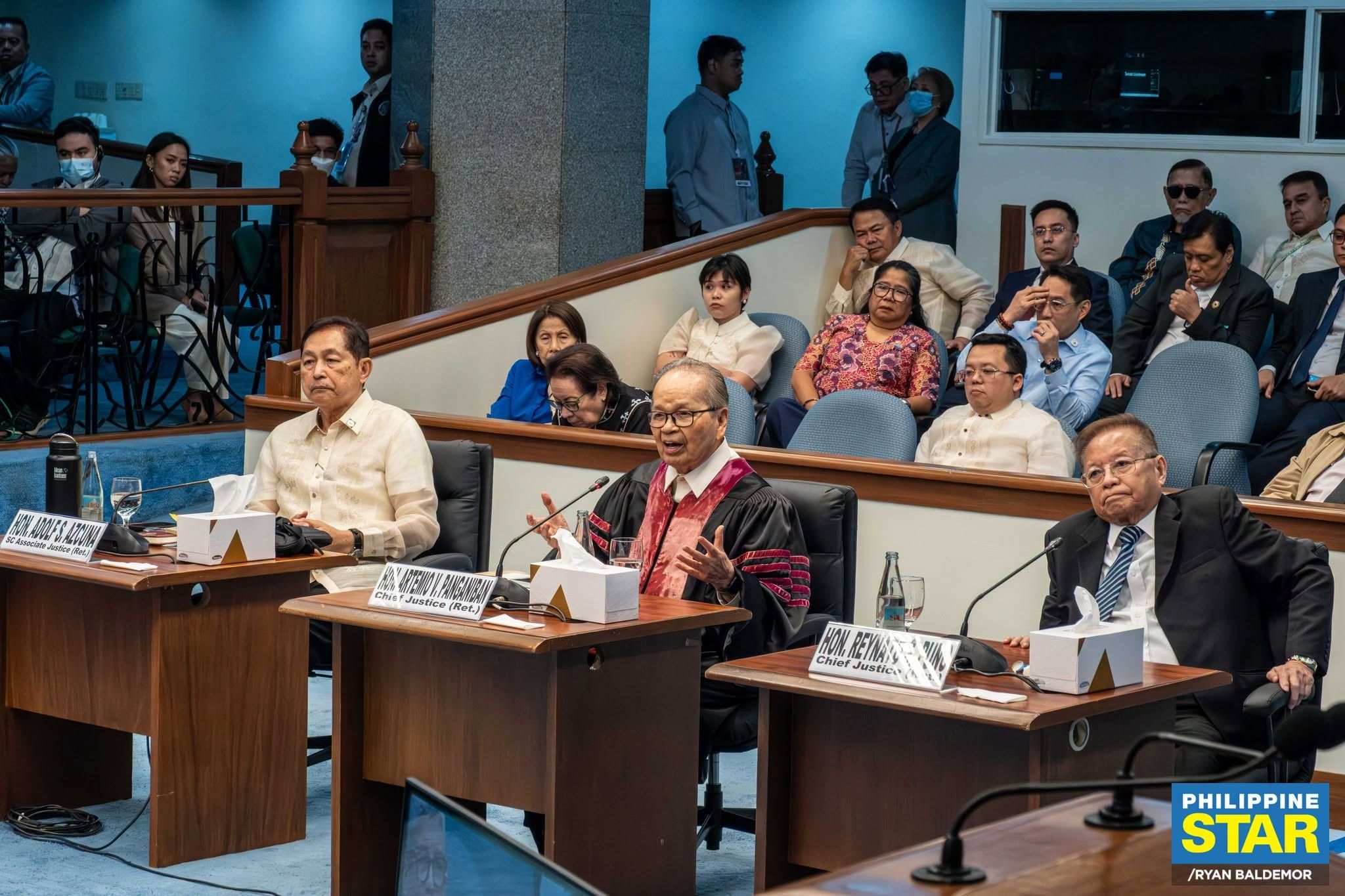
MANILA, Philippines — The definition of "two-thirds" in the impeachment process has become a focal point of debate among legal luminaries in the Philippines, with former Supreme Court justices presenting divergent views on how to calculate the required votes for conviction. On Wednesday, September 16, retired Chief Justices Artemio Panganiban and Reynato Puno, along with retired Associate Justice Adolfo Azcuna, appeared as amici curiae (friends of the court) to offer their insights. Retired Chief Justice Hilario Davide Jr. also submitted his opinion in a written memorandum. The core issue stems from Senator Erwin Tulfo's appeal of a ruling that states 16 out of 24 senators are needed to convict. The legal experts were tasked with clarifying whether the Constitution's "two-thirds of all the members of the Senate" refers to the entire 24-member body or only to those senators who are legally and physically able to participate in the proceedings. The amici presented their stances on three key questions: whether "all the members of the Senate" means all 24 senators or only those able to participate; whether the 1949 ruling in Avelino v. Cuenco, which excluded a senator beyond the chamber's reach from a quorum count, applies to senators who are detained, abroad, suspended, or whose whereabouts are unknown; and whether a senator-judge who did not attend or substantially participate in the trial may still vote on the verdict. On the central question of the two-thirds count, the amici were split three to one. Davide, Panganiban, and Puno argued that the two-thirds should be based on senators who can actually take part and hear witnesses in the proceedings. Azcuna, however, held that all 24 senators must be counted unless a seat becomes permanently vacant. Davide stated that the framers of the Constitution never debated the phrase, assuming "members" meant senators able to perform their duties. He argued that any other reading would "tolerate an absurdity, and perpetuate an injustice." Davide listed senators who should be excluded from the count: those who resigned or were expelled, those with serious mental or physical incapacity, those outside the country, in hiding, or whose whereabouts are unknown, and those under legal restraint. Panganiban acknowledged that a literal reading yields 16 votes but stressed that "reality changes the denominator in mathematics." He urged senators to consider the intent and purpose of constitutional provisions, guided by "truth and fairness." Panganiban also addressed a hypothetical scenario posed by Senator Tulfo, where circumstances might prevent enough senators from attending to reach 16 votes, arguing that a fixed threshold would immobilize the Senate's capacity for justice. Puno rejected a literal reading of the two-thirds rule, stating it would make the threshold "fixed and immutable." He advocated for a "contextual and functional" reading that allows flexibility for circumstances legally preventing a senator from functioning as a member of the court. Azcuna, the lone dissenter, argued that "as long as they are members of the Senate, they constitute the denominator in computing the threshold of two-thirds, because 'all' means 'all.'" He believed this requirement forces convictions to rest on a broad coalition, preventing manipulation by a ruling faction. Regarding the Avelino v. Cuenco ruling, Davide considered it not directly applicable but having "persuasive value" by analogy. Puno described it as "not a perfect precedent" but "one of the tests." Azcuna, however, stated it did not apply at all. Information source: Philstar Nation
Original source
Philstar Nation