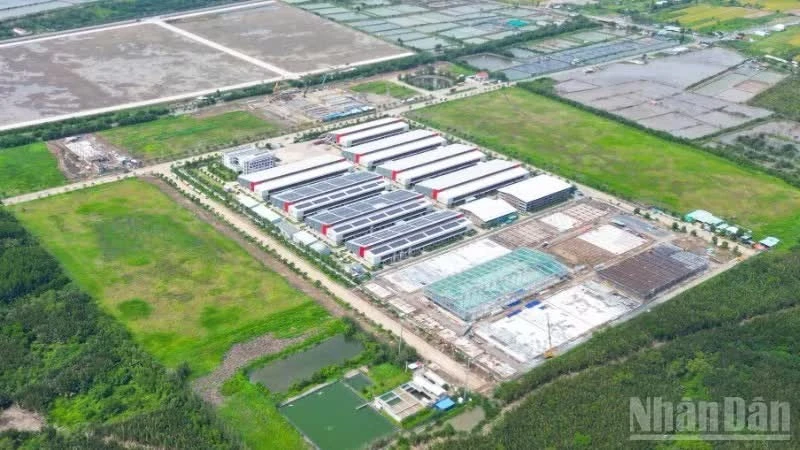
Vietnam Pushes 'Green' Strategy for Industrial Parks Amid Environmental Concerns
Business
2026年7月31日
7
Nhan Dan

General articles are free for 24 hours after publish.

Vietnam Pushes 'Green' Strategy for Industrial Parks Amid Environmental Concerns

Share
AI Summary

Vietnam operates around 730 industrial parks, but 80% lack adequate environmental infrastructure, leading to severe air, water, and noise pollution. Transitioning to eco-industrial parks is deemed urgent to balance economic growth with environmental protection.

Currently, approximately 730 industrial parks are operational nationwide, contributing positively to relocating polluting production facilities away from densely populated residential areas. However, the environmental protection landscape within these industrial parks still presents numerous challenges. Specifically, about 80% of industrial parks across the country suffer from a lack of integrated environmental treatment infrastructure. Key components such as centralized wastewater collection and treatment systems, exhaust gas filtration systems, and solid waste sorting and treatment facilities have largely not been invested in or are not operated according to technical standards. Consequently, issues of air pollution, water contamination, and noise pollution are becoming increasingly complex, directly impacting the quality of life for surrounding communities and placing pressure on local authorities in terms of environmental management, inspection, and violation xử lý. Experts suggest that developing eco-industrial parks is a strategic direction for the transition towards a green economy in the coming period, as this model offers comprehensive socio-economic and environmental benefits. Eco-industrial parks will act as magnets attracting high-quality foreign investment, particularly from multinational corporations that prioritize environmental standards and ESG (Environmental, Social, and Governance) management. Concurrently, businesses can enhance their added value in production by adopting clean technologies, conserving resources, and reducing operational costs. This model also serves as a potent tool for significantly cutting greenhouse gas emissions from industrial activities, fully aligning with and meeting Vietnam's international commitments to achieve net-zero emissions by 2050. The quality of life for surrounding communities will be elevated, fostering civilized, safe, clean, and transparent production zones. The transition to eco-industrial parks also means promoting "green job" opportunities, thereby upgrading the skill level of the local workforce. It provides an ideal environment for nurturing and fostering innovation within the business community. Furthermore, possessing modern, internationally compliant eco-industrial parks will enhance the competitive advantage of provinces and cities. However, a significant gap remains between the vision and the reality, demanding high determination from governments at all levels. To develop eco-industrial parks, establishing an attractive, transparent, and stable preferential policy system is crucial to draw capable strategic investors to participate in building technical infrastructure. Simultaneously, local authorities must proactively collaborate and provide maximum support to investors in resolving bottlenecks and difficulties related to land clearance, and simplifying relevant administrative procedures to expedite project progress. Building a network of eco-industrial parks is a solution that helps localities address the challenge of growth intertwined with environmental protection. This model not only meets stringent international standards but also contributes to the development of a green economy and a circular economy, directly contributing to the goal of achieving net-zero emissions by 2050. Source: Nhan Dan

0

Original source

Nhan Dan

原文を読む