Philippine Unemployment Inches Up to 4.8% in May 2026
Society
2026年7月8日
5
Rappler Business

Philippine Unemployment Inches Up to 4.8% in May 2026

AI サマリー

The Philippines' unemployment rate rose to 4.8% in May 2026, primarily due to significant job losses in the agriculture sector, particularly rice and corn farming. The Philippine Statistics Authority (PSA) reported this increase, though underemployment saw a notable improvement.

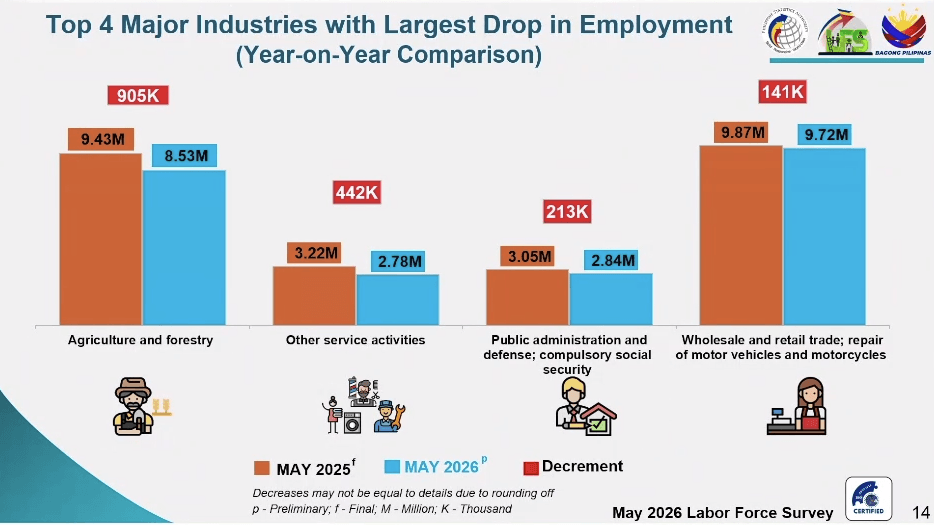
MANILA, Philippines – The unemployment rate rose slightly to 4.8% in May 2026, as losses in farm work – particularly in palay and corn farming – weighed on the labor market, the Philippine Statistics Authority (PSA) reported on Wednesday, July 8. The latest jobless rate was equivalent to 2.50 million unemployed Filipinos, higher than the 2.41 million recorded in April 2026 and the 2.03 million posted in May 2025. The May figure was only slightly worse than April’s 4.7%, but was nearly 1-percentage point higher than the 3.9% unemployment rate recorded in the same month last year. For the first five months of 2026, National Statistician Dennis Mapa said the unemployment rate averaged 5.1%, compared to 4.0% in the same period in 2025. Farm jobs down Asked whether the increase in unemployed Filipinos could be attributed to the Middle East fuel crisis, Mapa pointed instead to the large year-on-year drop in agriculture and forestry jobs. “Malaki ang pagbaba ng number of employed persons mula sa agriculture and forestry (There was a big drop in the number of employed persons in agriculture and forestry),” Mapa said. Agriculture and forestry shed 905,000 jobs year-on-year, the biggest net loss among industries. Much of this came from the growing of palay, which lost 734,000 jobs, and the growing of corn, which lost 428,000 jobs. Since the combined losses in palay and corn were larger than the agriculture and forestry industry’s overall decline, the figures suggest that gains in other agricultural subsectors partly offset the drop. “Siguro, impact ito ng weather condition nitong May 2026,” Mapa said, noting the developing El Niño conditions as well. (READ: Strong El Niño will develop rapidly over coming months, says UN weather agency) Other service activities also posted a large net annual loss of 442,000 jobs. The decline was more than accounted for by domestic services such as household help, drivers, and gardeners, which lost 461,000 jobs, meaning gains in other activities within the industry partly offset the losses. Mapa said this could indicate that households were cutting back on spending Public administration and defense lost 213,000 jobs year-on-year, while wholesale and retail trade, repair of motor vehicles and motorcycles lost 141,000 jobs. These losses offset gains in other sectors. The biggest annual increases came from administrative and support service activities, which added 329,000 jobs; mining and quarrying, which added 184,000; human health and social work activities, which added 173,000; fishing and aquaculture, which added 170,000; and construction, which added 168,000. Must Read Inflation eases to 6.4% in June 2026 as fuel, food prices cool Underemployment improves While unemployment worsened, underemployment improved sharply in May. The underemployment rate fell to 12.2%, equivalent to 6.04 million Filipinos who wanted additional work hours, another job, or a new job with longer hours. This was better than the 15.2% underemployment rate in April and the 13.1% rate in May 2025. In magnitude, this translated to a decline of around 564,000 underemployed Filipinos year-on-year. The biggest decreases in underemployment were seen in wholesale and retail trade, repair of motor vehicles and motorcycles, which recorded 240,000 fewer underemployed persons; agriculture and forestry, down by 154,000; domestic other service activities, down by 131,000; and construction, down by 130,000. The drop was driven mainly by visible underemployment, or workers who were working less than 40 hours a week but still wanted more work. The number of Filipinos who were visibly underemployed fell by around 664,000 year-on-year. The average weekly hours worked rose to 41.1 hours in May, higher than the 40.2 hours recorded in April and the 39.8 hours posted in May 2025. Around 34.36 million Filipinos worked more than 40 hours a week in May 2026, compared to 32.45 million in the same month last year. The May labor force survey does not yet capture the impact of the upcoming P85 minimum wage increase in Metro Manila, whose first tranche will take effect in the middle of July. Asked what historical data show about employment, underemployment, or hours worked after large wage hikes, Mapa said the PSA is first looking at the impact on prices, especially in sectors with a large labor input. The agency will still monitor the wage hike’s possible impact on employment and underemployment. – Rappler.com The Philippines is now upper-middle income. Why doesn’t it feel that way?

多角的分析

経済的影響

農業部門における雇用減少は、フィリピン経済の構造的な脆弱性を示唆しています。特に、稲作やトウモロコシ作といった一次産品への依存度が高い状況は、気候変動や国際市場の変動に対して経済全体が影響を受けやすいことを意味します。一方で、サービス業や建設業での雇用増加は、経済の多様化が進んでいる兆候でもありますが、農業従事者の雇用喪失を完全に補うには至っていません。不完全就業率の改善は、労働市場の需給バランスが一部で逼迫している可能性を示唆しますが、失業率の上昇は依然として懸念材料です。

投資家心理

農業部門の雇用喪失は、食料価格の安定性や国内供給網に影響を与える可能性があり、投資家にとってはリスク要因となり得ます。特に、農業関連企業や、農業生産に依存する食品加工業への投資には慎重な姿勢が求められるでしょう。しかし、行政・支援サービスや建設業など、雇用が増加しているセクターへの投資機会も存在します。また、最低賃金引き上げの影響は、企業の人件費負担を増加させる可能性がありますが、消費の活性化につながる可能性もあり、セクターごとの影響を詳細に分析する必要があります。

社会的影響

農業部門での雇用喪失は、地方の農村コミュニティに直接的な打撃を与えます。特に稲作やトウモロコシ作に従事する人々は、気候変動の影響を受けやすく、収穫量の不安定さが収入の減少に直結します。家計が支出を削減している可能性も指摘されており、これは一般市民の生活水準への影響を示唆します。一方で、不完全就業率の改善は、より多くの人々が収入を得られるようになったことを意味し、一部の生活改善に繋がる可能性があります。しかし、失業率の上昇は、依然として多くのフィリピン国民が経済的な不安を抱えていることを示しています。

市民の声

今回の統計は、特に農村部で生活する人々の不安を増大させる可能性があります。収穫量の減少や農作物価格の変動は、直接的に家計を圧迫します。また、家計が支出を削減しているという分析は、生活必需品以外の購入を控える動きが広がっていることを示唆しており、日々の生活への影響が懸念されます。一方で、不完全就業率の改善は、副業やより良い条件の仕事を見つけられた人々にとっては朗報ですが、失業した人々や不安定な雇用に就いている人々にとっては、依然として厳しい状況が続いています。

背景・歴史的文脈

フィリピンでは、農業が依然として多くの国民の生計を支える重要な産業ですが、気候変動の影響を受けやすく、生産性の向上や多様化が課題となっています。過去にも、エルニーニョ現象などの気象異常が農業生産に打撃を与え、雇用や食料価格に影響を及ぼした事例が複数あります。また、フィリピン経済はサービス業への依存度を高めていますが、農業部門の雇用喪失を完全に吸収するには至っていません。不完全就業率の高さは、潜在的な労働力不足や、より良い雇用機会へのアクセスの課題を示唆しており、経済成長の恩恵が国民全体に行き渡っていないという構造的な問題も指摘されています。

原文ソース

Rappler Business

原文を読む