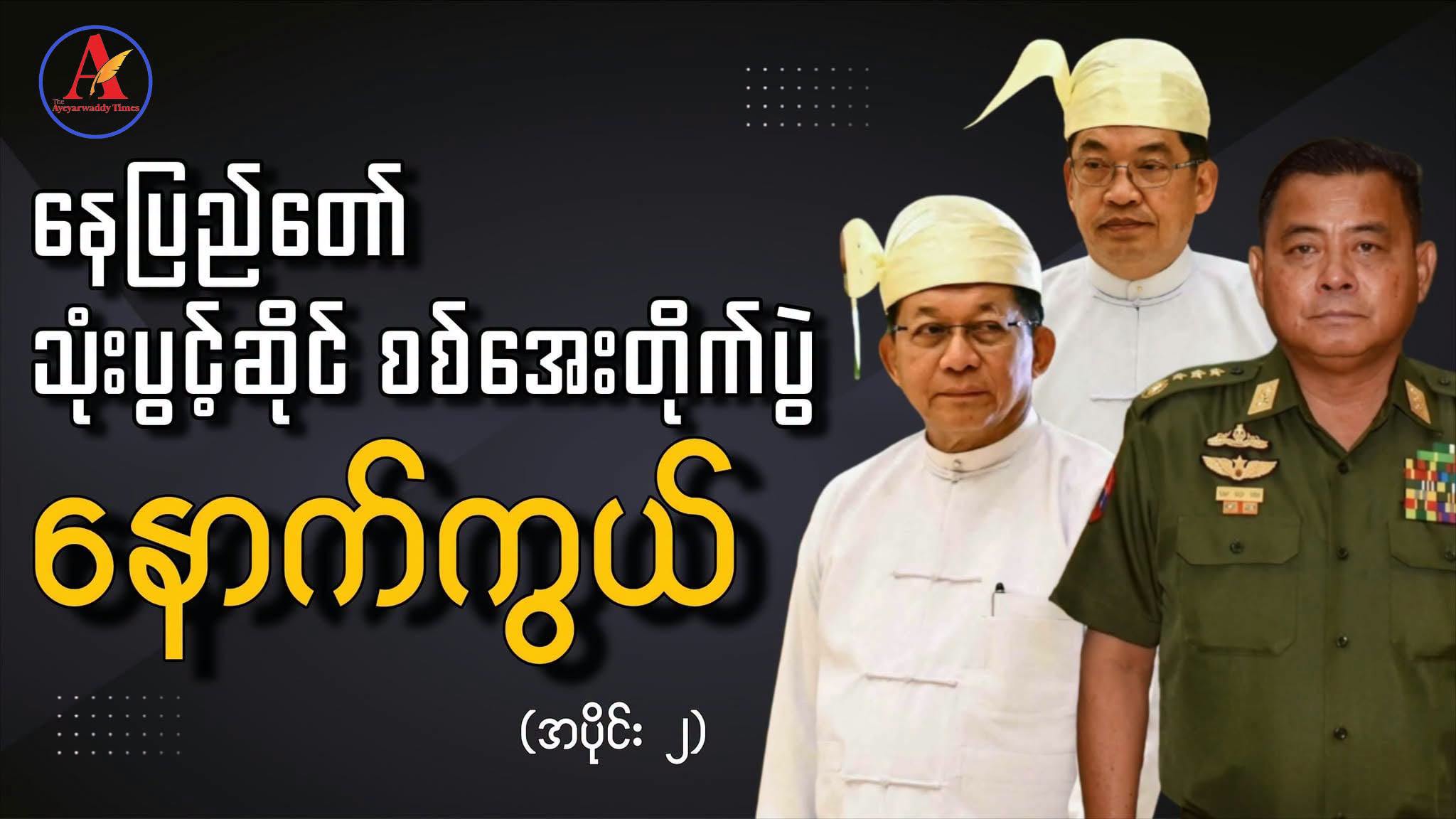
Min Aung Hlaing, Ye Win Oo and Nyo Saw – The Three-Way Cold War in Naypyidaw (Part 2)
Article by – TBR Commentary November 1, 2 Naypyidaw's Hostage Game Naypyidaw's power struggle has reached its most dangerous phase. It is the "Naypyidaw Hostage Game," built on the distrust between three characters. As political scientists often point out, the National Security Bureau (NSB), as currently structured, is not for the country's security, but rather a strategic trap designed to prevent leaders from overthrowing each other. In this trap, three individuals—the one holding the gun, the one holding the money, and the one holding the power—hold each other hostage. Let's continue to see how this game operates internally. The first game is the power struggle between the new Chief of Staff, Ye Win Oo, and Nyo Saw. As the new Chief of Staff, Ye Win Oo has the authority to directly command the gun-wielding military region commanders across the country. The ground commanders cannot defy Ye Win Oo's orders. However, Min Aung Hlaing is countering by using Nyo Saw. Although the ground commanders fear Ye Win Oo, they are entirely dependent on the military-owned business empire (MEC) controlled by Nyo Saw for their long-term economic interests, personal gains, and the supply routes for provisions, ammunition, and fuel for their frontline troops. If Ye Win Oo were to draw his sword to defy the President, Nyo Saw would have the power to immediately cut off the fuel and funds destined for Ye Win Oo's forces using his economic power. This is a counter-hostage tactic, playing on the idea that "a hungry army cannot obey orders." The second game is the "monopoly of information," the lifeblood of an authoritarian regime. The Secretary position, responsible for coordinating the daily operations of the National Security Bureau (NSB), is held by the Director of Military Affairs Security (MAS). This means that all military, political, and intelligence information coming from across the country first reaches the hands of the Secretary and the Vice Chairman, Ye Win Oo. Here, the greatest darkness begins for President Min Aung Hlaing. Since all true information reaching the President's desk must first be filtered and modified by Ye Win Oo, Min Aung Hlaing is trapped within the "Matrix-style truth" that his subordinate wants him to see. It is said that Min Aung Hlaing, sensing this, often seeks independent reports from personally trusted individuals in addition to official channels. However, because Ye Win Oo controls the MAS's technology and the nationwide digital surveillance systems, he can simultaneously track who is secretly informing the President. Therefore, the President finds himself once again a hostage, fearing his subordinate, who is his eyes and ears. Looking at these situations collectively, Naypyidaw's hostage game is a highly sensitive cold war scenario. Min Aung Hlaing has the official authority, Ye Win Oo has the gun and the eyes and ears, and U Nyo Saw has the treasury. If any one of the three were to initiate action, the other two would simultaneously cut off supply routes or use intelligence to trap and arrest them. This is why no one dares to make the first move, and they hold each other hostage. However, this internal balance is in a state where it could shatter at any moment if a strong external force were to intervene. In our next installment, we will analyze in detail what these external forces are that will accelerate that ending. 3. External Forces Accelerating the Ending The three-way cold war in Naypyidaw, amidst the guns, money bags, and orders in the dark chambers, will not remain confined to that room. There are two major external forces that will accelerate Naypyidaw's endgame, capable of shattering this standoff at any moment. The first and most intense pressure is the situation of defeat on the ground. In the current ground situation of 2026, the Myanmar military continues to face military defeats. The loss of strategic cities one after another on the battlefield, and the encirclement and annihilation of military region headquarters, are pushing the dissatisfaction and demoralization among junior and mid-level officers to a boiling point. Questions of "Why are we suffering such shameful defeats? " are on the verge of exploding within the military. When a military faces the danger of its entire organization collapsing due to defeat, it often scapegoats its top leader to ensure its own survival. The current Chief of Staff, Ye Win Oo, holds the most strategic card to exploit this situation. He can easily rally support within the military by explaining to the ground generals and region commanders that "We are losing because of President Min Aung Hlaing's flawed strategies and the incompetence of the ministries." To date, Ye Win Oo is said not to have enough internal military support to defy his superior. However, having previously served as the Director of MAS, he holds everyone's secrets and corrupt dealings, giving him an advantageous position to pocket his superior at any time with minimal bloodshed. To create a new coup in Naypyidaw, not only domestic pressure but also the stance of the major power, China, could become the second decisive force at this time. China's foreign policy is Realpolitik. It is a policy that looks only at "stability and its own national interests," not at individuals. Under President Min Aung Hlaing's administration, as Myanmar becomes chaotic and China's strategic investments like the Kyaukphyu deep-sea port and oil and gas pipelines become a concern, Min Aung Hlaing becomes a burden to China. On the other hand, Ye Win Oo, from his time as head of intelligence, had established close ties with Chinese security agencies. If Ye Win Oo officially proposes, "If I take power, I will fully protect China's interests, restore border stability, and find new avenues for negotiation with the revolutionary groups," the proposal
Read up to 3 eligible full articles per Japan day (JST) for free
Create a free account to open up to 3 eligible full articles per Japan calendar day (JST). Headlines and summaries remain available across ASEAN 7.
Related articles
- Women’s League of Burma Urges International Support for Locally Led Women, Peace, and Security Initiatives
Addressing delegates on October 26 on behalf of the coalition, Naw Hser Hser, WLB’s Advocacy Team Leader, stressed that while global WPS frameworks exist under UN Security Council Resolution 1325, their implementation re
- Airstrikes kill 12 in Rakhine State as bombs target bridge and maternity clinic
At least 12 civilians were killed and 32 others were injured after the Myanmar Air Force launched a coordinated wave of airstrikes across Arakan State on Sunday, targeting civilian transit corridors, residential settleme
- 83 Thai Nationals Arrested in Online Scam and Gambling Crackdown in Tachilek
THE Government is treat- ing the identification, pre- vention and suppression of online scams and online gambling operations as a national responsibility, rec- ognizing the serious threat these crimes pose not only to lo
- Myanmar military and Arakan Army forcibly recruiting Rohingya
In the Rakhine State capital Sittwe, military commanders have ordered the arrest of men in Rohingya communities and internally displaced persons (IDP) camps if local leaders fail to hand over a designated quota of new re