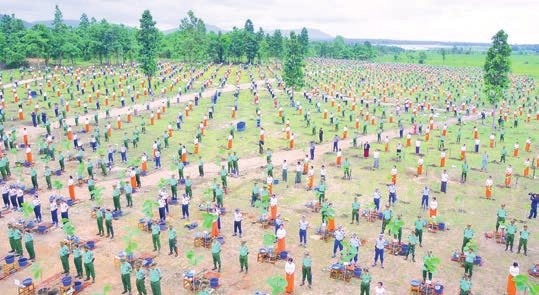
Grow trees to mitigate impacts of climate change
MYANMAR possesses abundant forests, rivers, streams, lakes, biodiversity, and natural resources. Its diverse ecosystems, forests, biodiversity, and natural wealth provide a strong foundation for the country’s food production capacity, the development of green economic activities, environmental sustainability, and climate balance. Forests continuously provide essential ecosystem services such as climate regulation, food security, disaster risk prevention, and the conservation of water and soil resources. They also supply forest products and various environmental services. Since forests are central to natural ecosystems, they must be systematically cultivated, maintained, and managed to ensure long-term sustainability. Myanmar is the second largest in terms of forest cover among ASEAN member states. Myanmar’s forest cover was 42.19 per cent of the country’s total land area, and in 2025 it was recorded at 42.15 per cent. In order to leave behind a stable and healthy ecological environment for present and future generations, it is necessary to set a target of increasing forest cover to 50 per cent of the country’s total land area andto make concerted efforts towards achieving this goal. According to the 2026 Climate Risk Index of certain international climate monitoring organizations, Myanmar is among the 10 countries most affected by climate change. Climate change will lead to increasingly severe and intense secondary natural disasters. The central dry zone of Myanmar has been identified as one of the areas with some of the highest temperatures in the world, reaching 44.9° Celsius in 2026. Similarly, 12 major cities in the dry zone have been recorded with temperatures of 41° Celsius and above. In particular, it is forecast that by the end of this year, a very strong Super El Niño may develop, and it is further predicted that 2026 and 2027 could become among the hottest years in recorded global history. Among the various approaches to addressing the climate change and environmental challenges facing the world, tree planting and forest conservation are considered the simplest, easiest, most cost-effective, and universally achievable measures. At the same time, they are environmentally friendly and among the most beneficial actions that can be undertaken. Efforts should be made to promote environmental conservation and nature-based economic development models such as the Bioeconomy, Green Economy, and Circular Economy. As forests help regulate the climate and preserve a wide range of natural resources, they serve as a fundamental pillar for economic development. In order to increase forest cover across the country, forest conservation activities should be jointly carried out as a national responsibility. By Dr Zeyar Win By Laura Htet (UDE) Grow trees to mitigate impacts of climate change Efforts should be made to promote environmental conservation and nature-based economic development models such as the Bioeconomy, Green Economy, and Circular Economy. As forests help regulate the climate and preserve a wide range of natural resources, they serve as a fundamental pillar for economic development. In order to increase forest cover across the country, forest conservation activities should be jointly carried out as a national responsibility. After all, the most important relationship we will ever have is the one we we have with ourselves. And perhaps the brightest window through which we can see our worth is not the judgement of others, but the understanding we develop within our own hearts. As the world braces for a possible Super El Niño, Myanmar must prepare for more than just hotter days. The risks span from crop failures to disease outbreaks and power shortages. Yet with foresight, resilience, and community cooperation, the nation can withstand the challenge. Myanmar’s El Niño Threat: Climate and Health Risks G LOBAL climate monitoring agencies warn that late 2026 to 2027 could bring a Strong El Niño or even a Super El Niño, a phenomenon that threatens to reshape weather patterns worldwide. For Myanmar, a country heavily dependent on monsoon rains, the prospect raises urgent concerns about heat, drought, agriculture, and public health. El Niño occurs when sea surface temperatures in the equatorial Pacific rise above normal, disrupting rainfall and wind circulation across continents. The name dates back to the 1600s, when Peruvian fishermen noticed warm currents around Christmas that reduced fish catches and triggered heavy rains. They called it El Niño, meaning “The Christ Child”. By the late 19th century, scientists began studying the phenomenon systematically. In the 1920s, British physicist Sir Gilbert Walker identified the Southern Oscillation, a shift in air pressure between the eastern and western Pacific. Later, Norwegian-American meteorologist Jacob Bjerknes proved that ocean warming and pressure changes were linked, forming a global climate cycle now known as ENSO (El Niño – SouthernOscillation). Myanmar’s reliance on monsoon rains makes it particularly exposed to El Niño’s impacts. Past events have brought record-breaking heat, delayed rainfall, and severe water shortages. • 1997-1998 El Niño: One of the hottest and driest years in Myanmar’s history. River levels, including the Ayeyawady, dropped dramatically, crippling agriculture. • 2015-2016 El Niño: Temperatures soared to 45-47°C in Ayeyawady, Magway, Mandalay, and Sagaing regions. Thousands of villages faced water scarcity. • 2023-2024 El Niño: Coincided with a global record event, unleashing intense heat waves and worsening drought across the country. These episodes highlight how climate change is intensifying El Niño, pushing temperatures to new extremes and straining rural communities. If a Super El Niño develops, Myanmar could face: • Extreme heat: Higher risk of heatstroke, especially among children and the elderly. • Water shortages: Hydropower generation may falter as reservoirs dry, leading to nationwide electricity rationing. • Agricultural losses: Reduced rainfall could lower yields of rice, beans, sesame, and other staples. • Livestock stress: Animals may suffer from heat and lack of drinking water. • Wildfires: Dry conditions increase forest fire risks, worsening air pollution and respiratory illness. Health Risks on the Rise Doctors warn that El Niño periods often trigger a surge in health problems: • Heat-related illnesses such as dehydration, heat exhaustion, and heatstroke. • Waterborne diseases like diarrhea and intestinal infections from unsafe water. • Respiratory issues including asthma, lung disease, and eye irritation caused by smoke and dust from wildfires. • Vector-borne diseases such as dengue, as mosquito breeding patterns shift with climate changes. • Nutrition challenges as crop failures lead to food shortages and malnutrition, particularly among children and pregnant women. • Mental health strains including stress, anxiety, and insomnia linked to extreme heat and hardship. Preventive Measures Health experts urge citizens to prepare: • Drink plenty of clean water; boil before use. • Avoid outdoor exposure between 11 am and 3 pm. • Wear light, breathable clothing. • Pay special attention to children and the elderly. • Practice hygiene: handwashing, safe food preparation. • Use masks in dusty or smoky areas. • Eat balanced diets with vegetables, fruits, and protein-rich foods. • Ensure adequate rest and seek family or community support. • Follow climate warnings and prepare for natural disasters. Public health specialists emphasize that prevention is key. Strengthening Myanmar’s health systems, ensuring early warning mechanisms, and promoting community awareness can reduce the toll of climate shocks. “Prevention is better than cure,” experts say, urging collective action to safeguard lives. As the world braces for a possible Super El Niño, Myanmar must prepare for more than just hotter days. The risks span from crop failures to disease outbreaks and power shortages. Yet with foresight, resilience, and community cooperation, the nation can withstand the challenge. The looming climate event is a reminder that health and environment are inseparable. Protecting citizens from heat, hunger, and disease will be as critical as managing rivers and reservoirs. In the face of global climate disruption, Myanmar’s path forward lies in preparedness, solidarity, and strong public health systems. T HERE is a quote that I have always loved. The first time I read it, it stayed with me for a long time because of its simple but powerful truth: “If we hurt a child, the child’s love for their parents does not become smaller. It is the child’s love for themselves that becomes smaller.” At first glance, these words seem surprising. Many of us might assume that when someone is treated badly, they will stop loving the person who hurt them. However, human emotions are often more complicated than that. From the moment we are born, we naturally have a sense of self-love. It is part of being human. This basic instinct helps us survive. When we are hungry, we look for food. When we are cold, we search for warmth. Every living creature shares this desire to stay alive. Yet survival is not the same as self-worth. Learning to value ourselves, appreciate our strengths, and believe that we deserve kindness is something different. Unlike basic survival instincts, self-worth does not develop on its own. It grows through our experiences, our relationships, and the environment around us. This is why the people in our lives matter so much. As children, we learn who we are through the way our families treat us. As adults, we continue to discover ourselves through our friendships, workplaces, communities, and relationships. In many ways, our self-image is like a mirror built from the reflections we receive from others. When people encourage us, support us, and recognize our efforts, we often feel stronger and more confident. On the other hand, when we are constantly criticized, ignored, or undervalued, it becomes much harder to see our own worth. This process affects everyone. Many of us have areas in life where we feel secure. These strengths help us face challenges with confidence. However, we also have insecurities – parts of ourselves that we secretly worry about. When someone questions something we are confident about, we can usually handle it. We trust ourselves enough not to be shaken. But when someone touches one of our insecurities, the impact can be very different. We may feel hurt, embarrassed, disappointed, or even ashamed. Some people might ask why adults allow these comments to affect them. Shouldn’t we already know our value? The reality is more complicated. Many women are intelligent, kind, and capable, yet after spending years with people who fail to appreciate them, they begin to doubt whether they deserve love and respect. Many men work hard, support their families, and fulfil their responsibilities, yet after constantly being treated without respect, they begin to lose respect for themselves as well. The reason is not weakness. The reason is often love. Love has a unique influence on how we see ourselves. We cannot look directly into our own minds and hearts. Instead, we often understand ourselves through the people closest to us. When we love someone, their opinions carry great weight. Their words can brighten our day or ruin it. Their approval can make us feel valued, while their criticism can leave lasting scars. Even when someone we love hurts us, our feelings for them do not always disappear immediately. Sometimes we continue loving them long after they have stopped treating us with kindness. What slowly fades instead is our belief in ourselves. This process rarely happens overnight. It can take months, years, or even decades. Little by little, repeated negative messages can change how we think. A single comment may not matter much, but hearing the same criticism repeatedly can eventually become part of our self-image. This is why healthy boundaries are so important. People who grow up learning that they have value are often better able to protect themselves from harmful treatment. They understand that love should not require the loss of self-respect. Unfortunately, many of us are still learning this lesson. We live in a world where comparison is constant. Every day, social media, advertisements, and social expectations remind us of what we do not have. As a result, many people carry hidden insecurities. Because of this, the influence of our daily environment should never be underestimated. At the same time, positive influences can be equally powerful. This helps explain why some people with ordinary abilities seem remarkably confident. They may have spent their lives surrounded by encouragement and sup
This article requires PRO
This article is outside the free access window or is a special report. PRO unlocks it and the full archive.
Related articles
- Myanmar military reinforces positions in flood-hit Tanintharyi Region
Sources close to the People’s Defence Force (PDF) in the Tanintharyi Region capital Dawei Township told DVB that the Myanmar military has reinforced its positions in Dawei, Launglon and Thayetchaung townships after flood
- Southwest monsoon withdraws from Myanmar
The Department of Meteorology and Hydrology announced on October 6 that the southwest monsoon has withdrawn from across Myanmar. Furthermore, it is reported that moderate clouds are developing over the southern parts of
- Gold items found at landslide site returned to owner
Approximately 15 ticals of gold found in a house buried by a landslide on October 4 in Tao Chee Village, Launglon Township, Tanintharyi Region, where landslides occurred, have been returned to their owner, according to t
- Machinery, workers sent to Dawei for recovery
NINETEEN machinery vehicles and skilled workers departed Myeik for Dawei, Taninthayi Region, on the evening of 3 October to assist with rescue and rehabilita- tion work in disaster-hit areas of Dawei District af- fected