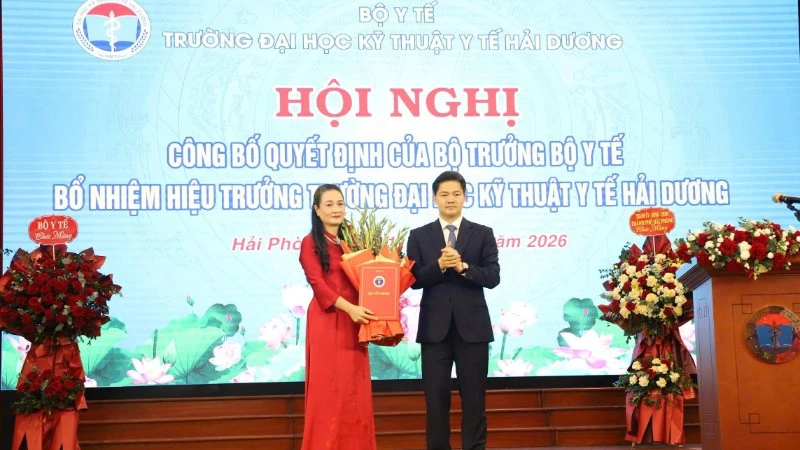
Vietnam's Ministry of Health Appoints New President for Hai Duong University of Medical Technology
Health
2026年7月11日
5
Nhan Dan

Vietnam's Ministry of Health Appoints New President for Hai Duong University of Medical Technology

AI サマリー

Vietnam's Ministry of Health has appointed Associate Professor, Dr. Đinh Thị Diệu Hằng as the new President of Hai Duong University of Medical Technology. The appointment is expected to contribute to the university's development and the training of high-quality medical personnel.

The Ministry of Health of Vietnam has announced the decision to appoint Associate Professor, Dr. Đinh Thị Diệu Hằng as the new President of Hai Duong University of Medical Technology. This appointment marks a significant step towards the university's development and the achievement of national goals in training high-quality medical personnel. At a ceremony held in Hai Phong on July 11, Deputy Minister of Health Vũ Mạnh Hà presented the appointment decision to Dr. Hằng. Deputy Minister Hà highly praised Dr. Hằng's experience, political acumen, and dedication to education and research cultivated over many years within the university. He stated that Dr. Hằng would bear "great responsibility before the Party, the State, the Ministry of Health, and the entire staff of the university." The Ministry of Health emphasized the current focus of Vietnam's healthcare system on implementing directives from the Central Committee, including Resolution No. 72-NQ/TW on protecting, caring for, and improving public health, and Resolution No. 57-NQ/TW on developing science, technology, innovation, and national digital transformation. Under these circumstances, educational institutions like the University of Medical Technology are urged to further innovate their management models, standardize training based on competency, promote scientific research, digital transformation, and international integration. Deputy Minister Hà pointed out that Hai Duong University of Medical Technology has the opportunity to continue playing a pioneering role in training high-quality medical technical personnel and meeting the demands of advanced and smart healthcare in the new era. While preserving its 65-year tradition, the university is expected to promote the healthy development of its Party organization, foster unity and exemplary conduct among its leadership, fundamentally and comprehensively reform its training, develop curricula based on competency standards, and strengthen ties with healthcare facilities. Furthermore, breakthroughs in scientific research, innovation, and digital transformation were encouraged, along with the application of artificial intelligence (AI), big data, and digital technologies in education, research, and university management. The development of research groups in medical technology, biotechnology, and digital health was also highlighted. Expanding cooperation with domestic and international universities, research institutes, hospitals, and organizations, as well as strengthening ties with localities and businesses, are considered crucial. Dr. Hằng, accepting her new role, affirmed her commitment to ensuring the quality of education, scientific research, and medical service provision at the university. She pledged to focus on preparing for national competency assessments and licensing exams, particularly in medical technology and nursing. Dr. Hằng stated her intention to drive digital transformation in management and training, enhance scientific and technological activities, and gradually establish research centers in health sciences, laboratory technology, rehabilitation, digital medical imaging technology, and medical AI, aiming to build green and smart universities and affiliated hospitals. She also emphasized strengthening relationships with medical and pharmaceutical universities, research institutes, central and local hospitals, military units, and domestic and international organizations in training, research, and healthcare services for the community. The university will continue to promote the study and following of Ho Chi Minh's moral example, ensuring comprehensive education for students, with medical ethics as the foundation, and each teacher serving as a role model in continuous professional development, medical ethics, and communication skills for students to emulate. Source: Nhan Dan

多角的分析

経済的影響

保健省による大学学長の任命は、直接的な経済効果をもたらすものではないが、長期的な視点ではベトナムの医療産業の高度化と国際競争力向上に寄与する。特に、AIやデジタル技術の導入推進は、医療サービスの効率化や新たなビジネス機会の創出につながる可能性がある。これは、ベトナムが目指す「スマート国家」構想とも連携し、医療分野におけるデジタル経済の発展を後押しすると考えられる。

投資家心理

このニュース自体が直接的な投資機会を示すものではないが、ベトナムの医療・教育分野への政府の注力姿勢を示すものとして注目される。投資家は、大学の改革や研究開発の進展が、将来的な医療技術関連企業の成長や、ヘルスケアサービス分野への投資機会に繋がる可能性を評価する必要がある。特に、AIやデジタルヘルス関連のスタートアップへの支援強化が期待される。

社会的影響

ハイデュオン医科技術大学の新学長任命は、地方の教育機関における人材育成の質向上への期待を高める。特に、医療技術分野は、地域住民の健康増進に直結するため、質の高い医療従事者の育成は喫緊の課題である。新学長が掲げる「グリーンでスマートな大学」の実現は、学生の学習環境の改善だけでなく、地域医療への貢献という点で、社会全体にポジティブな影響を与える可能性がある。

市民の声

ハノイやホーチミンなどの大都市だけでなく、ハイズオンのような地方都市の大学の学長人事は、全国的な医療サービスの均てん化という観点から重要である。市民としては、質の高い医療技術者の育成を通じて、将来的に地方でも高度な医療を受けられるようになることへの期待がある。また、大学の国際化や研究開発の進展は、ベトナム国民全体の医療水準向上につながると考えられる。

背景・歴史的文脈

ベトナムの一党体制下では、共産党中央委員会や政府が国家の発展戦略を策定し、各分野への指示を出す。教育分野、特に高度専門人材の育成は、国家の経済成長と社会安定に不可欠と位置づけられている。保健省による大学学長の任命は、党と政府の意向を反映し、教育機関の運営方針を国家戦略に沿ったものにするための重要な手段である。近年、ベトナムは科学技術の発展とデジタルトランスフォーメーションを国家の最優先課題の一つとしており、医療分野においても、AIやビッグデータといった先進技術の導入、国際標準に準拠した教育体制の構築が強く推進されている。ハイズオン医科技術大学は、このような国家的な改革の波の中で、その役割を再定義し、新たなリーダーシップの下で発展を目指すこととなる。

原文ソース

Nhan Dan

原文を読む