General articles are free for 24 hours after publish.
Indian Navy Bolsters Submarine Rescue Capabilities, Eyes Regional Role
The Indian Navy has commissioned the INS Nipun, a state-of-the-art Diving Support Vessel, significantly enhancing its submarine rescue capabilities. This move positions India to become a preferred submarine rescue partner in the Indo-Pacific region.
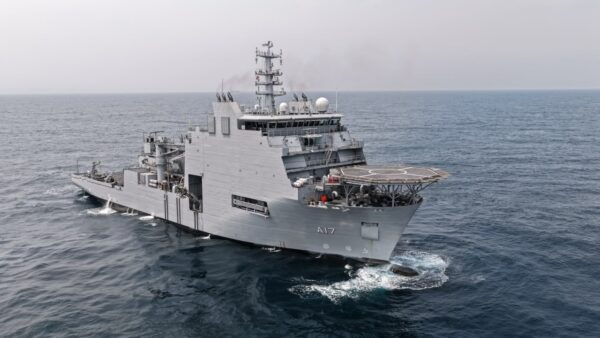
Read The Diplomat, Know The Asia-Pacific Commissioned on August 31, INS Nipun significantly augments the Navy’s specialist diving, underwater intervention, salvage, and submarine rescue support capability. INS Nipun, which was commissioned on August 31, 2026. On August 31, India commissioned INS Nipun, the second dedicated Diving Support Vessel (DSV) that serves as the mothership for the two Deep Submergence Rescue Vehicles (DSRVs) in service. With this, the Indian Navy crossed a threshold in a critical operational capability – submarine rescue – that has a bearing not just for India but for the entire region. Submarines are some of the most complex machines in existence and their operation is highly specialized. Submarine rescue takes that to another level and is a forte of a very small group of countries. Indian Navy Chief Admiral Krishna Swaminathan’s remarks at the commissioning ceremony in Mumbai aptly encapsulate this. The Nipun significantly enhances the capacity to respond to a distressed submarine, whether of the Indian Navy or that of a partner navy, he said, adding that this capability would also enable India to support submarine rescue and emerge as the “preferred submarine rescue partner” in the region. The Indian Navy signed a deal worth 193 million British pounds (around $217 million) with U.K.-based James Fischer Defense in 2016 under which it procured two DSRVs, a Launch and Recovery System (LARS), and a LARS-integrated decompression chamber. They were operationalized at Mumbai on India’s western seaboard at the end of 2018 and at Visakhapatnam on the eastern seaboard in early 2019. Concurrently, in September 2018, the navy signed a deal with state-owned Hindustan Shipyard Limited, located at Visakhapatnam, for the construction of the two DSVs, with the first vessel to be delivered in 36 months. Until the DSVs were completed, INS Sabarmati of the Ship Building Corporation of India acted as the interim ship for both the vessels. This left a major operational void, as it meant more time, which is the most critical factor in the event of a submarine disaster in the ocean depths. The two vessels were launched into water in September 2022, and the first, INS Nistar, was commissioned on July 18, 2025. The induction of INS Nipun now closes that loop, significantly augmenting the Indian Navy’s specialist diving, underwater intervention, salvage, and submarine rescue support capability. So far, the Indian Navy operated an older diving support vessel, INS Nireekshak, with limited submarine rescue capabilities. In the backdrop of the capability gaps in the past, India had signed an agreement with the United States for utilizing the U.S. Navy’s global submarine rescue flyaway kit. The Capability Displacing 10,000 tons, measuring over 118 meters in length, and with an endurance of 60 days, the Nistar and the Nipun were purpose-built for deep-sea diving and underwater operations for inspection and intervention and to serve as mother ships to the DSRVs. Each DSV can accommodate 25 officers and 225 sailors. Further, the expansive deep-sea diving systems with specialized diving complex, dynamic positioning capability, and associated life-support and medical facilities enable them to conduct sustained operations at sea, according to the Indian Navy. For this, they carry a 15-ton subsea crane, a diving bell, remotely operated vehicles (ROVs), side-scan sonar, compression chambers, and a self-propelled hyperbaric lifeboat. They can undertake deep-sea diving and salvage operations up to a depth of 300 meters. The DSRVs, in turn, can go down to a maximum depth of 650 meters and rescue 14 people in one go. They also carry a ROV and, together with the side-scan sonar, can locate a submarine at depths of up to 1,000 meters. Once a submarine is successfully located, a sub-module of the system, the Submarine Rescue Vehicle, mates with the submarine to rescue trapped personnel. The same feature can also be utilized to provide emergency supplies to a submarine. In 2018, before induction, the DSRV was put to trials, during which it set several “firsts” for the Indian Navy. It dived to a depth of 666 meters, the deepest submergence by a manned vessel in Indian waters, and carried out ROV operations at over 750 meters and side-scan sonar operations at over 650 meters. Given the nature of its operation, the DSRV is designed for ease of transportation. For this purpose, the entire system has been divided into 24 components, which can be easily transported by road, sea, and air. In addition to being paired with the mothership, the system can also be airlifted by heavy transport aircraft like the IL-76 and C-17 operated by the Indian Air Force, enabling swift deployment across theaters. The Criticality Reaching a disaster-struck submarine in the narrow time window is critical and a DSRV offers that lifeline for any submarine-operating Navy. For the Indian Navy, the order of criticality multiplies manifold, given its aging submarine fleet. The Indian Navy operates 16 conventional submarines – six Russian Kilo-class submarines and four German HDW-class submarines, both aging fleets long awaiting replacement, as well as six newer French Scorpene-class submarines. The newest Kilo-class sub is 26 years old, and the HDW class is over 30 years old. The fleets saw life extensions to keep them going amid delayed procurements. As stated by Captain Vikas Gautam, officer-in-charge of the Submarine Rescue Unit (East), during Exercise Milan in February this year, the true measure of any navy is not only its firepower, but “its resolve and capability to bring its men and women home safely.” Regional Assistance and Cooperative Arrangements The maritime domain with its wide expanse is inherently complex, and submarine rescue is a restricted capability both in terms of complexity and economics. In the last few years, India has signed several cooperation agreements with countries in the region for submarine rescue, offering its capabilities, which span bilateral arrangements and multilateral engagements. The Indian Navy also actively cooperates with the International Submarine Escape and Rescue Liaison Office (ISMERLO), established by the North Atlantic Treaty Organization (NATO), which coordinates international submarine rescue responses. In a demonstration of India’s capabilities in real time, in April 2021, India dispatched the two DSRVs to locate the missing Indonesian submarine KRI Nanggala, one with the mother ship and another airlifted in a C-17. However, they were recalled midway as the disaster-stricken submarine was located in the ocean depths. All crew onboard were dead. In January 2021, India and Singapore signed an implementing agreement on submarine rescue support and cooperation between the two navies. In September 2024, India and South Africa signed an implementing agreement that ensures the safety of the South African Navy’s submarine crew in times of distress or ac
Original source
The Diplomat Indonesia