General articles are free for 24 hours after publish.
Philippine Agriculture Export Strategy Hindered by Budget Shortfall
The Philippines' Department of Agriculture is prioritizing an export strategy, but budget allocation is not keeping pace. The nation lags significantly behind Vietnam in production and export values, highlighting the necessity of increased congressional funding for strategy execution.
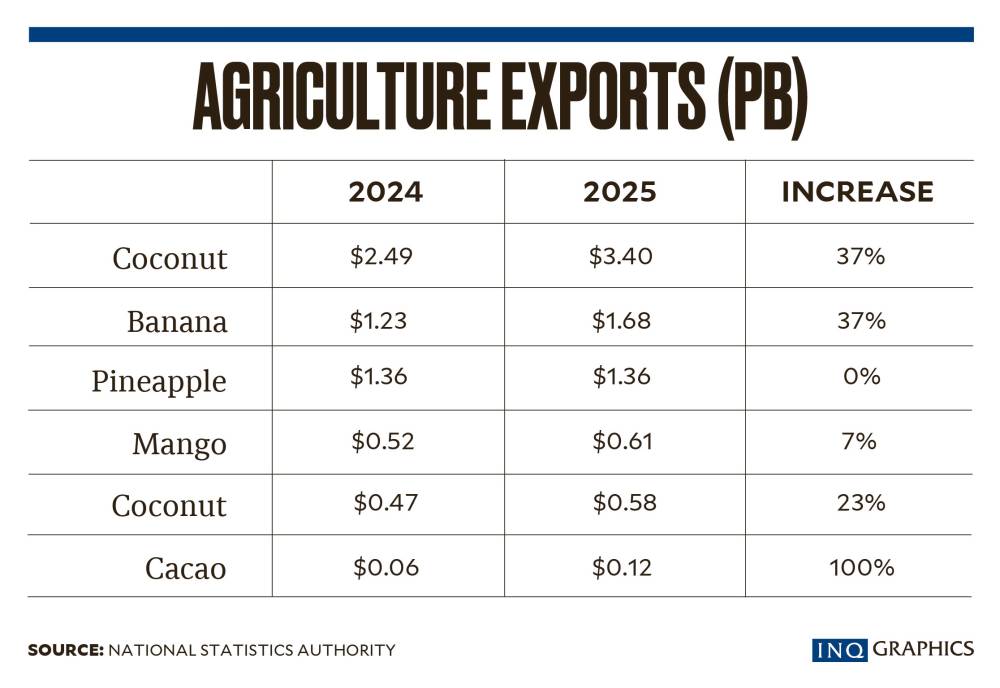
Just as structure should follow strategy, so should budget support this strategy. At the Department of Agriculture (DA), this is happening, but not enough. The first step is to decide on a correct strategy. For a long time, the strategy of agriculture exports as a key focus was ignored. There was no structure to support this, and no budget. But first, is an agriculture export strategy correct for us? Definitely. Let us consider Vietnam. For economic growth and poverty reduction, its government decided to strategically focus on agriculture exports. They backed this up with both structure and budget. Vietnam’s population is 101 million, similar to our 113 million. Last year, their agriculture production value was $60 billion, twice our $32 billion. Worse, their agriculture exports totaled $70 billion, eight times our $8.5 billion. If we only attain 60 percent of their agriculture exports, we would not have needed the 2025 overseas remittances of $39.6 billion, done at great cost to our social lives. Our agriculture system, unlike Vietnam’s, is severely flawed. They implemented what we taught them. We did not implement. As a result, we have low value-added, fragmented farms, defective logistics, weak processing and poor market development. On top of this, until Agriculture Secretary Francisco Tiu Laurel Jr. took over in late 2024, we had no export vision. As the elected private sector international committee chair of the legislated public-private Philippine Council of Agriculture and Fisheries (PCAF), I saw firsthand what Tiu Laurel accomplished. He established the structure of an Export Development Office (EDO) headed by Undersecretary Philip Young. Given the government’s Export Development Plan of $8.6 billion by the end of 2028, Tiu Laurel helped deliver $8.5 billion in 2025, three years ahead of schedule. Last year, our agriculture exports increased by 19 percent, even higher than Vietnam’s growth rate of 13 percent and Thailand’s 3 percent. The limited High-Value Crops (HVC) budget, which also finances the DA export strategy, is only 0.5 percent of the total P250-billion DA budget. It has three parts: P1.8 billion for HVC1 products for domestic and household consumption; P600 million for 16 priority export products; and P400 million just for coffee. HVC1 covers crops such as lowland vegetables (e.g., tomato, eggplant, etc), spices (e.g., onions, black pepper, etc.), and fuits (e.g., guyabano, langka, etc). HVC2 covers 16 priority export crops. In addition, the budget support for all agriculture export and promotion is lodged here. Considering that agriculture exports is now a major strategy, it is incongruous that HVC2 has such a small budget. Consider the table below. Internal discussions among the different units and departments sometimes have puzzling results. Congress must now use its “power of the purse” to make the necessary corrections. Take the case of banana. The good news is that there was a reported 37-percent increase in value in 2025. (Note: There is a need for stakeholders to significantly improve our reporting system accuracy, which implies an increased budget for this). However, our 2025 export value decreased to one-half of 2020. A proposal was made for an annual P1-billion annual budget for the next five years. This would not only restore our lost ground, but result in $1 billion in increased revenue over that period. It was rejected, despite the very high return on investment. Banana now has to get a small share of the P600 million allocated for the 16 priority products. With this budget orientation that does not support strategy, the EDO stated that we will soon lose our market shares to countries like Vietnam, Thailand and Cambodia. This means huge job losses, increased poverty and a weakened trade balance. Tiu Laurel and the EDO have done their share, as proven by their commendable performance with our exporters last year. There are now well-conceived export sector programs, meaningful governance participation with the stakeholders and an Export Help Desk, which is a focal point and provider of fast service. This has helped build exporter trust and confidence in the DA. Will Congress now support the agriculture export strategy with the appropriate budget? If not, the export gains that have been recently won will be wiped out. Instead, Congress should lead the way so that this crucial strategy transforms from rhetoric to reality, and moves our agriculture and nation forward. INQ The author is Agriwatch chair, former secretary of presidential flagship programs and projects, and former undersecretary of the Department of Agriculture and the Department of Trade and Industry. Contact is [email protected].
Original source
Inquirer Business