General articles are free for 24 hours after publish.
JASDF Global Hawk Presumed Crashed Off Western Japan
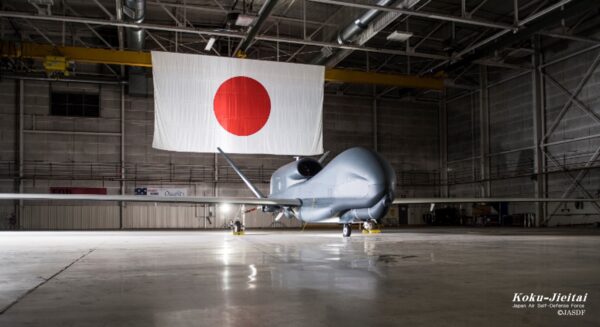
A Japan Air Self-Defense Force (JASDF) RQ-4B Global Hawk surveillance drone is presumed to have crashed into the Sea of Japan on September 15 after experiencing communication problems and disappearing from radar. This marks the first such incident for the JASDF, raising concerns about its operational capabilities and intelligence, surveillance, and reconnaissance (ISR) capacity. An investigation into the cause is underway.
A Japan Air Self-Defense Force (JASDF) RQ-4B Global Hawk is presumed to have crashed into the Sea of Japan (East Sea) on September 15 after experiencing communication problems and disappearing from radar. It’s the first such incident involving a JASDF Global Hawk, a high-altitude, unmanned surveillance aircraft manufactured by U.S. defense firm Northrop Grumman. The aircraft, assigned to the 502nd Squadron of the Airborne Warning and Control Wing at Misawa Air Base in Aomori Prefecture, took off from the base at around 10:20 a.m., according to the JASDF. Problems connecting with the aircraft’s communications equipment began after 12:55 p.m. Three minutes later, at around 12:58 p.m., its radar track disappeared over waters about 50 kilometers north of Tottori Prefecture in western Japan. Japan immediately mounted a search for the missing UAV. The effort involved two F-15J fighters, a U-125A search-and-rescue aircraft, a UH-60J helicopter, and a KC-46A tanker from the JASDF, as well as the Japan Maritime Self-Defense Force frigate Agano and missile boat Hayabusa. The Japan Coast Guard discovered floating debris at around 2:19 p.m., and a JASDF F-15J fighter reported a debris sighting six minutes later. The U-125A search-and-rescue aircraft photographed the debris at 3:12 p.m. By 5:20 p.m., the JASDF had determined from the photographs that the debris was likely from the missing Global Hawk. “Based on the floating objects discovered, the aircraft is presumed to have crashed,” the Air Staff Office said in its second report on the incident. The cause remains under investigation. No damage outside the Self-Defense Forces had been reported as of 5 p.m. The incident raises questions not only about what caused the Global Hawk to go down but also about the potential impact on Japan’s intelligence, surveillance, and reconnaissance (ISR) capabilities. At a press conference earlier on September 15, JASDF Chief of Staff General Morita Takehiro said the aircraft “was not on a training flight,” but declined to disclose what it had been doing. Asked by this author whether the Global Hawk was likely to have crashed, Morita said at the time that the JASDF was considering “all possibilities” as it conducted the search. The subsequent discovery of debris led the service to presume that the aircraft had indeed crashed. The JASDF operates three RQ-4Bs, all based at Misawa. Morita said this was the first time a JASDF Global Hawk had gone missing. Japan began acquiring the Global Hawk in fiscal year 2015 to strengthen its persistent wide-area surveillance capabilities. The first aircraft arrived at Misawa in March 2022; the third arrived in June 2023, completing the planned three-aircraft fleet. The RQ-4B is one of the JASDF’s key intelligence-gathering platforms. With a wingspan of about 40 meters and a length of about 15 meters, the UAV can remain airborne for around 36 hours and operate at altitudes of around 60,000 feet. Its high-altitude endurance allows it to monitor vast areas for extended periods without putting an aircrew at risk. It is also an expensive asset. Japanese Defense Ministry documents put the unit cost of a Global Hawk at approximately 17.3 billion yen ($111.7 million). If the aircraft is ultimately confirmed lost, it would represent not only a significant financial loss but also the loss of one-third of Japan’s small Global Hawk fleet. Retired JASDF Lt. Gen. Araki Junichi told NHK that a simple loss of communications would not necessarily explain the presumed crash because the aircraft is programmed to return to base if communications are lost. He suggested that an engine or other mechanical problem may have prevented normal flight, although the cause has yet to be established. Araki also warned that losing one of the three aircraft could make continuous surveillance operations more difficult, potentially requiring other aircraft to compensate and increasing the burden on operational units. The immediate priority is to recover as much of the aircraft as possible and determine what happened during the critical three-minute period between the onset of communication problems and the disappearance of its radar track. Investigators will also need to establish what the aircraft was doing at the time, why communications failed, whether its automatic return-to-base function was activated, and why the aircraft was apparently unable to continue flying or return to base. The answers will be important not only for preventing a recurrence, but also for assessing the reliability of a strategically important surveillance capability at a time when Japan is seeking to strengthen persistent intelligence-gathering around its increasingly contested neighborhood. Subscribe today and join thousands of diplomats, analysts, policy professionals and business readers who rely on The Diplomat for expert Asia-Pacific coverage. Get unlimited access to in-depth analysis you won't find anywhere else, from South China Sea tensions to ASEAN diplomacy to India-Pakistan relations. More than 5,000 articles a year. Already have an account? Log in. Takahashi Kosuke is Tokyo Correspondent for The Diplomat. Get briefed on the story of the week, and developing stories to watch across the Asia-Pacific.
Original source
The Diplomat Indonesia