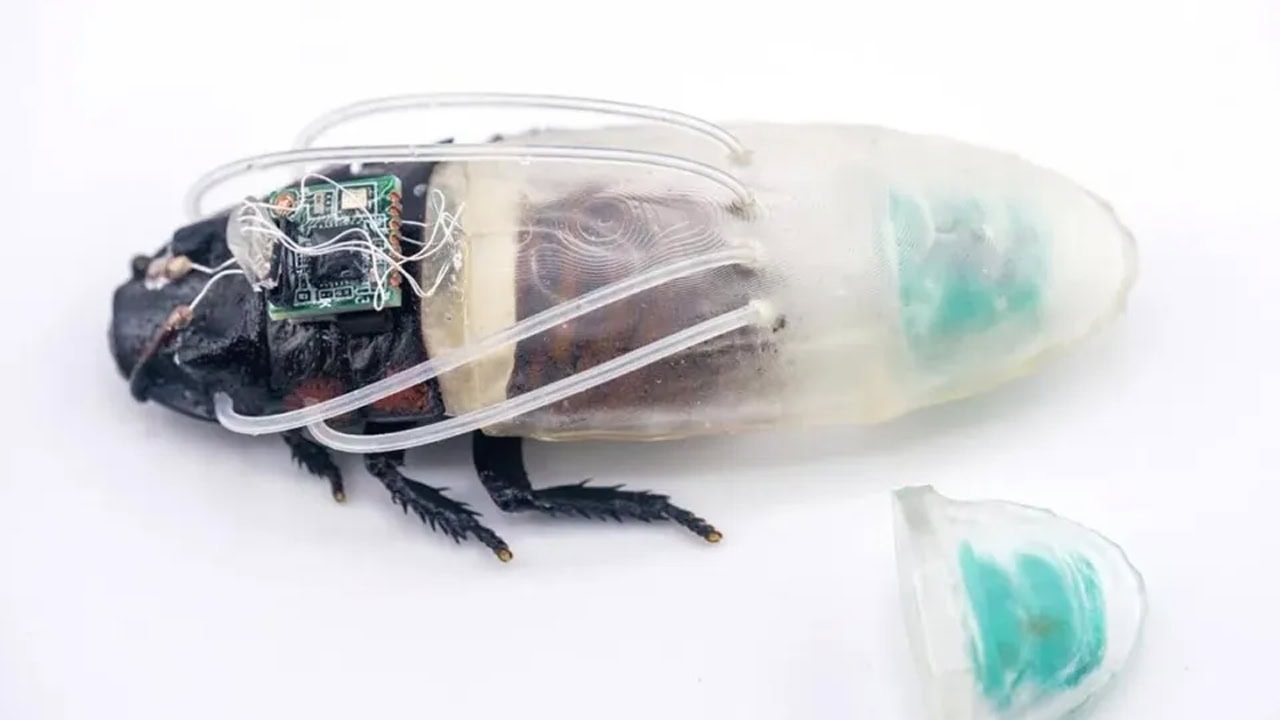
Cambodia Explores Underwater Cyborg Cockroaches for Disaster Rescue
Singapore and Japanese researchers have developed a 'diving suit' for cyborg cockroaches, potentially aiding disaster rescue efforts in Cambodia. The innovation extends their underwater and low-oxygen survival time to three hours, enhancing their search capabilities.
Singapore and Japanese scientists have developed a groundbreaking "diving suit" designed to enhance the capabilities of cyborg cockroaches in disaster rescue operations. This innovation holds potential for application in countries like Cambodia, which are prone to natural disasters. The flexible diving suit, a collaborative effort between Nanyang Technological University (NTU) in Singapore and Waseda University in Japan, enables the insects to survive and move underwater, as well as in low-oxygen environments, for up to three hours. Equipped with infrared cameras, sensors, and electrodes, these cyborg cockroaches can assist in locating survivors in disaster-stricken areas. Previously, the use of these roaches was limited as they rely on their natural respiratory system and cannot take in oxygen when fully submerged. To overcome this, researchers developed a miniature suit comprising an oxygen-generation tank, a flexible shell, and four silicone oxygen-supply tubes. Diluted hydrogen peroxide is injected into a 3D-printed tank containing a sponge coated with manganese dioxide. The reaction releases oxygen, which is channeled through the shell and tubes to the cockroach's spiracles, allowing it to breathe underwater. The suit was tested using the Madagascar hissing cockroach, a species commonly used in cyborg insect research due to its size and robustness. The team's findings were published in the peer-reviewed journal Nature Communications. Hirotaka Sato, a professor at NTU's School of Mechanical and Aerospace Engineering, explained, "Our new insect diving suit works like the oxygen tank used by human divers. It generates oxygen and delivers it directly to the insect’s breathing holes, allowing the cyborg cockroach to survive and move in underwater or low-oxygen environments." He highlighted the importance of this advancement, especially as heavy rains and flooding can obstruct access to disaster areas. Shinjiro Umezu, a professor at Waseda University's School of Creative Science and Engineering, noted that the key engineering challenge was to create a system that was small, light, and flexible enough for the insect to wear, while still producing sufficient oxygen for extended underwater movement. "Our approach combines a soft waterproof shell with a simple yet reliable chemical oxygen generator. This allows the insect to retain its natural mobility while being protected from an environment that it cannot normally survive in," he added. The researchers are currently testing the diving suit in simulated disaster environments and aim to improve its durability and integrate sensors and navigation systems. They suggest that beyond search-and-rescue, the suit could potentially be used for inspecting flooded pipes and tunnels. Given Cambodia's history of natural disasters such as floods and earthquakes, such innovative technology could significantly enhance the efficiency of life-saving operations.
多角的分析
このニュースは直接的な経済効果を示すものではないが、将来的な災害救助コストの削減や、インフラ点検など新たなサービス分野の創出につながる可能性を秘めている。特に、カンボジアのようにインフラ整備が進行中の国では、点検・保守コストの削減に寄与する可能性がある。また、この技術が実用化されれば、関連するロボティクスやバイオテクノロジー分野への投資を促進する触媒となり得る。
現時点では、この技術は研究開発段階であり、直接的な投資機会は限定的である。しかし、将来的には、災害対応ロボット、インフラ点検サービス、またはサイボーグ昆虫技術に関連するスタートアップ企業への投資が考えられる。投資家は、技術の成熟度、実用化のスピード、そして規制当局の承認プロセスを注視する必要がある。カンボジアのような新興市場での応用は、高いリターンをもたらす可能性があるが、同時にリスクも伴う。
この技術は、災害発生時の生存者発見能力を向上させることで、人命救助に直接貢献する可能性がある。特に、カンボジアのようなインフラが脆弱な地域では、狭い場所や危険な場所での捜索活動において、ゴキブリのような小型で機敏な昆虫の活用は、人間の捜索隊員のリスクを軽減し、より迅速な救助活動を可能にする。一方で、昆虫を「サイボーグ化」し、災害救助に利用することに対する倫理的な議論も生じる可能性がある。
カンボジア市民にとって、この技術は災害時の安全確保に間接的な恩恵をもたらす可能性がある。特に、洪水や地震などの自然災害が多い地域では、迅速な救助活動が生存率に直結する。サイボーグゴキブリが、人間が到達困難な場所での生存者捜索を支援できれば、より多くの命が救われることが期待できる。しかし、この技術が一般市民の生活に直接的な影響を与えるまでには、まだ時間がかかるだろう。
背景・歴史的文脈
サイボーグ昆虫技術は、2000年代初頭から研究が進められてきた。当初は、昆虫の生体機能を外部から制御し、偵察や監視に利用する試みが中心であった。近年、センサー技術や小型化技術の進歩により、より複雑なタスクへの応用が可能になりつつある。今回の潜水服開発は、昆虫の生存環境を拡張するという点で、この分野の新たな展開を示唆している。カンボジアにおいては、過去に頻発した洪水や地震といった自然災害への対応能力強化が喫緊の課題であり、こうした先進技術の導入が検討される背景がある。
原文ソース
Phnom Penh Post