General articles are free for 24 hours after publish.
Cambodia Denounces Thai Cluster Bomb Use, Alleging International Law Violations
Cambodia's Cambodian Mine Action Centre (CMAC) announced that the Thai military used cluster bombs in violation of international law during its invasion of Cambodian territory. It detailed the technical characteristics and extensive damage, warning of the long-term threat posed by unexploded ordnance.
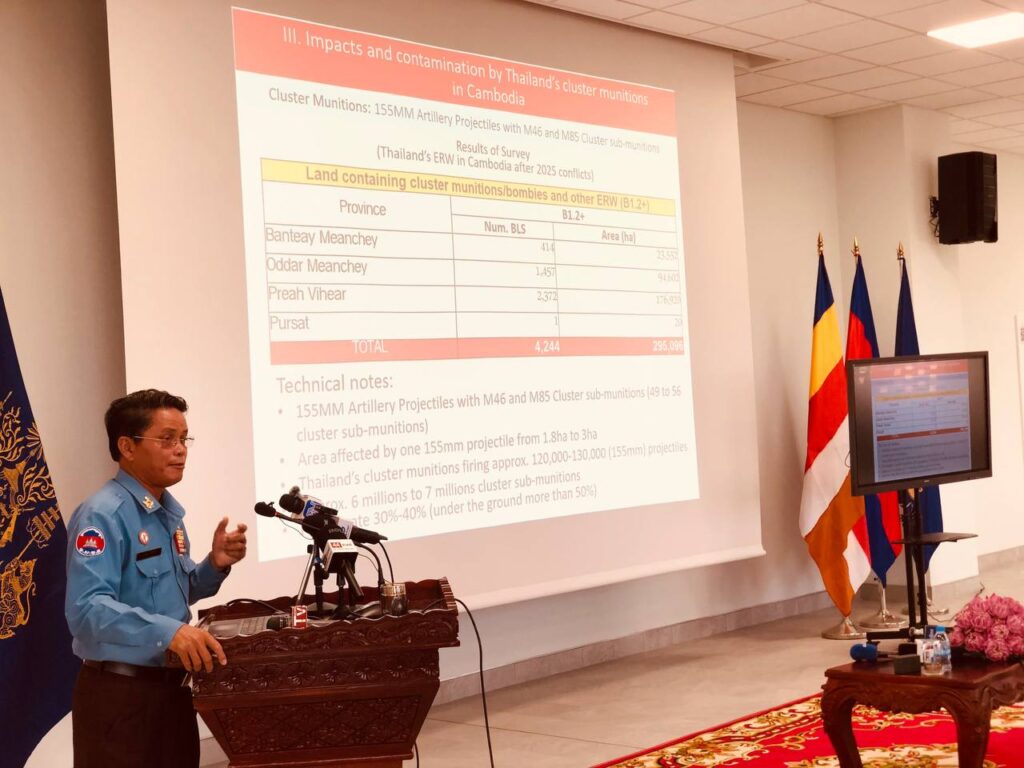
The Cambodian Mine Action Centre (CMAC) has asserted that the Thai military employed numerous types of deadly weapons, particularly cluster bombs that contravene international law, during its invasion and occupation of Cambodian territory. At a press conference on September 11, 2026, Heng Ratana, Director-General of CMAC, detailed the technical specifications of cluster bombs used by the Thai military to attack civilian sites situated far from combat zones. A large projectile weighing over 20 kilograms, containing submunitions, is classified as a cluster bomb. The 155mm projectiles reportedly used by the Thai military weigh approximately 46.5 kilograms each and can carry between 49 to 58 small submunitions per large bomb. These cluster bombs can be launched from artillery or dropped from combat aircraft and drones. These weapons are designed to disperse submunitions over an area of approximately 1.8 to 3 hectares per large bomb, a stark contrast to conventional artillery shells which cause destruction within a radius of only 15 to 20 meters. Regarding firing capabilities, older 155mm artillery pieces can fire 2 rounds per minute, while modern semi-automatic artillery can achieve a rate of 15 to 30 rounds per minute. During a 26-day conflict, the Thai military reportedly fired these munitions continuously, day and night. Cluster bombs are equipped with self-destruction mechanisms or timed fuses designed to detonate 3 to 4 minutes after impact. However, on-site investigations indicate that the unexploded ordnance (UXO) rate is approximately 30% to 40% on the surface and can exceed 50% when buried underground, posing a severe and ongoing threat to civilians. According to CMAC's research data, cluster bombs fell on 335 out of 349 affected villages, covering an area of approximately 295,000 hectares, equivalent to 2,950 square kilometers. Based on this vast area, calculations suggest that between 120,000 to 150,000 large bombs were fired. Multiplied by roughly 50 submunitions per bomb, this amounts to millions of individual submunitions.
Original source
Kampuchea Thmey Local