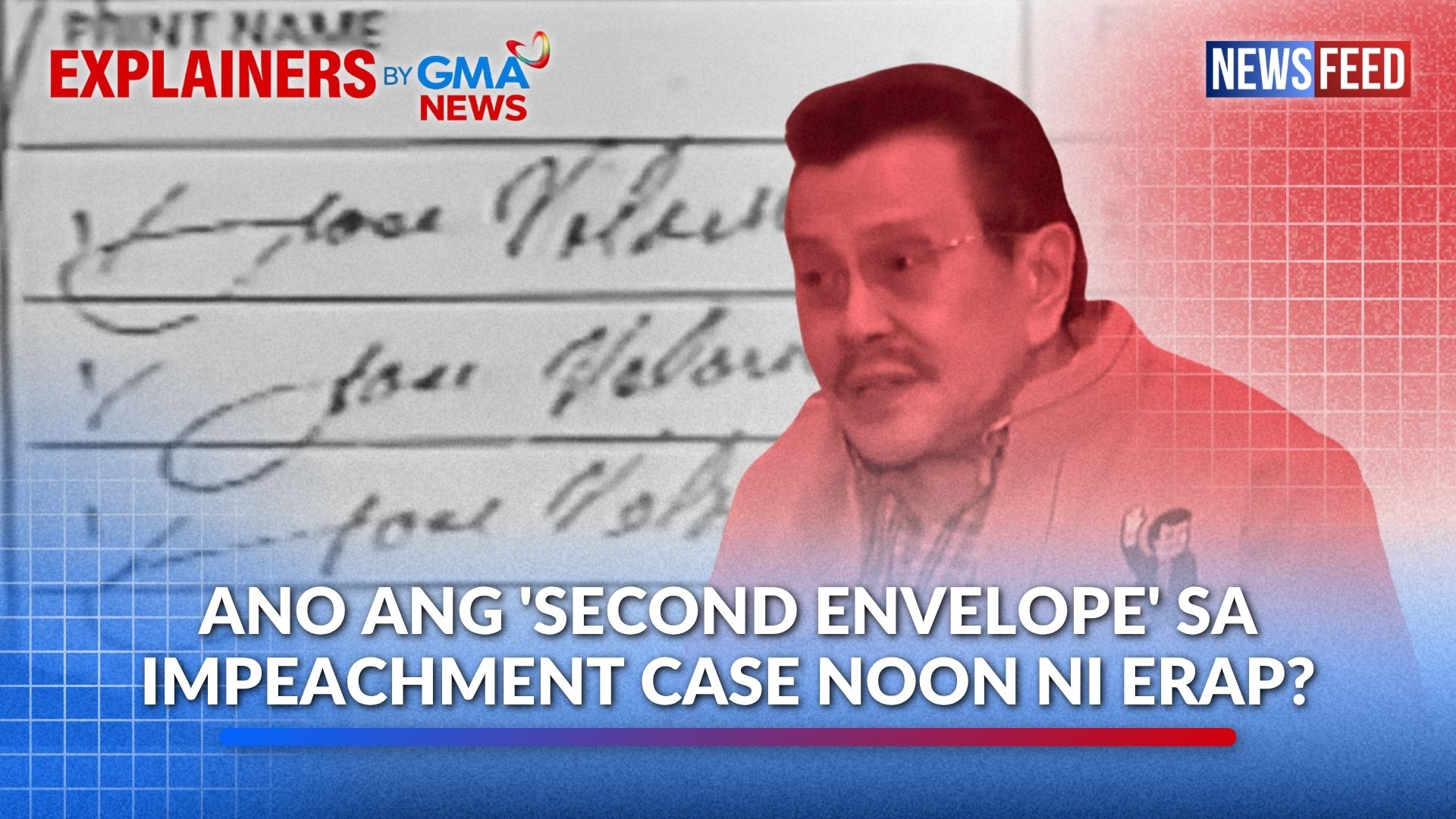
Second Envelope' Controversy Rekindled Amid VP Duterte's Impeachment Trial
Technology
2026年7月22日
5
GMA News Philippines

General articles are free for 24 hours after publish.

Second Envelope' Controversy Rekindled Amid VP Duterte's Impeachment Trial

Share
AI Summary

Discussions surrounding the controversial 'second envelope' from former President Erap Estrada's impeachment trial have resurfaced amid the impeachment proceedings against Vice President Sara Duterte, highlighting parallels in the battle over financial record disclosure.

Discussions surrounding the controversial 'second envelope' from former President Erap Estrada's impeachment trial over two decades ago have heated up in the Philippines, following the issuance of a subpoena for Vice President Sara Duterte's financial records. What was this envelope? What was inside it? Why was it controversial? In 2000, Estrada was impeached by the House of Representatives on charges of bribery, graft and corruption, betrayal of public trust, and violation of the Constitution. As of 2026, he is the only Philippine president to have ever been impeached by the House. During the Senate impeachment trial, a surprise witness, then-bank executive Clarissa Ocampo, linked Estrada to the 'Jose Velarde' account, which allegedly contained proof of Estrada's ill-gotten wealth. Senator-judges were presented with a second envelope that supposedly contained evidence that corroborated the witness' story. Ocampo said Estrada himself affixed the signature of Jose Velarde on the document. Some of the senator-judges expressed the need to open the envelope. Then senator-judge Franklin Drilon said the evidence was 'relevant and material.' 'My colleagues, Envelope Number Two is relevant and material in our quest for truth. Envelope Number Two is relevant and material for the credibility of this proceeding. Envelope Number Two is relevant and material for the credibility of this institution. Envelope Number Two is relevant and material to the faith of our people in this democracy,' Drilon said in 2001. However, other senator-judges voted against this. Then-senator Tessie Aquino-Oreta called the prosecution's desire to open the envelope a 'fishing expedition.' 'I cannot and will not allow this court, Mr. Chief Justice, to be used wittingly or unwittingly by the prosecution in their fishing expedition to the detriment of our country's economy,' Aquino-Oreta said. Then senator-judge John Osmeña said the proceedings were turning into a 'spectacle.' 'For me, Mr. President, Mr. Chief Justice, this is just a simple vote on a simple procedural issue which is well-defined, provided for in the Rules of Evidence and all the rules that we have been following. So, in conclusion, may I say, Mr. President and Mr. Chief Justice, what is this fuss all about?' Osmeña asked. In the end, 11 senator-judges voted against the opening of the second envelope, with 10 voting otherwise. Several members of the prosecution and attendants of the impeachment trial walked out of the proceedings in protest. This turn of events at the Senate impeachment court was considered the spark that ignited the second EDSA People Power Revolt, which led to Estrada's ouster from Malacañang on January 20, 2001. More than a decade later, the financial records of the late Chief Justice Renato Corona also became a hot topic during his impeachment trial in 2012. Corona was impeached by the House over his failure to declare his Statement of Assets, Liabilities and Net Worth (SALN). Much like in Duterte's case, senator-judges deliberated on the issuance of a subpoena to get his bank and tax records. Fast forward to 2026, on Day 7 of Sara Duterte's impeachment trial, the court approved the issuance of a subpoena for her financial records. The House Prosecution team said this was vital to know the whole truth in relation to Article II of the impeachment charges, which pertains to the discrepancies in Duterte's Statement of Assets, Liabilities, and Net Worth (SALN). Duterte's defense team, however, argued that this subpoena would violate due process. They cited the Bank Secrecy Law, which mandated that all of the bank transactions of an individual should be confidential. However, the impeachment process is one of the exemptions. The court found that the prosecution was able to prove the need to subpoena Duterte's bank and tax records. 'Their admissibility and evidentiary use shall remain subject to the Prosecution establishing their connection to the alleged unexplained wealth during the Respondent's present term in relation to Article II of the Articles of Impeachment,' impeachment presiding officer Senator Francis 'Chiz' Escudero said. Source: GMA News Philippines

0

Original source

GMA News Philippines

原文を読む