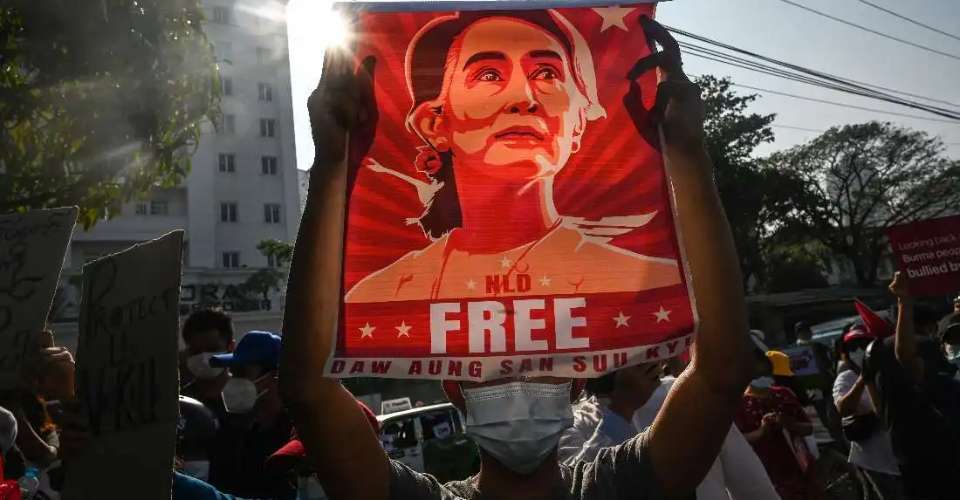
Free Myanmar’s political prisoners
The international community must act to free those in jail and deny the junta legitimacy until they are released Benedict Rogers for UCA News Earlier this month, the Committee to Protect Journalists (CPJ) announced that Myanmar photojournalist Sai Zaw Thaike would receive one of its International Press Freedom Awards, alongside journalists from five other countries. This is the second time this year that this courageous reporter with the independent news outlet Myanmar Now has been honored, having been awarded Reporters Without Borders’ (RSF) Courage Prize in June. The tragedy is that Sai Zaw Thaike will not be in New York to receive the CPJ award, just as he could not be in Marseille to receive RSF’s prize. Why? Because he is serving a 20-year prison sentence in a Myanmar jail. Sai Zaw Thaike was arrested on May 23, 2023, while covering the aftermath of Cyclone Mocha in Sittwe, where many members of the persecuted Rohingya minority were killed in the storm. Four months later, he was sentenced to 20 years with hard labor — among the longest known sentences imposed on any journalist in Myanmar since the 2021 coup. In jail, Sai Zaw Thaike has been beaten, tortured and physically abused, and denied medical treatment. Three years after his arrest and sentencing, it is right that he should be honored by groups like the CPJ and RSF. But the international community should do much more to secure his release, and the release of other political prisoners like him. Sai Zaw Thaike is far from alone. According to the CPJ, he is one of at least 30 journalists in jail in Myanmar, making the country the world’s second-worst imprisoner of journalists. Moreover, he is among more than 30,000 people arrested by the military regime since the coup, and one of more than 14,000 political prisoners still in prison in Myanmar today, according to the Assistance Association for Political Prisoners. As a human rights defender, I care about every political prisoner. One political prisoner is one too many. But as a writer and journalist, I have a special affinity with those who have been jailed for what they have written and published, just as I have a particular solidarity as a person of faith with those persecuted for their religious beliefs. Other cases that stand out alongside Sai Zaw Thaike’s — particularly because of the severity of their sentences — include that of Myo San Soe, a freelance journalist sentenced to 15 years in prison on terrorism charges in December 2022 simply for reporting on anti-coup protests, or writer and anti-coup protest leader Wai Moe Naing, who was initially sentenced to 34 years imprisonment after his arrest following protests against the coup in Monywa, Sagaing Region. In May 2023, he was sentenced to a further 20 years for high treason, and a year later he received another 20-year sentence — taking his total sentence to 74 years. Like so many of Myanmar’s political prisoners, he has reportedly been beaten, tortured, and denied medical treatment. Last week, I wrote here about the case of Dr Linn Htut, the elected chief minister of Shan State and a participant in the 1988 democracy movement. His son, Sai, an artist, is a friend of mine, and has spent the past five years fighting for his father’s freedom. Sai — who earlier this year at the Oslo Freedom Forum received the Vaclav Havel International Prize for Creative Dissent, presented by the actor Richard Gere — has told me first-hand how soldiers seized his father in the early hours of the morning on Feb. 1, 2021, as they perpetrated their illegal coup. He was later sentenced to 20 years in prison and now faces the real danger of dying in custody, as he is denied proper medical care. Another case of grave concern is Myat Kyaw Thu, a student from Dawei who participated in protests against the coup. In December 2021, he was sentenced to 29 years in prison, and then a year later faced a new charge which led to seven more years, resulting in a 36-year sentence. These cases are just some of the most egregious. There are thousands more people languishing in Myanmar’s jails, enduring torture and mistreatment, whose names and stories are not yet known. Of course, the most well-known political prisoner in Myanmar is the country’s democratically elected leader, Aung San Suu Kyi, who won re-election in November 2020. Earlier this year, if the electoral cycle had been respected and upheld, she would have completed her second term in office and would right now either be beginning her third term or be moving into retirement having passed the baton on to her successors. Instead, she has spent the past five years in jail, serving a prison sentence that was originally 33 years, later commuted to 27 years and further reduced to 18 years. At the age of 81, that means she will die in detention unless international pressure for her release is increased. Earlier this year she was reportedly moved from prison to house arrest, but the conditions and whereabouts of her current detention are still unknown. Even the confirmation that she is still alive, through photographs and video of her meeting the International Committee of the Red Cross released earlier this month, provides no information about the conditions of her continued detention. As Myanmar’s dictator Min Aung Hlaing begins to tour the region and beyond in search of legitimacy, the international community must unite with one voice to deliver a clear message: there can be no legitimacy as long as a single political prisoner remains in jail. Min Aung Hlaing must be pressed to free all 14,000 or more remaining political prisoners — immediately and unconditionally. That starts with Aung San Suu Kyi, but it absolutely must not end there. The Association of South-East Asian Nations (ASEAN) in particular should leverage its trade and business interests to press the regime to free political prisoners. Thailand’s recent seemingly unconditional embrace of Min Aung Hlaing was egregious and disgraceful — Thailand could make amends by leading the way within ASEAN to press for the release of political prisoners. It must lead to people like Sai Zaw Thaike being freed and able to collect his awards in Marseille and New York, Dr Linn Htut being reunited with his son Sai, Wai Moe Naing being able to write again without fear, and Myo San Soe being able to report again without hindrance. Not one inch of credibility should be afforded to Min Aung Hlaing unless and until these and thousands of other brave journalists, activists, lawyers, politicians and human rights defenders are free to speak their minds. And until Myanmar’s people can live in peace without fear of airstrikes. Twenty-six years ago, as a young journalist-activist, I was in East Timor in the immediate aftermath of that tiny, courageous nation’s valiant fight for freedom. As I surveyed the burning villages, the scenes of massacres, the smouldering embers of destroyed homes, schools, hospitals and church
This article requires PRO
This article is outside the free access window or is a special report. PRO unlocks it and the full archive.
Related articles
- Mae Tao Clinic highlights Thai-Myanmar border crisis after winning Okinawa Peace Prize
In an exclusive interview with DVB following the announcement of the 13th Okinawa Peace Prize, Dr. Cynthia Maung, founder and director of the Mae Tao Clinic, reflected on the clinic’s recognition as the first non-Japanes
- MAA calls for a one-day work stoppage to protest the visit of the interim president Min Aung Hlaing to Malaysia
Ayeyarwaddy Times October 5 Myanmar Affairs Alliance (MAA) has urged Myanmar nationals residing in Malaysia to participate in a "work stoppage strike" by refraining from going to work entirely on the upcoming October 7th
- Skeletons of 12 Civilians Discovered in Mass Graves in Myanmar’s Myaing Township
The human remains of 12 civilians abducted by Myanmar military forces in June 2023 have been discovered in two mass graves near Wetpoke Village in Magway Region’s Myaing Township, according to local resistance fighters a
- Myanmar workers in Malaysia call for strike ahead of Min Aung Hlaing visit to Kuala Lumpur
The Myanmar Affairs Alliance, an advocacy coalition representing Myanmar migrant workers across Malaysia, issued an urgent appeal on Monday, calling for a nationwide “Work Stoppage Strike” on Wednesday. The strike is org