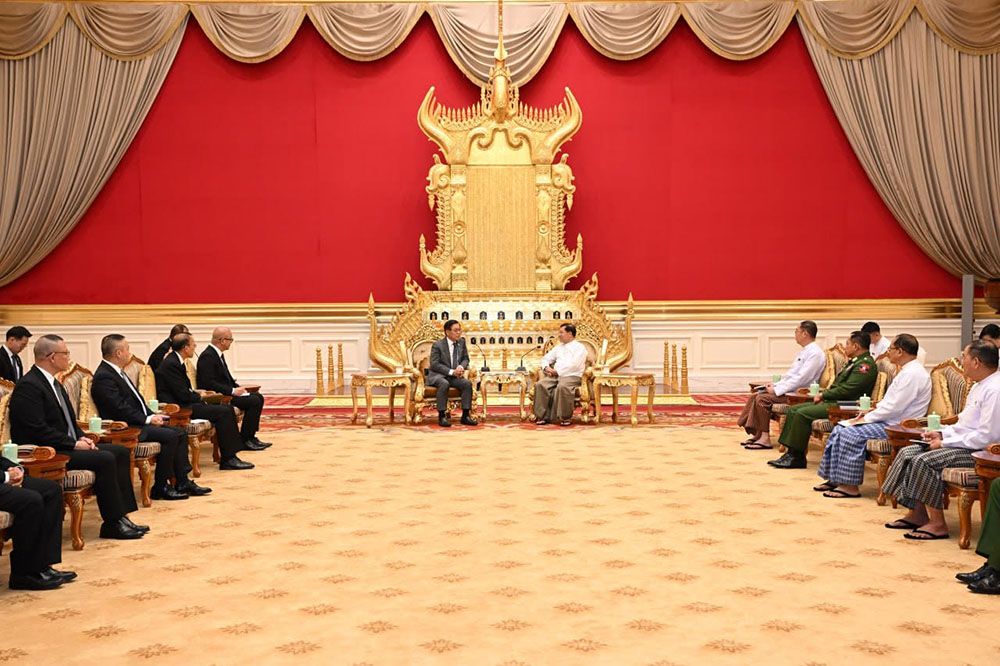
Thailand offers to mediate talks between Myanmar regime and 2 ethnic armed groups
Thailand has offered to facilitate talks between Myanmar’s military regime and ethnic armed groups, including the Karen National Union (KNU) and Karenni National Progressive Party (KNPP), Thai Foreign Minister Sihasak Ph
Read up to 3 eligible full articles per Japan day (JST) for free
Create a free account to open up to 3 eligible full articles per Japan calendar day (JST). Headlines and summaries remain available across ASEAN 7.
Related articles
- Cash bribes buy passage for telecom scammers at Myanmar junta checkpoints
Security personnel along major transit routes—connecting Mon State’s capital, Mawlamyine, to Mudon, and Karen State’s capital, Hpa-An, to border hubs such as Myawaddy, Shwe Kokko and Payathonzu—reportedly demand between
- Crackdown intensifies on border-based online scams targeting Chinese citizens
RECOGNIZING that on-line scams and gambling are global challenges involving technology, in-formation, the economy, security and international relations, the Government has made combating these activities a national duty.
- Myanmar at a crossroads: International justice, accountability and federal democracy
Myanmar is approaching a defining moment in its modern history. More than five years after the military seized power in February 2021, the country remains trapped in a devastating conflict marked by airstrikes against civilians, mass displacement, food insecurity and widespread destruction of public infrastructure. Yet the central question is no longer simply whether the military can retain power through force. It is whether a military institution that has repeatedly failed to establish political legitimacy, national reconciliation and lasting stability can continue to impose its authority on a population demanding a different political future. Three interconnected developments deserve particular attention: the forthcoming judgment of the International Court of Justice (ICJ) in The Gambia v. Myanmar genocide case on November 19; the expanding international accountability process concerning Senior General Min Aung Hlaing; and the emergence of the Steering Council for the Emergence of a Federal Democratic Union (SCEF) as a framework for political and military coordination among resistance forces. Together, these developments raise a fundamental question: can Myanmar move beyond military domination towards a federal democratic union founded on national equality, civilian authority and the rights of all its people? November 19: A Defining Moment for International Justice On November 19, the International Court of Justice in The Hague will deliver its final judgment in The Gambia v. Myanmar, concerning alleged violations of the 1948 Genocide Convention against the Rohingya population. The case, initiated by The Gambia in 2019 with the support of the Organization of Islamic Cooperation, concerns allegations arising particularly from the Myanmar military’s 2017 operations in northern Rakhine State. More than 700,000 Rohingya fled to Bangladesh following those operations, amid reports of killings, sexual violence, village destruction and forced displacement. The ICJ proceedings concern the international legal responsibility of Myanmar as a State, rather than the individual criminal responsibility of military commanders. Nevertheless, the judgment could have significant legal and political implications for the military leadership. For the Rohingya, it represents a long-awaited opportunity for international judicial recognition of the atrocities they have endured. For Myanmar, it presents a broader challenge: whether a future democratic political order can be built upon justice, equal citizenship and the protection of every community. The Rohingya crisis cannot be separated from Myanmar’s wider struggle for democracy and federalism. A sustainable political transition must address historical persecution, exclusion and denial of rights, alongside the longstanding grievances of other ethnic nationalities. Justice for the Rohingya must be part of a broader commitment to justice for all the peoples of Myanmar. International accountability: The case against Min Aung Hlaing The forthcoming ICJ judgment is part of a wider international accountability process. On November 27, 2024, the Prosecutor of the International Criminal Court (ICC) announced an application for an arrest warrant against Min Aung Hlaing concerning alleged crimes against humanity of deportation and persecution of the Rohingya. The application remains subject to judicial consideration and should not be confused with an arrest warrant formally issued by the Court. The ICJ and ICC proceedings are legally distinct. The ICJ examines Myanmar’s responsibility as a State under the Genocide Convention, while the ICC addresses individual criminal responsibility. Together, however, these proceedings demonstrate that military authority does not place political or military leaders beyond international legal scrutiny. For victims, accountability is not merely a diplomatic exercise. It is about recognition, justice and ending generations of impunity. The principle is clear: no political authority or military command should stand above international law. Military violence and Myanmar’s humanitarian catastrophe The military’s continued reliance on air power has become one of the most devastating characteristics of the conflict. Across Myanmar, civilians face airstrikes, artillery attacks, displacement and the destruction of homes, schools, hospitals and places of refuge. The reported airstrike in Kyauktaw Township, Rakhine State, on September 28, illustrates the continuing vulnerability of civilian communities. Such incidents require independent investigation, with those responsible for unlawful attacks held accountable under international law. The humanitarian consequences are immense. The United Nations’ 2026 Humanitarian Needs and Response Plan estimated that more than 16 million people would require humanitarian assistance and protection during the year. A July 2026 update from the U.N. estimated nearly 3.8 million internally displaced people. Conflict, economic collapse, natural disasters and restricted humanitarian access have further intensified the crisis. Particularly concerning is the shortage of assistance reaching communities in areas administered or controlled by the National Unity Government (NUG), SCEF-affiliated forces, ethnic resistance organizations and local civilian administrations. Cross-border humanitarian assistance and locally led delivery mechanisms are essential for reaching communities where conventional aid routes are inaccessible or restricted. Local civil society organizations, ethnic humanitarian networks, religious institutions and volunteers continue to provide essential services under extremely difficult conditions. However, their capacity cannot replace the scale of international support required. Humanitarian assistance must be delivered according to need, regardless of which administration exercises control over a particular territory. A displaced child should never be denied food or medical assistance because of the political status of the place where that child lives. Humanitarian access must not become a political bargaining instrument. SCEF: Building a framework for federal democratic coordination Against this background, the establishment of the Steering Council for the Emergence of a Federal Democratic Union (SCEF) on March 30 represents an important institutional development within Myanmar’s resistance movement. SCEF was formed as a political and military coalition intend
- Thai Foreign Minister Urges Reduction of Violence During Myanmar Visit, Discusses Border Security Including Tiger Business
Thai Foreign Minister Don Pramudwinai and his delegation, who are visiting Myanmar, met with interim President Min Aung Hlaing today, November 12, and discussed border security, trade, and transnational crimes, according