General articles are free for 24 hours after publish.
Scam centres growing ‘exponentially’ despite Myanmar crackdown
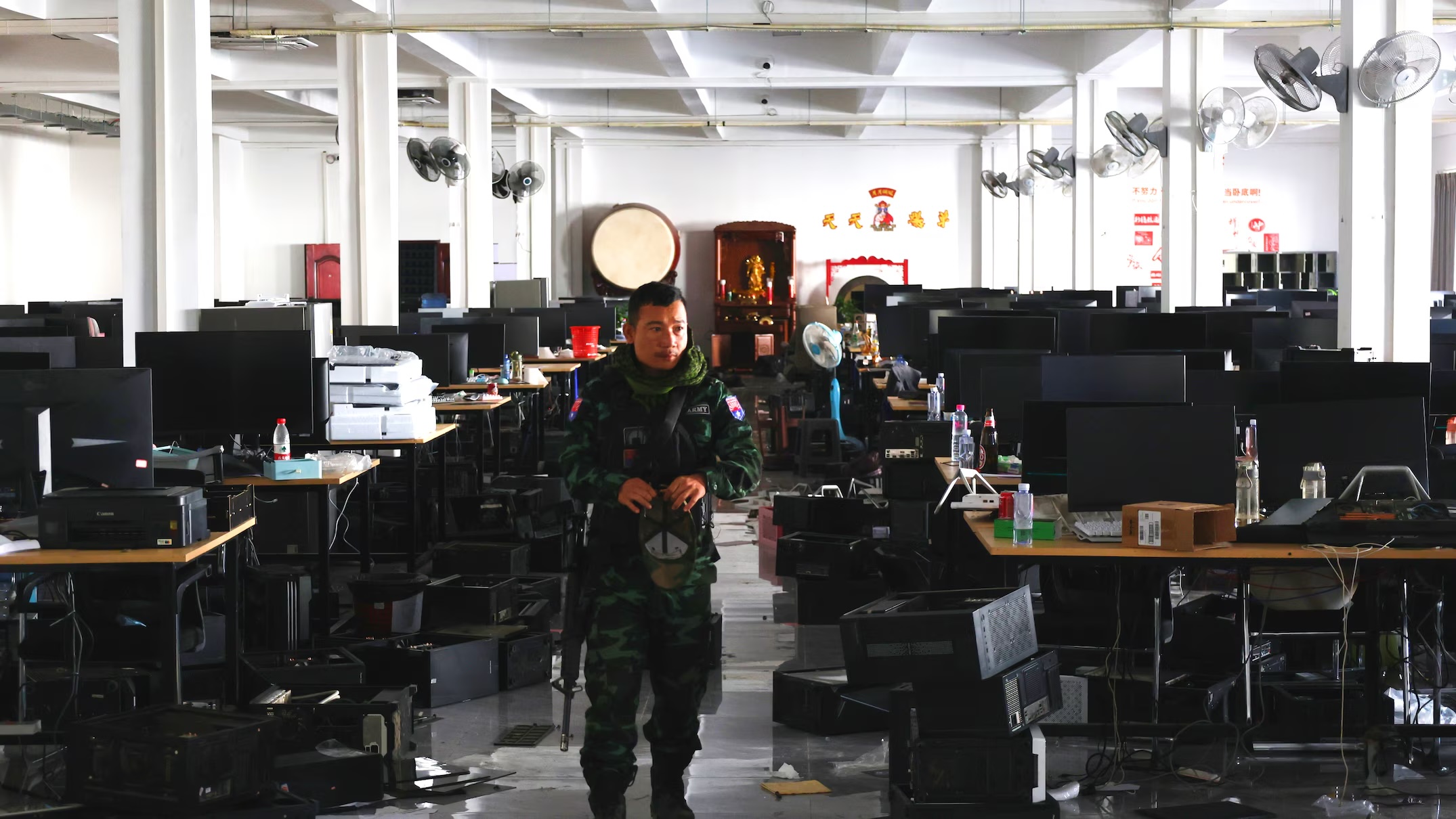
The scam industry in Myanmar is morphing and heading into the jungle, according to satellite imagery, victim testimony and local investigators. By Libby Hogan, Jarrod Fankhauser and Julian Fell for ABC Deep in Myanmar’s borderlands, pro-democracy fighters from an ethnic Karen armed group made an unexpected discovery after retaking territory held by a militia. The Karen National Liberation Army entered a large apartment complex behind jungle and razor wire fences. Inside, they found one of the country’s largest online scamming operations. About 3,000 people were working in the compound. “When we started to hear their stories, I realised just how plain evil the treatment of workers was in there,” said Cameron, a pseudonym used for security reasons as he continues working inside Myanmar. He works for the Free Burma Rangers, a humanitarian organisation that provided medical assistance for the newly freed victims. “Some were out in the cold, all freezing and vulnerable near the river.” The compound, known as Shunda Park, was a hub of industrial-scale cyber fraud. “When we didn’t hit the targets of scamming enough people, we were hung by chains and kept in dark rooms,” recalled Ivan, a Malaysian man who was trafficked through Thailand to Myanmar and freed during the operation. Other workers described similar experiences to Ivan: held in dark rooms for days with little food or water for punishment. Photos were shared with the ABC showing bruises and other injuries that had been inflicted. During the discovery, troops recovered thousands of phones, SIM cards and hard drives, alongside training manuals that instructed workers how to run romance scams. The capture of Shunda Park offered a rare glimpse inside an industry that has flourished in the chaos of Myanmar’s civil war. Since the military seized power in a 2021 coup, scam compounds have proliferated across the country’s lawless border regions, generating millions of dollars while exploiting trafficked workers from around the world. The ABC heard from two people, Ivan from Malaysia and a man from Taiwan, who were trafficked into compounds in the mountains of Myanmar’s Karen State. They asked to remain anonymous for fear of their safety or being targeted online. Scam industry growing in Myanmar, despite crackdowns Thailand and the Myanmar military have publicised their dismantling of scam centres, including two sprawling compounds that were far larger than Shunda Park. Shwe Kokko and KK Park, two notorious operations, held thousands of workers when they were raided last year. Up to 25,000 scammers worked in KK Park alone before it was spectacularly bombed. Thai anti-trafficking officials warned the true number of people held in the compound could have been higher. But investigators say the industry is decentralising rather than shutting down. “The problem isn’t disappearing, it’s morphing,” said Jason Tower, a senior analyst with the Global Initiative Against Transnational Organized Crime. Free Burma Rangers confirmed a similar pattern on the ground. “We saw multiple probable scam compounds under construction on the way to Shunda Park,” Cameron said. Nathan Ruser, an Australian Strategic Policy Institute analyst who monitors the compounds through satellite imagery, said new facilities were visibly under construction even as authorities talked of crackdowns elsewhere. “The growth of these centres is [following] an exponential curve,” he said. Many of the newer compounds look like apartments. They’re springing up along the border with Thailand; many are within minutes’ drive of each other. Tower said there was evidence of a new model built to evade detection. “Scamming 2.0 is effectively compounds no longer within view from the Thai border, but operating deeper inside Myanmar,” he told the ABC. Satellite imagery suggests that one of the newer compounds, called Tai Chang, sprang up in 2024. Human rights groups have received calls for help from victims inside Tai Chang that confirm tactics far more brutal than previous compounds are being used to pressure workers. “They are further away so they’re heavily reliant on trafficking victims,” said Ruser, referring to the lack of workers living nearby the compounds. “There’s a lot more torture … a lot less medical care. “There’s less infrastructure [in the smaller locations]”, he said, pointing to compounds popping up along the Moei River in southern Myanmar, further away from the border crossing between Thailand and Myanmar. What’s more, investigators say the large compounds such as KK Park have undergone what anti-trafficking expert Mechelle Moore from Global Alms described as “performative demolition”. Buildings visible from main roads appear damaged or abandoned, while many operations continue or shift elsewhere. “The crime syndicates were given a heads-up … they left early before the raids started,” said an anti-trafficking investigator who tracks scam compounds along the border. “We actually confirmed KK Park and others around it are still very much standing and operational,” she said. Up and down the Thai border, scam centres continue to operate. To the south, they are spreading into more rural areas. When one compound was shut down, said Mr Ruser, another was likely to spring up elsewhere. “Scam centres require only a small footprint: a rented hotel, computers, electricity, an internet connection and permissive local law enforcement. “That makes it almost impossible to stamp out comprehensively across the region.” Who are the scammers? Many of the people carrying out the scams are themselves victims. Lin, a Taiwanese man, said he was lured to Bangkok with the promise of a translation job before being trafficked across the border into Myanmar. Scammers were told to conduct “pig butchering”, which involves building fake online profiles and cultivating relationships before persuading people to hand over large sums, often through cryptocurrency. Freed victims said they were primarily targeting Americans on social media, but they also went after Australians. “I was targeting Australian women,” a liberated Ethiopian man later told British news. He added, “Mostly the good clients are the older women because they are desperate for love.” When Lin attempted to contact Taiwanese police and email his location in a plea for help, he said he was brutally punished. “I was confined to a cage and forced to stand handcuffed in the sun for hours each day,” Lin wrote in an email to several NGOs asking for help. He shared photographs showing bruises across his body and said repeated beatings left him with suspected fractured ribs. “I could hear my bones grinding together when I walked and breathed,” he said. Inside Shunda Park, success and failure were mapped into the building itself. Workers who generated high revenue were housed on the upper floors, says Cameron of Free Burma Rangers. On lower levels, those who failed were put in punis
Original source
DVB