Vietnam's Rare 'Stone Dragon' Offers New Potential for Geological Research and Tourism
Technology
2026年8月4日
7
VnExpress

General articles are free for 24 hours after publish.

Vietnam's Rare 'Stone Dragon' Offers New Potential for Geological Research and Tourism

Share
AI Summary

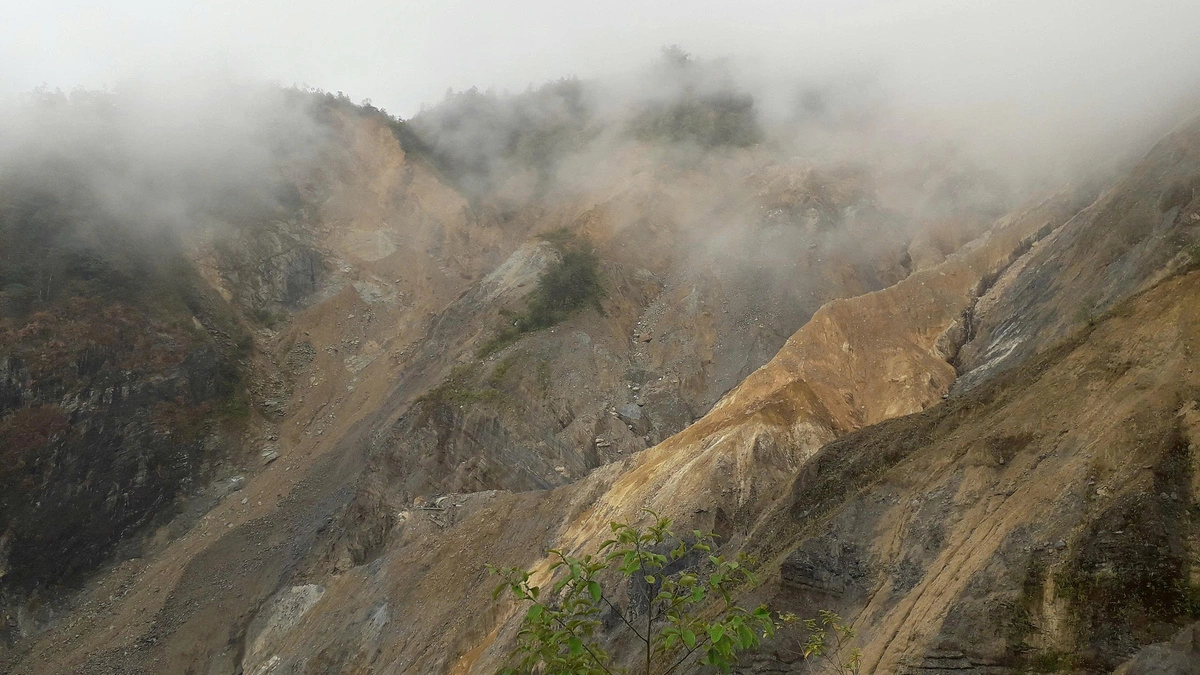
A 'stone dragon,' a mudflow phenomenon spanning approximately 10 km and still developing in Lai Châu Province, northern Vietnam, is gaining attention as an exceptionally rare geological feature. Experts highlight its potential as a valuable opportunity for geological research and sustainable tourism development.

A mudflow remnant, locally dubbed the 'stone dragon' by residents, has emerged in Lai Châu Province, northern Vietnam, drawing significant attention from experts as an exceptionally rare geological phenomenon. This formation spans approximately 10 km in length and 100-600 meters in width, and is noted for its ongoing activity and development. A team of experts from the Institute of Earth Sciences, Vietnam Academy of Science and Technology, has proposed research and conservation efforts for the 'stone dragon,' along with its potential for geological tourism. Associate Professor Vũ Cao Minh, a member of the expert team, explained that the phenomenon is a mudflow remnant that has been forming and active for nearly 100 years. While famous mudflow sites like Switzerland's Illgraben, China's Dongchuan, and Japan's Tateyama exist, Minh emphasized that a mudflow with the scale, complete structure, and visually intuitive form of the Nậm Vời site is extremely rare. The local moniker 'stone dragon' is fitting, as observers from above can clearly discern distinct sections resembling a head, neck, body, and tail. The 'dragon's mouth,' located at the source area, is particularly noteworthy, eroding with each heavy rainfall and carrying thousands of cubic meters of soil and rock downstream. This 'mouth' currently measures about 500 meters wide and over a kilometer long, having expanded by nearly 50 meters in the last five years alone. From a geological perspective, the Nậm Vời mudflow remnant exhibits nearly all the components of a complete mudflow system, including the material source, transport path, and depositional area, all of which are easily identifiable in the field. Minh stated that this phenomenon is a prime example of the constant movement of the Earth's surface, particularly the weathering and erosion in mountainous regions and their transport to lower areas via rivers. Systematic investigation of this area could provide invaluable insights into landform formation mechanisms, mudflow development patterns, and the evolution of mountainous landscapes. Beyond its academic significance, the phenomenon directly impacts local community safety. The Nậm Vời area has experienced numerous landslides and mudflows, forcing over 100 households to relocate from hazardous zones. Therefore, studying this phenomenon is crucial not only for advancing scientific knowledge but also for mitigating geological disaster risks. Furthermore, Minh highlighted the potential for the 'stone dragon' to serve as a hub for geological research, education, and tourism. Citing examples from volcanic regions in Japan, he suggested that well-planned tourism development, incorporating scientific information and infrastructure, could offer more than just scenic views, providing opportunities to learn about Earth's processes and human interaction with nature. The site could potentially evolve into an 'outdoor geology classroom' for students, scientists, and tourists. For sustainable utilization, the immediate priority is detailed investigation and research to clarify its scientific value. Concurrently, establishing a monitoring system, protecting upstream forests, and minimizing impacts that alter the terrain without scientific planning are essential. Fortunately, the 'stone dragon' is situated within a broader area rich in geological, natural, historical, and cultural assets, allowing for integrated tourism development that could include the Pú Đao landscape, the life of the Mảng ethnic group, and the Lê Lợi steles. Currently, some international scientists have conducted initial surveys and expressed interest in further in-depth research. Vietnam aims to establish a model for transforming an area heavily impacted by natural disasters into a space for research, education, and sustainable eco-tourism development. Source: VnExpress

0

Original source

VnExpress

原文を読む